KAMPALA
By Halima Athumani
For months, Charles Oyet would wake up in the middle of the night, terrified and screaming.
Three months of captivity with Uganda's rebel Lord's Resistance Army (LRA) has left him psychologically scarred.
"The dreams were disturbing," Oyet, 26, told Anadolu Agency. "At night, you would find me shouting."
He had been returning from school in the northern town of Adjumani on November 20, 2004, when a handful of men stopped him and asked him his business.
"I said I was going home," Oyet recounted. "But they said, 'No, leave your bicycle here and come with us'."
This was the beginning of three months of captivity by the LRA, a notorious rebel group blamed for abducting, killing and displacing civilians across East and Central Africa, whose leader, Joseph Kony, has since been indicted by the International Criminal Court for war crimes.
Oyet had just sat for his Ordinary Secondary Level examinations to acquire the Uganda Certificate Education.
Speaking English and knowing how to write spared him the military training that most of the LRA's male abductees are forced to undergo.
"They wanted me to take notes because they thought I didn't have enough training to fight," he recalled.
In January 2005, as they roamed the countryside, the rebels came to an area familiar to Oyet, who at that point decided to make a break for it.
The LRA first took up arms in 1986, after President Yoweri Museveni took power, claiming to champion the marginalized communities of northern Uganda.
Based in the region for 20 years, the LRA failed to win over the locals, who said the group didn't represent their collective grievances.
From 2008 to 2010, the LRA had been one of the most violent groups in Congo, reportedly killing some 2300 civilians and abducting nearly 2500 others.
The LRA's first major foray into the Central African Republic (CAR) was in March 2008, when it abducted dozens of people in a series of raids near Obo, capital of Haut Mbomou, one of CAR's 14 prefectures.
In 2013, LRA militants moved further north into Haut Kotto, CAR's largest prefecture.
The LRA has been blamed for abducting, killing and displacing civilians across East and Central Africa.
-Scarred-
Although Oyet was spared the usual ordeal of becoming a child soldier, his lengthy captivity left deep psychological scars.
"I feared being around people, thinking they were talking about me as an ex-combatant with the LRA," he told AA.
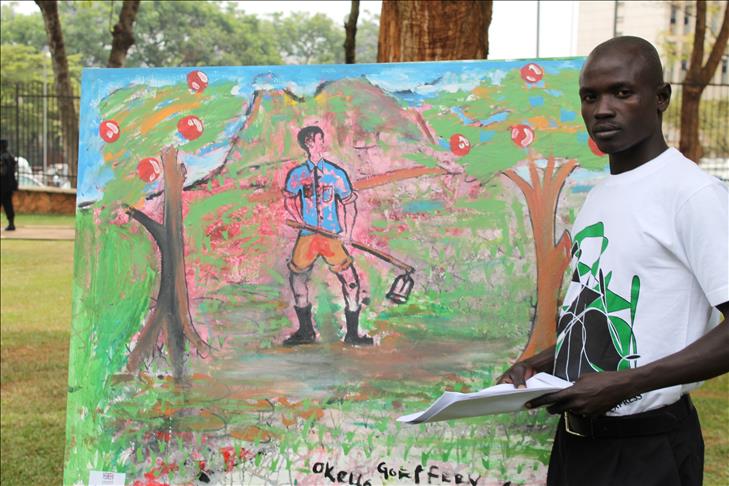
But thanks to the efforts of Basic Skill Uganda, a local NGO devoted to rehabilitating former LRA abductees, Oyet is learning to pick up the pieces of his life – through art.
"These pieces of art depict what we want to do in our community to earn a living," he said, pointing to his drawings, which sell for $141 each.
"This is my imagination of what I feel to tell the story of a better life for youth in northern Uganda," he added.
He says creating artwork has helped him deal better with others.
"Because in drawing all this, I have been meeting different people," he explained. "It also shows me that the community has something useful I can use in my life."
One out of every ten young people in northern Uganda has suffered trauma as a result of the LRA insurgency and has at one point considered suicide, according to the NGO.
"Most of the youth we spoke to showed symptoms of apathy, lack of ambition and helplessness," Basic Skill Uganda CEO Christina Ntulo told AA.
She cited a 2011 study by her NGO that revealed that almost 60 percent of the nation's youth suffered from depression, anxiety, alcoholism or self-destructive behavior.
She also noted the "shocking" number of young people "who responded to the question that they think about killing themselves or that they had actually planned to kill themselves."
"We found that there was a strong relation between those who were thinking of killing themselves and [a lack of] food," she added.
Most war survivors had stayed in homes in which they would only eat a meal every two or three days. There were also those who had been forced to take care of large families.
"You would have a 22-year-old with children she came with from abduction, a grandmother and other siblings," said Ntulo.
Basic Skill Uganda has established 260 self-help groups that cater to more than 3,500 young people.
"Of these, up to 35 percent had suicidal intentions," Ntulo said.
Thanks to the NGO, young people now receive counseling and – in cases of severe depression – medication.
According to Ntulo, Basic Skill Uganda has lost only one person to suicide since 2011.
"Most of us were suicidal; many were drinking," admits Oyet, the abductee-turned-painter. "But now there's change, thanks to the training."
englishnews@aa.com.tr