Anadolu staff
17 March 2026•Update: 17 March 2026
ISTANBUL
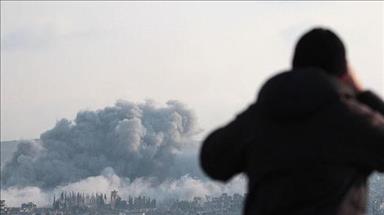
Dozens of monks from South Korea’s largest Buddhist sect staged a protest Tuesday against the US and Israeli strikes on Iran, according to Yonhap News.
Monks from the Jogye Order bowed in the streets as they marched toward the US Embassy in Seoul, protesting the ongoing US-Israeli strikes on Iran and President Donald Trump’s call for countries to deploy warships to the Strait of Hormuz.
They held placards reading “stop killing” and “no warship deployment.”
Among the protesters were 26 monks who repeatedly performed full-body prostrations as they walked roughly 3 kilometers (1.8 miles), KBS World Radio reported.
A US Navy warship carrying thousands of Marines and sailors is nearing the Malacca Strait en route to the Middle East, CNN reported, adding the USS Tripoli is "believed" to be carrying troops from the Okinawa-based 31st Marine Expeditionary Unit (MEU), a rapid-response force of 2,200 personnel deployed in Japan.
On Sunday, the US president had called on China, France, Japan, South Korea, and the UK to join what he described as a “team effort” to keep the Strait of Hormuz open by sending warships, though no country has so far publicly committed to the plan.
However, South Korean Defense Minister Ahn Gyu-back said Tuesday Seoul has "not received any official request" from the US to deploy warships to the Middle East.
Both Japan and South Korea are military allies of the US in the wider Asia-Pacific, which host thousands of American troops, weaponry and bases.
Tokyo has also said it did not receive a formal request to deploy a warship to the Middle East.
European countries have rejected US calls to deploy naval forces to the Strait of Hormuz, saying they do not intend to engage militarily in the escalating conflict with Iran.
The Strait of Hormuz has been at the center of global energy concerns since Iran’s Islamic Revolutionary Guard Corps announced its closure to most vessels, in retaliation for the US-Israeli attacks that began on Feb. 28.
Before the conflict, about 20 million barrels of oil passed through the strait daily. Its disruption has pushed oil prices higher.
Iranian authorities say more than 1,300 people, including then-Supreme Leader Ali Khamenei, have been killed in the strikes.
Iran has retaliated with drone and missile attacks targeting Israel, Jordan, Iraq and Gulf countries hosting US military assets.