Pakistan is hosting landmark direct US-Iran negotiations on Saturday, dubbed the Islamabad Talks -- the most significant since 1979 -- to end an extensive Middle East conflict amid a fragile two-week ceasefire.
The talks, mediated by Pakistan, are being held at an undisclosed location in the heavily fortified national capital of Islamabad, and may continue for "several days," according to the Pakistani officials.
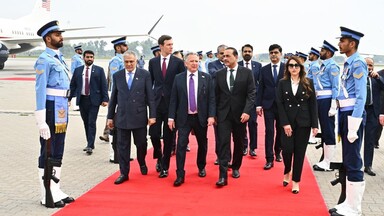
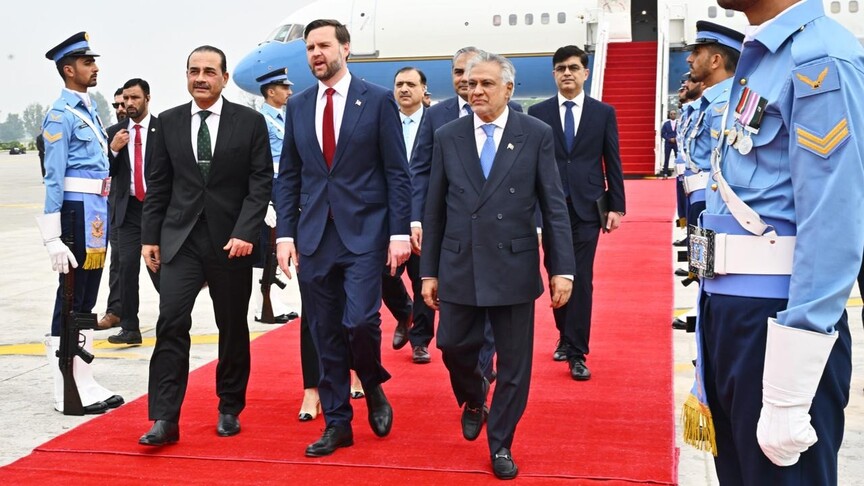
The US and Iranian delegations arrived separately in Islamabad for the talks, which is the most significant high-level, face-to-face engagement since 1979, when a pro-American regime was overthrown in Tehran.
US Vice President JD Vance leads the American delegation, and includes President Donald Trump's Special Envoy to the Middle East Steve Witkoff and Trump's son-in-law Jared Kushner.
Parliament Speaker Bagher Qalibaf is leading the Iranian delegation, which includes Foreign Minister Abbas Araghchi, deputy to the National Security Council Ali Bagheri Kani, among others.
Vance said his delegation would meet the Iranians with “open hands,” expecting the negotiations to be “positive,” but said Trump gave them “some pretty clear guidelines,” and warned against “bad faith,” if any, from Tehran.
Pakistan's Foreign Minister Ishaq Dar will represent Islamabad in the talks, which have been called a "make-or-break to seek a permanent ceasefire, by Prime Minister Shehbaz Sharif.
The two delegations are also scheduled to separately meet Sharif, a senior government official told Anadolu.
Munawar Hussain Pahnwar, a Pakistani academic, told Anadolu that the talks are "a turning point in the history of the relationship between” the US and Iran, as well as the Middle Eastern power structure, and in global politics since the 1979 Islamic Revolution of Iran.
“If succeeded, this engagement would change the nature of the diplomatic relationship between the two longtime foes," said Pahnwar, who is an associate professor at the Area Study Centre for Africa, North and South America, Quaid-i-Azam University in Islamabad.
Nuclear-armed Pakistan, together with Türkiye, China, Saudi Arabia and Egypt, managed to secure a two-week ceasefire between Washington and Tehran on Wednesday, 39 days after the US and Israel initiated attacks on Iran in late February.
According to a US-based renowned expert on Iran, Trita Parsi, the composition of the Iranian delegation attending the Islamabad Talks is “large and senior” level.
Noting previous talks, which culminated in the Joint Comprehensive Plan of Action (JCPOA), or the Iranian Nuclear Deal in 2015, Parsi wrote, “And Qalibaf may meet directly w/ Vance(!),” on US social media company X, referring to possible direct talks between the Iranian parliament speaker and US vice president. Trump, during his first term at the White House, pulled out of the JCPOA.
Pakistani officials told Anadolu that the format of the negotiations is a mix of direct and indirect talks.
“Before, the Iranians refused such meetings. They agree now because they see themselves in a far stronger position," he said.
Shamshad Ahmad, a veteran Pakistani diplomat, described the talks as “most significant” since 1979.
It “is not (just) significant for the two sides, or Pakistan,” Ahmad told Anadolu over phone, referring to the US and Iran.
The talks “are important for the global peace as whole world is affected, economy is choked, and there is energy crisis,” said Ahmad, who served as foreign secretary in 1998 when Pakistan conducted its last nuclear test.
Regional tensions have escalated since Feb. 28, when the US and Israel initiated war against Iran, killing more than 3,000 people, according to Iranian authorities.
Tehran retaliated with drone and missile strikes targeting Israel as well as Jordan, Iraq and Gulf countries hosting US military assets. Iran also restricted the movement of ships through the Strait of Hormuz, triggering an energy crisis in the wider Asian region.
At least 13 US servicemen have been killed, while dozens have been wounded, in addition to damage to US military assets worth billions.
As part of the ceasefire deal, the two sides agreed to meet in Islamabad for talks to negotiate a lasting peace.
Iran’s Deputy Foreign Minister Majid Takht-Ravanchi said Tehran’s proposed 10-point framework has been accepted as the basis for the negotiations, while reiterating that Iran would not support a ceasefire without guarantees against renewed aggression.
The proposed framework, as outlined by Iranian officials, includes guarantees of non-aggression against Iran; continued Iranian control of the Strait of Hormuz; recognition of Iran’s right to uranium enrichment; lifting all US primary and secondary sanctions; termination of UN Security Council resolutions against Iran; termination of resolutions by the International Atomic Energy Agency Board of Governors; payment of compensation for war damages to Iran; withdrawal of US combat forces from the region and ending hostilities across all fronts, including in Lebanon.
Trump, however, has demanded that Iran cease its nuclear program, limit its ballistic missile program and dismantle its "proxies" in the Middle East, while threatening to strike critical infrastructure if Tehran fails to strike a deal.
Ali Vaez, Iran project director and senior adviser at the International Crisis Group, told Anadolu that the two sides agreeing on the scope of “what they're negotiating… (is) a start.”
The “upgraded seniority in each delegation is a signal that they both mean business,” Vaez told Anadolu.
Describing the composition of Iranian delegation, he said, it “reflects both the diplomatic and political/security elements of the regime.”
About Ghalibaf leading the delegation, Vaez said he “may be able to secure some buy-in, but any potential agreement is likely to be met some internal pushback.”
The Crisis Group analyst, however, cautioned about the outcome of talks, citing influence of Islamic Revolutionary Guard Corps.
The senior ranks of the Iranian establishment “remain deeply mistrustful of the US and seem confident - arguably overconfident - on what the war has done for their leverage,” he said.
Vaez added it was “too soon to know whether and how much the past few weeks have shifted Tehran's thinking.”
While second Iranian Supreme Leader Ali Khamenei was killed, he said, “the economic situation remains poor and the prospect of renewed hostilities will add to the burdens a regime facing significant internal discontent is already contending with.”
“Previous talks and the contrasting understandings of the ceasefire show that even having a fundamental baseline on the parameters can be a challenge before getting into the technical details,” he added.
Iranians overthrew the Pahlavi dynasty from power in 1979, and an Islamic Republic was declared with Ayatollah Khomeini becoming the first supreme leader.
In November of that year, protesters stormed the US Embassy in Tehran, taking 66 hostages and initiating a 444-day crisis.
It caused a total breakdown in relations, leading to the shutting of the US Embassy in Tehran, as well as the Iranian Embassy in Washington.
Since then, Tehran has operated a small consulate office, known as the Interests Section of Iran, from the Pakistani Embassy compound in Washington.
news_share_descriptionsubscription_contact

contact_the_ombudsman
is_there_an_error_in_this_story