ISTANBUL
The wooded highlands of Tapalpa, a municipality in the western Mexican state of Jalisco, became the epicenter of a geopolitical shock Sunday.
After years of failed attempts and near misses, Mexican security forces launched a decisive operation that resulted in the death of Nemesio Oseguera Cervantes, the elusive drug lord known as “El Mencho.”
While the operation successfully neutralized the leader of the Jalisco New Generation Cartel (CJNG), it came at a steep cost. The raid triggered a wave of retaliatory violence that paralyzed large swathes of the country, grounding flights and leaving dozens of law enforcement officers dead.
For more than a decade, Oseguera had overseen a paramilitary empire that flooded the United States with fentanyl and turned parts of Mexico into war zones. His removal marks the end of an era in Mexican organized crime, but it may also signal the beginning of a bloodier period of fragmentation.
Who is El Mencho?
Oseguera’s rise to the top of Mexico’s criminal underworld began after a stint in the US and a brief career in law enforcement.
In the 1980s, he migrated illegally to California, living in San Francisco and Sacramento, where he became familiar with the logistics of transnational drug distribution. His time in the US was marked by legal trouble: he was arrested in 1986 for possession of a stolen firearm and again in 1992 for conspiracy to distribute heroin.
After serving three years in a US federal prison, he was deported to Mexico at age 30. Upon his return, he joined the local police, serving as a municipal officer in Cabo Corrientes and Tomatlan, Jalisco.
He later left the force to join the Milenio Cartel. Following the group’s fragmentation, he founded the CJNG. Oseguera amassed a personal fortune estimated at between $500 million and $1 billion, while the cartel’s total assets were valued as high as $50 billion.
The Jalisco New Generation Cartel
Under El Mencho’s iron-fisted leadership, the CJNG evolved from a localized splinter group into a heavily militarized global enterprise. While its precise founding date remains unclear, the cartel distinguished itself through extreme brutality and the use of military-grade weaponry.
Its willingness to directly confront the state became its hallmark. In 2015, CJNG operatives used a rocket-propelled grenade to shoot down a Mexican military helicopter in Jalisco, an unprecedented escalation. Five years later, in June 2020, the group carried out a brazen assassination attempt on Omar Garcia Harfuch, then the head of Mexico City’s police, in the heart of the capital.
The CJNG would expand to surpass the rival Sinaloa Cartel in territorial reach, maintaining supply chains spanning the Americas, Asia, Europe and Africa. The US government identified the group as a major driver of the fentanyl crisis, prompting President Donald Trump’s administration to designate it as a foreign terrorist organization in February 2025.
How the operation unfolded
The operation that brought down El Mencho was the culmination of long-term surveillance and hinged on a critical human intelligence lead involving a romantic partner.
According to National Defense Secretary Gen. Ricardo Trevilla, military intelligence located a “trusted man” connected to one of El Mencho’s partners on Feb. 20. Agents tracked him as he transported the woman to a property in Tapalpa, about 80 miles (129 kilometers) south of Guadalajara.
Surveillance confirmed the couple met at the location. Although the woman left the property on Feb. 21, intelligence indicated that “El Mencho remained in that place,” Trevilla told reporters.
Early Sunday, an operational force composed of three elements moved in: an airmobile unit supported by six helicopters, air cover provided by Texan aircraft, and ground units from Army Special Forces.
The confrontation was immediate and violent. Cartel gunmen opened fire on the military, covering their leader as he and his inner circle fled into the dense forest surrounding the compound.
“Special Forces personnel pursued them,” Trevilla said, describing how troops established a perimeter and tracked the group through the brush. During the pursuit, a military helicopter was hit by gunfire and forced to make an emergency landing.
In the ensuing firefight, Oseguera and two of his bodyguards were wounded. After the area was secured, military medics determined they required urgent evacuation. All three later died.
Trevilla said the Attorney General’s Office subsequently confirmed the body was identified as Oseguera.
Deadly violence ensues
The immediate fallout was chaotic and deadly. The Mexican government described the human toll as severe.
In Jalisco, 25 members of the National Guard, a custodian and an official from the state prosecutor’s office were killed. A civilian woman also lost her life. On the cartel side, 30 operatives were killed in Jalisco, with another four killed in neighboring Michoacan.
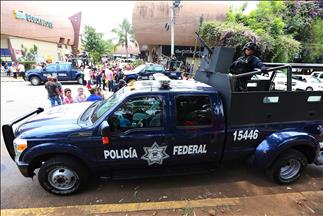
The cartel’s response was swift. Authorities reported “violent reactions” nationwide, including 85 blockades on federal highways stretching from Baja California in the north to Oaxaca in the south. Criminal groups burned vehicles and carried out 27 attacks on security forces, leading to the arrest of 70 people.
The federal government deployed 2,500 additional Special Forces troops to the region, reinforcing the 7,000 already stationed in Jalisco.
Civilian life in western Mexico ground to a halt. Jalisco Gov. Pablo Lemus Navarro issued a red alert, suspending public transportation and canceling large public events. The Federal Civil Aviation Agency said airports remained operational, but flights to Puerto Vallarta were diverted or canceled due to security concerns near the airfield.
In a parallel operation in El Grullo, Jalisco, military forces also killed Hugo H., known as “El Tuli,” a key financial operator for the cartel. Authorities seized more than $965,000 and 7.2 million pesos from him.
Global security alerts
The operation drew immediate international attention, particularly from the US, which had placed a $15 million bounty on Oseguera, alongside Mexico’s own reward of 300 million pesos.
White House spokeswoman Karoline Leavitt confirmed that the US “provided intelligence support” to Mexico, describing El Mencho as a top target due to his role in fentanyl trafficking.
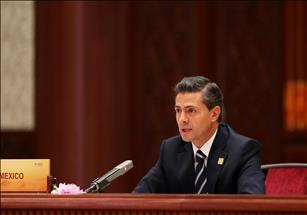
Mexican President Claudia Sheinbaum emphasized that no US troops were involved, characterizing the cooperation strictly as intelligence sharing.
Governments worldwide issued safety warnings. The US State Department urged citizens in Jalisco to shelter in place. European countries including France, the UK and Belgium advised against non-essential travel to western Mexico. Türkiye’s embassy in Mexico also urged Turkish nationals to exercise caution.
What comes next
El Mencho’s death leaves a power vacuum at the top of one of Mexico’s most aggressive criminal organizations. The removal of a charismatic, centralized leader raises the risk of violent fragmentation as rival factions compete for control.
Succession is complicated by the incarceration of several family members who managed the cartel’s finances.
Mexican media have identified four potential successors: Audias Flores Silva, known as “El Jardinero,” who controls key territory in Nayarit and Zacatecas; Gonzalo Mendoza Gaytan, or “El Sapo,” who dominates the lucrative Puerto Vallarta corridor; Juan Carlos Valencia Gonzalez, El Mencho’s stepson; and Ricardo Ruiz Velasco, leader of the cartel’s elite paramilitary wing.
President Sheinbaum has called for calm, asserting that “in most of the national territory, activities are proceeding with complete normality.”