
Passions run low as Greece braces for upcoming election
Passions are running low in Greece as weary citizens seem equally divided between leftist Syriza and center-right New Democracy
By Vasiliki Mitsiniotou
ATHENS, Greece
Passions are running low in Greece as weary citizens, brought to their knees by international creditors and a chaotic spell of politics in the last few months, head to polling booths again this Sunday to elect a new prime minister.
“We have voted two times already this year, but nothing has changed. No matter who gets elected, my pension will still be cut,” 68-year-old Giorgos Toumanidis views pretty much sum up the general feeling in the country.
This election weariness is also apparent in the lackluster pre-election campaigns. No more than a thousand people participated in the rally of center-right New Democracy party leader Evangelos Meimarakis at Omonia Square Thursday. Even though the party set up kiosks in Athens’s Syntagma and Klafthmonos square, people did not approach them.
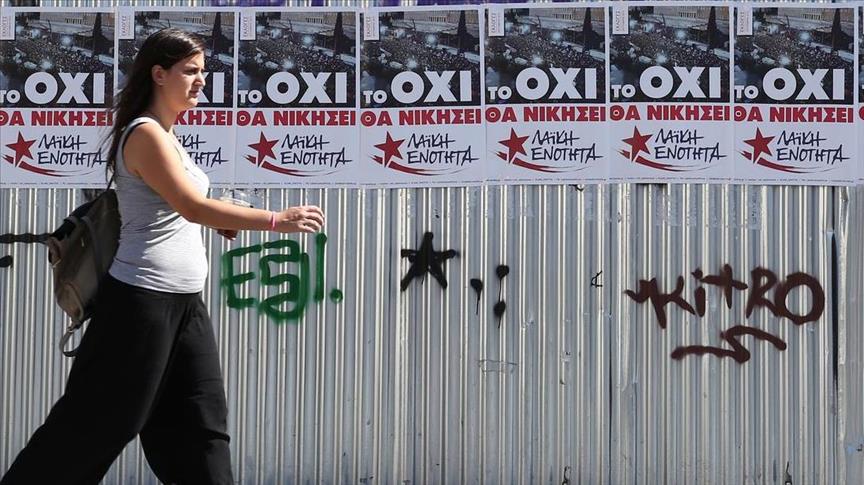
After the leftist Syriza party secured victory in January and a referendum on the terms of the bailout agreement in July, this year has been a long and arduous political journey for everyone in Greece. The enthusiasm, which enveloped the last elections and gave a renewed panache to leftist movements across the world, has now all but disappeared.
Nevertheless, Greeks know the importance of this vote, and they seem equally divided between Syriza and New Democracy. According to the latest poll by the University of Macedonia on Wednesday, New Democracy has 30 percent of the Greek votes, outrunning Syriza by only 0.5 percent.
“This is a virtual democracy,” 35-year-old Soultana Gianoglou, unemployed for over a year now, said. “But I do not believe in not voting. I will give Syriza another chance because they truly negotiated,” Gianoglou added.
Asimina Petridi, a 55-year-old mother, also said that she would give Syriza another chance because former Prime Minister Alexis Tsipras was “clean, and not as corrupted like the others”.
They both seem to concur with the perspective of Aristides Hatzis, law and economics professor at University of Athens Law School. "Tsipras is still seen as the fresh face, the likable David taking on the Goliaths," Hatzis wrote for the Protagon.gr website.
Evropi Kosmidou, 36-year-old civil engineer, said that he would vote for New Democracy. “These elections are by no means politically neutral. We face the pro-European concept juxtaposed with left-obsessions, whether they derive from the forces of Syriza or as a result of its weaknesses,” Kosmidou said.
Tsipras resigned from his post on August 20 after many of his Syriza parliamentarians opposed the new austerity measures that came with the new €86 billion bailout agreement. He believes that snap elections are his best bet to form a stable government that would implement the painful reforms.
Greece’s economy is in bad shape. According to Eurostat, almost 21.5 percent of the population has struggled to meet basic living needs; 26 percent cannot find a job; also, wages and pensions have suffered severe cuts.
However, Eurogroup chief Jeroen Dijsselbloem ruled out any bailout renegotiation on Saturday regardless of who wins the elections. “The work needs to continue as much as possible and the same would go for the institutions,” he said.
Many believe that only a coalition of parties can result in a stable government. However, in the final televised debate on Monday between Alexis Tsipras and his conservative rival Meimarakis, divisive sentiments were appearing.
"We can have a national team not only in the governance of the country, but also a national negotiating team [for the bailout]," Meimarakis said. But he ruled out sharing power with Tspiras.
Tspiras too said that a coalition with the conservatives would be unnatural. "We have fundamental differences and as such, we cannot co-exist," he said.
There is a strong possibility that no party will emerge from the Sept. 20 vote with a majority. This may lead to further political instability and likely difficulty in implementing the bailout program. Analysts believe the key to Sunday’s election will be the final decision of disappointed Syriza voters.
A recent poll conducted by ProRata for the left-leaning Efimerida ton Syntakton newspaper on Tuesday put undecided voters between 6 and 15 percent of the total. In Exarchia, a lively neighborhood in central Athens known as a political hotspot, you can find plenty of them, especially young people.
Some have had enough of the turmoil. One such voter is Panagiotis Kordopatis, a 35-year-old forester. “I will not vote because I do not believe that there is going to be any change coming from this system. It is not because of the parties, it is this system of governance,” Kordopatis said.
He said that politics was being conducted in a way that alienated people’s real needs. “There are no leaders any more. People want to vote for someone who can lead them out of this. This is an important factor but I don’t believe that change is linked to a charismatic personality but to people’s support of a policy, a proposal. Assignments do not work,” he added.
Anadolu Agency website contains only a portion of the news stories offered to subscribers in the AA News Broadcasting System (HAS), and in summarized form. Please contact us for subscription options.