Seyit Kurt
12 September 2026•Update: 12 September 2026
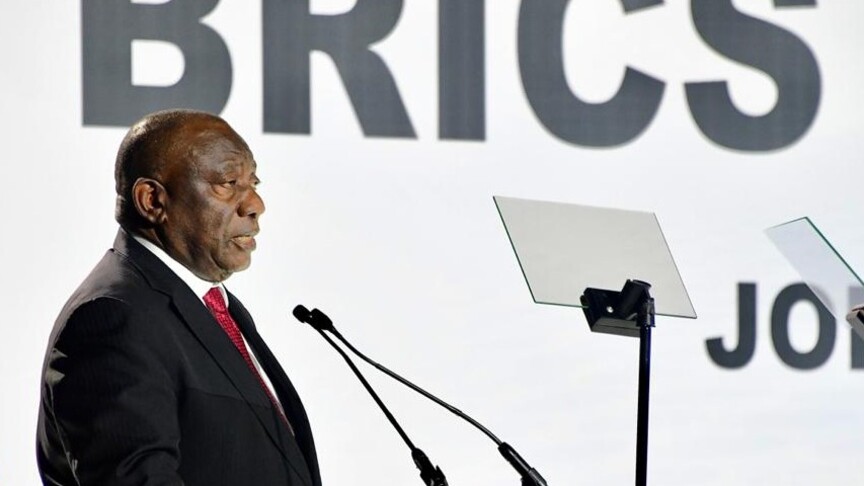
South African President Cyril Ramaphosa on Saturday called for accountability for what he described as atrocities against the peoples of Palestine and Sudan, as well as an “illegal war” against Iran, warning against the selective application of international law.
“To give strength to the law, there must be accountability for atrocities, for the ongoing genocide against the people of Palestine, for the crimes committed against the people of the Sudan, and for the illegal war against Iran,” Ramaphosa said in an address to the BRICS leaders’ summit in New Delhi, India.
“We must exert pressure and expose violations whenever and by whomever they are committed. International law cannot be applied selectively,” he said.
Ramaphosa said the same principles must apply to all states and the same protections to all peoples, noting that South Africa and other countries have turned to bodies such as the International Court of Justice to seek justice for Palestinians.
He warned that the relevance of the UN and the durability of the multilateral system are being threatened by “overt violations” of the UN Charter and the resort to war to settle differences between states.
The South African president said multilateral institutions and rules are increasingly being ignored and undermined, making BRICS more important in the current geopolitical landscape.
“BRICS represents a world in which no nation needs to choose between East and West, North and South,” he said, adding that the grouping represents a world with multiple centers of power and a common commitment to development, dignity and a more equitable international order.
Ramaphosa also reiterated South Africa’s call for comprehensive reform of the UN Security Council, saying Africa, despite accounting for 54 UN member states and nearly one-fifth of humanity, still lacks permanent representation on the council.
“This is neither just nor sustainable,” he said, calling for a Security Council that is “more representative, more accountable, more transparent, and effective.”
Ramaphosa said BRICS should remain a united voice for reform, demonstrate that multilateral cooperation can deliver practical results, help shape fairer and more development-oriented global governance, and serve as a bridge across geopolitical divides.
“In a fragmented world, dialogue matters more than consensus,” he added.
The BRICS leaders gathered in the Indian capital for the 18th summit, which is expected to produce the New Delhi Declaration, outlining a collective framework aimed at translating policy commitments into concrete action.