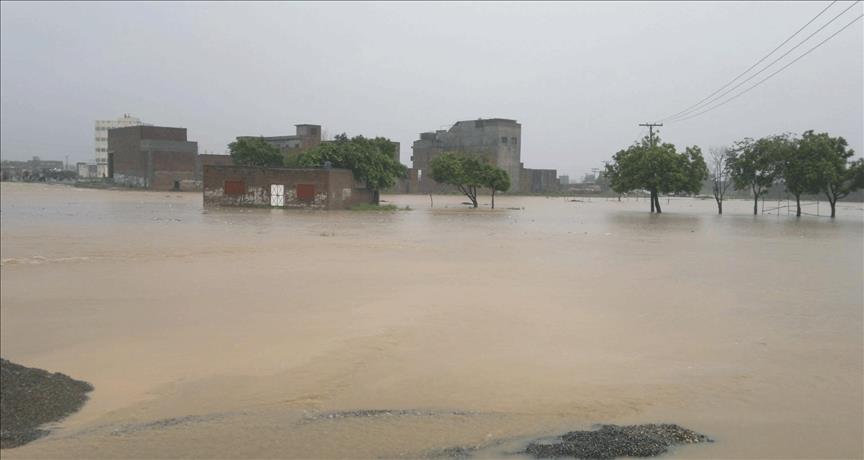
Rescue workers backed by army troops are racing against time to rescue thousands of people stranded in several parts of Pakistan amid fresh warnings to inhabitants to vacate various other areas due to possible flashfloods in the next 48 to 72 hours.
"Water entered our village within half an hour, leaving us with no option but to flee to save our lives with whatever we could pick up," Mureed Hussein, a farmer from Mithan village in the northeastern Kasur district of Punjab province, told Anadolu Agency.
"We could hardly pick up a few clothes, crockery and a small quantity of food before a huge breach occurred in the embankment near our village and a deluge of water inundated everything all of a sudden," he said.
Hussein, along with some 150 other villagers, reached a shelter camp set up by the district administration on Tuesday.
"I had to leave my cattle and house at the mercy of Allah," he recalled. "I do not know what happened to them."
He said hundreds of other villagers were still stranded in floodwater waiting to be rescued.
Rescue workers and army troops used boats and helicopters to move hundreds of stranded residents of several villages in the Sukkur district of southern Sindh province, where flashfloods and rains have devastated huge swathes of agricultural land and crops.
Although parts of northwestern Khyber Pakhtunkhawa (KP), southern Sindh and southwestern Baluchistan provinces are still under water, the northeastern Punjab seems to be the worst affected province in recent days.
According to the latest figures released by the National Disaster Management Authority (NDMA), an organization that coordinates among different rescue agencies, over 400,000 people have so far been affected because of the flashfloods and heavy rains in all four provinces.
The death toll in flood-related incidents has jumped to at least 118 in 1,700 villages affected nationwide, according to NDMA data.
Medical authorities fear an outbreak of waterborne diseases in flood-affected areas, where people are compelled to drink polluted water and eat unhygienic food.
"Paramedics have been sent to the ten worst affected areas in all four provinces, where reports of diarrhea, gastro, malaria and other waterborne diseases are higher," Dr. Shafqat Javed, in charge of the PakistanIslamic Medical Association (PIMA), a doctors' relief organization, told Anadolu Agency.
"Mobile clinics are being set up in respective areas to control waterborne diseases, which may reach alarming levels if immediate preventive measures are not adopted," he warned.
- Fresh warning-
Flood control authorities have issued fresh warnings for various districts of Punjab, the country's richest and most populous province, amid surging water levels in the Sutlej, Ravi, Sindh and Chenab rivers.
"We have already asked the population settled on the bank of River Sutlej to vacate their villages after India released over 100,000 cusec [cubic feet per second] of water in the river, raising the water to a warning level," Syed Javed Bukhari, district coordination officer of the northeastern Kasur district, which borders India, told AA.
"We have set up three shelter camps in and around the district for those affected by the floods, whose numbers are expected to grow in coming days as water levels [in River Sutlej] are still rising," he said.
Flood warnings were also issued for Sahiwal district, where people have begun vacating their areas following increasing water levels in River Ravi.
Flood control authorities have also issued a high alert for the nearby villages of Guddu and Sukkur, where low to high flooding is expected within the next 72 hours respectively.
Chief Minister of Punjab Shahbaz Sharif, the younger brother of Prime Minister Nawaz Sharif, has criticized India for not informing Pakistan in advance about its release of extra water into the Sutlej and Ravi rivers.
This action, according to him, has been causing widespread devastation in Punjab, which otherwise could have been averted.
However, Pakistan's Indus Water Commissioner told newsmen that India was left with no other option but to release water into the Sutlej and Ravi rivers, otherwise heavy water levels could wash away its dams and barrages.
He said the water commissioners of both countries were in constant contact.
According to a 1960 Indus Water Treaty brokered by the World Bank, India has the right to use the waters of the Ravi, Beas and Sutlej rivers before they enterPakistan, whereas Pakistan has control of the Indus, Jhelum and Chenab rivers.