Yasin Gungor
26 September 2026•Update: 26 September 2026
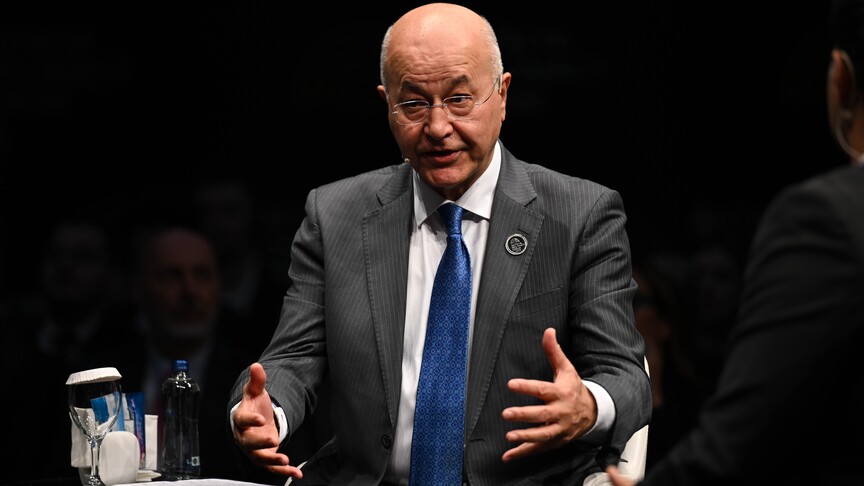
UN High Commissioner for Refugees Barham Salih said on Friday that mounting forced displacement poses a fundamental threat to international stability.
He urged the UN Security Council to prioritize political solutions over indefinite humanitarian assistance.
"This is not only a humanitarian challenge; it is fundamentally a challenge to international peace and security, and that is why this discussion belongs here," Salih told a Security Council briefing on the sidelines of the 81st UN General Assembly session, stressing that displacement is "rapidly" outpacing durable solutions across proliferating and protracted conflicts.
Salih said that more than 117 million people have fled violence, persecution and conflict, maintaining that managing displacement indefinitely cannot serve as the measure of collective ambition. Under the "50 by 35" vision launched earlier this year, UNHCR aims to halve by 2035 the number of long-term displaced refugees who remain dependent on humanitarian assistance.
Political horizons needed in Sudan, Sahel, regional crises
Addressing the crisis in Sudan, Salih affirmed that "humanitarian assistance can keep people alive" but cannot deliver the peace citizens need to rebuild, calling for a truce and "serious" dialogue. In the Sahel, he argued that security and humanitarian protection must reinforce each other rather than operate as competing goals.
Salih said the "real test" of a peace process is to see whether it leads people to return to their homes in the Democratic Republic of Congo, and urged the Security Council to "help sustain that momentum."
Salih termed the half-century displacement of Sahrawi refugees in Western Sahara "untenable, unsustainable and genuinely truly inhumane" amid deteriorating conditions and severe funding shortages.
Salih demanded the unconditional release of all UN and humanitarian staff arbitrarily detained by Houthi authorities in Yemen, where UNHCR declared an initial Level 1 emergency alongside Djibouti and Somalia to scale up cash assistance and shelter.
Sustainable returns in Syria, Afghanistan
Turning to post-conflict reconstruction, Salih noted that 3.8 million Syrians displaced internally or abroad have returned home since December 2024. But he emphasized that determination alone cannot rebuild the country without international engagement and recovery investment.
He added that nearly 8 million Afghans are expected to return by the year's end, often under adverse and involuntary conditions.
"Return, I want to say, is an event; a solution is what comes after," said Salih, concluding that international success must mean creating circumstances where displaced people no longer require aid.
Gaza displacement, unhindered aid
Council members voiced alarm about conditions in the Gaza Strip, and Denmark highlighted that the enclave's population of 2.1 million people faces displacement and urgent shelter needs due to continued Israeli attacks.
Somalia's delegation argued that the prolonged Israeli occupation remains a "central cause" of Palestinian displacement.
China, meanwhile, urged the international community to guarantee basic supplies, oppose forced displacement and reject land annexation in Gaza or the occupied West Bank.
Russia insisted on "maintaining and wholeheartedly supporting the work of the UN Palestine refugee agency, UNRWA" amid a “humanitarian catastrophe.”
Addressing root drivers of displacement
Delegates stressed that relief supplies cannot substitute for political progress, with Panama maintaining that the ultimate objective "cannot be to eternally administer suffering" but to eliminate conditions producing it.
The Democratic Republic of the Congo described humanitarian assistance as vital but "no substitute for political action," while Pakistan affirmed that relief mitigates fallout while only political accords sustainably prevent conflict.
Liberia said a return without reintegration constitutes "displacement by another name," cautioning against sending refugees back to battlefields lacking schools or hospitals, while Colombia urged cross-cutting action against organized crime syndicates that exploit and amplify forced migration flows.