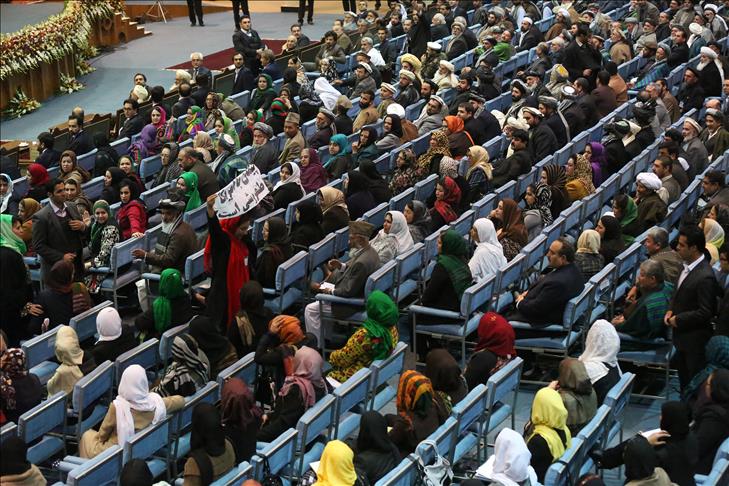
As they began four days of deliberations on a proposed security deal with the US, members of Afghanistan's Loya Jirga ("Grand Assembly") were divided over an article of the deal giving legal immunity to US troops.
"I think they must be prosecuted in Afghanistan if they commit a crime here," Belqees Hadi, a member of the provincial council of the Balk province and Jirga delegate, told Anadolu Agency. "People should see it."
But she is also worried that without the presence of foreign forces, Afghan women might face more hardship.
"I don't want to lose the achievements we have made in the past ten years regarding women's rights," Hadi said. "If the security agreement is fruitful for Afghan women and Afghanistan, I will definitely support it."
The consultative Loya Jirga will end on Sunday, when delegates will give their recommendations to the government regarding whether or not to endorse the agreement.
Earlier Thursday, Afghan President Hamid Karzai inaugurated the Loya Jirga, in which 2,500 tribal leaders, academics, lawmakers, senators, religious scholars and community representatives will huddle together for four days to discuss the pros and cons of the proposed security deal.
The three issues related to the proposed deal that are expected to be the most contentious have to do with legal jurisdiction, unilateral US operations inside Afghan territory, and foreign threats to Afghanistan's sovereignty, currently classified as acts of "aggression."
"The only issue to be discussed here is the security agreement with America, so put your attention as much as you can and decide," Karzai told Jirga delegates.
If signed, the deal will allow the long-term presence of US troops in the country despite next year's scheduled withdrawal of all US-led foreign forces.
Currently, some 52,000 US troops remain in Afghanistan. The US would like to retain nearly 10,000 of these beyond 2014.
If the bilateral security agreement is not signed, however, all US troops will be obliged to depart the country next year.
-Backed-
Jirga member Jamshed Azimi said he supported the idea of giving legal immunity to foreign troops.
"It's not a big deal for me," he told AA. "We are far behind in prosecuting Afghan criminals; it takes years to prosecute them."
"So America will actually be helping us by sentencing its own soldiers," Azimi argued.
Members of the Afghanistan Young Leaders' Initiative (AYLI), an NGO, voiced similar sentiments.
"Elements in neighboring countries are known to be the number-one threat to Afghanistan and will continue to challenge the Afghan government, particularly after the 2014 NATO drawdown," the group declared in a statement.
"The US government has offered a commitment to stand by Afghan forces in fighting not only against conventional foreign aggression, but also the safe havens of threats to Afghan security and their proxy groups," it added.
"On the matter of legal jurisdiction for US troops, we recognize that accepting this clause is not an ideal situation for Afghanistan," the AYLI asserted.
"But we do recognize the reality we are living in, as well as the fact that other countries around the world have also agreed to give US primary legal jurisdiction as a condition for bilateral security agreements," it added.
"These terms are common; Afghanistan will not be an exception in accepting them," the AYLI said, going on to note that several countries – including Japan and South Korea – "have similar arrangements."
By Zubair Babakarkhail
englishnews@aa.com.tr