
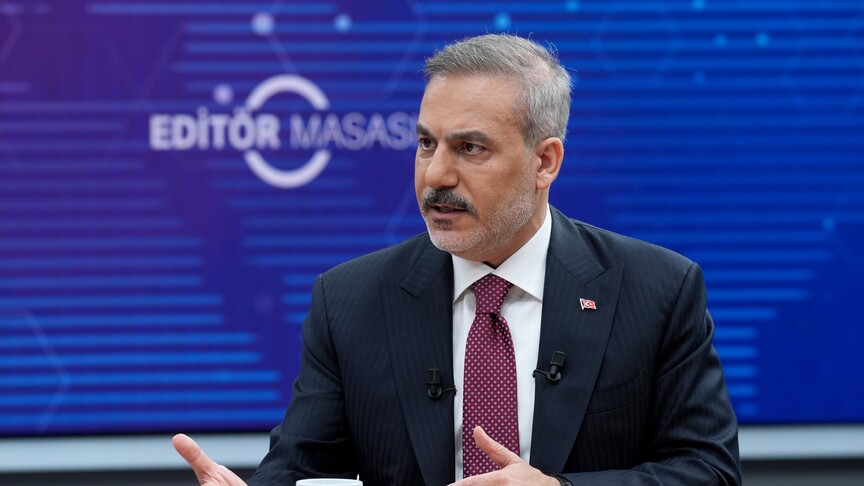
Turkish Foreign Minister Hakan Fidan said Saturday that the Mecca Joint Defense Agreement is technically the same as Article 5 of the NATO Treaty concerning collective defense.
Speaking at Anadolu's Editor's Desk program, Fidan said the agreement signed by Türkiye, Saudi Arabia and Pakistan aims to contribute to lasting stability in the region.
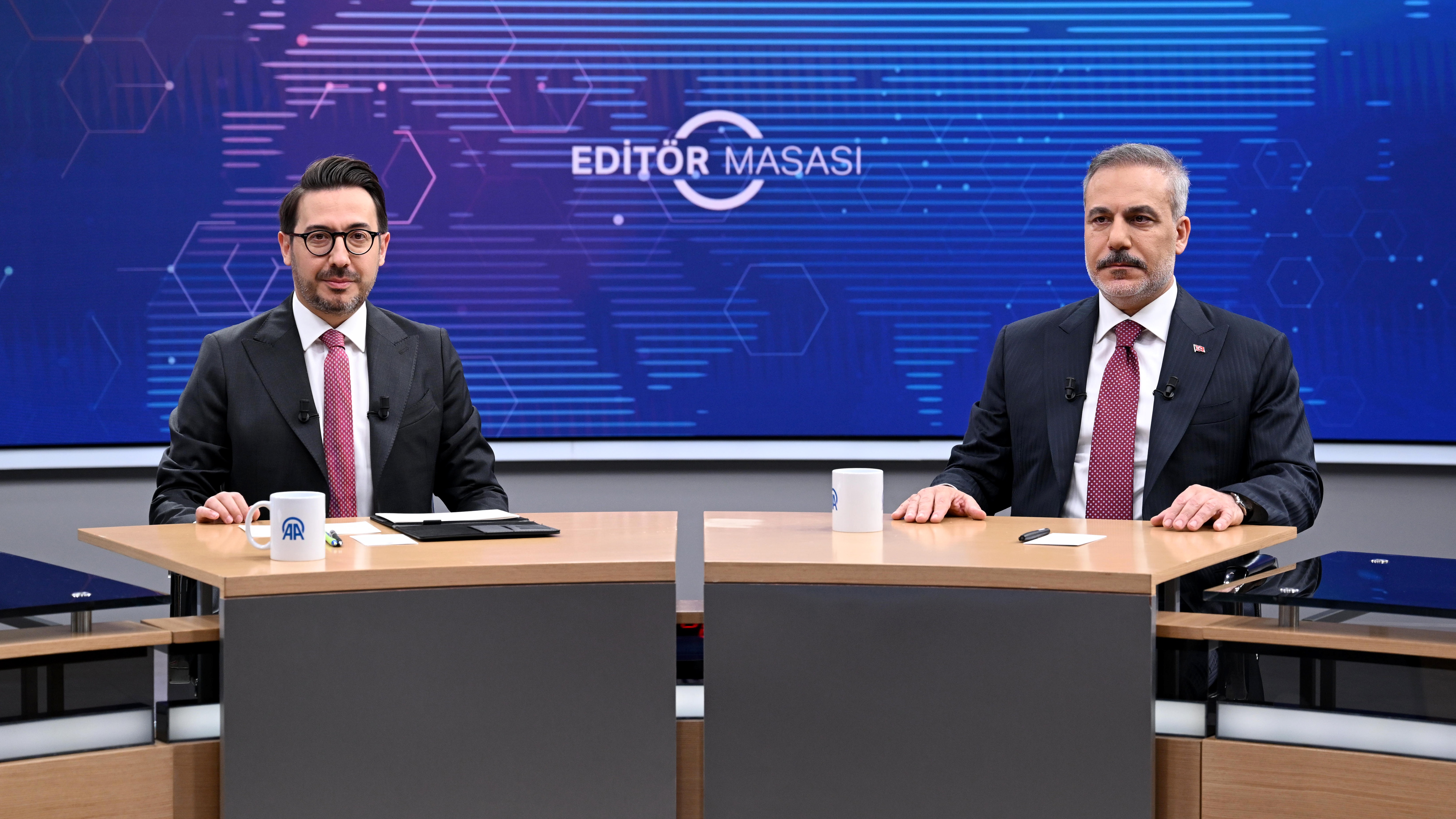
"There is no common threat that we have put in writing," Fidan said, adding that the agreement does not target any country that does not attack its signatories.
Fidan said discussions on the initiative began before the current war environment, when there was no Iran-US-Israel war, but Türkiye anticipated that American security concerns in the region would change, other developments would emerge and its fight against terrorism would remain on the agenda.
He stressed that Türkiye, Saudi Arabia and Pakistan are not expansionist countries.
"Saudi Arabia, Pakistan and Türkiye, when you look at their foreign policy positions, are not countries that have expansionist policies. They are countries concerned with their own borders, their own problems and their development, and, if possible, they want to contribute positively to their environment through good relations and good neighborliness," he said.
Fidan said the three countries have different styles and capacities, but when brought together, they naturally form a defense-oriented organization rather than an offensive one.
"Now, when we come together with these countries, naturally we are becoming a defense-oriented organization. It is not an approach of going on the offensive and saying, 'Let's do this or that together.' Therefore, unless it is attacked by a country, whether from inside or outside the region, this alliance cannot have any dispute with any country. But, of course, the power composition we have put forward will make a constructive contribution to regional stability," he said.
Fidan said that was the reason for advancing the initiative and stressed that Iran was not the target of the agreement.
He added that countries that do not attack the signatories are not considered targets.
Fidan said the alliance had been examined closely from legal, political and strategic perspectives and that Türkiye saw no problem with the framework. He also noted that NATO countries had previously concluded similar agreements.
"Under our president's vision, we should not remain limited to three countries. We should grow and, if necessary, bring all countries under this umbrella," he said.
"The Mecca Agreement is the most important step toward bringing lasting stability to this region," Fidan said, adding that the region has experienced instability for the past century since the withdrawal of the Ottoman Empire.
Fidan described the signing of the agreement as a "historic day," saying it represented one of the milestones that Türkiye had been pursuing for years under President Recep Tayyip Erdogan's leadership.
He said the region had suffered from long-running instability characterized by wars, occupations, exiles and displaced people across Türkiye's east and southeast and the broader geography generally known as the Middle East.
Fidan said successive AK Party governments had closely monitored and analyzed this lack of a stable regional system for years and had considered how a lasting order could be established to address those problems.
He said Türkiye had further developed its ideas on the issue over the past several years, focusing on practical steps that could be taken. After initial assessments were made, those ideas were shared with relevant parties and eventually brought to the stage of being translated into concrete action.
Fidan said increasing regional ownership of security issues is central to Türkiye's approach.
"External hegemons coming into the region do not solve the problems; they make them more acute, and the cost becomes very high," he said, arguing that regional countries should develop more institutional mechanisms through which they can ensure their own security, economic stability, development and prosperity.
Fidan said Türkiye has strong relations with almost all countries in the region, but noted that those relations had largely been shaped by prevailing circumstances, political perceptions and understandings and could change at any moment.
He said Ankara had long believed that those ties should be made more permanent, adding that relations described as brotherly or otherwise should become more structural, professional and self-sustaining for the sake of regional stability.
Fidan said a region ultimately needs a defense alliance because countries cannot build economic structures on top of an environment in which they are uncertain about one another's security.
Citing the EU as an example, he said the European Economic Community took shape in the environment provided by the American security umbrella and later evolved.
He said Türkiye's regional vision similarly seeks to reduce or at least halt instability and eventually foster greater economic and social integration, improving the prosperity of regional populations.
Fidan acknowledged that the initiative is at an early stage and will not be easy to establish, but said Türkiye has already completed the intellectual and conceptual preparations and planning.
Fidan said Türkiye had also worked on how the initiative could be implemented institutionally and was aware of the potential problems that could arise.
"I have been discussing these issues continuously for exactly two years and eight months with our partners, with the partners with whom we signed the agreement, and with other countries in the region," he said.
He added that President Erdogan had repeatedly raised the issue in his meetings with regional leaders.
Asked about the preparation process, Fidan said it involved moving the initiative “from the level of an idea to a concept, and from a concept to the point of an agreement.”
Fidan underscored that this is not a new phenomenon within NATO, saying: “Türkiye is, of course, a country that is aware of its responsibilities. We are in no position to keep these different geographies and different priorities to conflict with one another in any way.”
Fidan said this was an area that needs to be managed and noted that he had also raised the issue during his meeting with his German counterpart.
The foreign minister pointed out that Türkiye’s objective here is based on regional ownership, stressing that Ankara has influence in many strategic locations and signaling that a similar initiative should also be pursued in Europe.
He also said there have been serious discussions with Europe about what can be done regarding the security architecture, adding: “Given its geography, Türkiye has a strategic orientation toward the wider European geography through the Caucasus, the Middle East, the Black Sea, the Mediterranean and the Balkans. For each strategic basin, you need to develop a perspective and align these perspectives, even when areas of tension emerge.”
Fidan referred to Türkiye’s experience in this area, noting that Ankara is a NATO country with distinct geographical conditions concerning the Middle East and the Caucasus and that this has been analyzed.
Fidan highlighted the breadth of Türkiye’s strategic sphere, noting that each strategic basin has different positions and conditions.
Drawing attention to the need to develop security and economic architectures for these regions, Fidan said: “Because we do not approach this with a hegemonic mindset, we need to build this together with the countries of the region. Following the agreement in the Caucasus, hopefully -- there is currently a ceasefire, and it is a ceasefire that is working well -- Armenia and Azerbaijan are moving toward a lasting peace agreement, and we support this. While supporting this, we have a security and economic architecture perspective in mind.”
Asked whether a similar structure could be established in regions such as the Caucasus and Central Asia, Fidan replied: “These can be built when necessary. At times, there may be a greater need for economic cooperation. But as you know, the Middle East’s biggest problem right now is mutual wars, insecurity and conflicts, so we need to start with a security architecture. There is also a search for a security architecture in Europe.”
Fidan said Europe’s and the Middle East’s security architectures could be harmonized through Türkiye in the medium- to long-term, noting that the “intellectual and conceptual groundwork” for this has already been established. He said both sides seek security, economic development and competitiveness, adding that these “strategic orientations can be harmonized,” although turning generally accepted principles into practice will take time and "the transformation in Europe will be a longer-term transformation.”
Fidan said the Mecca Joint Defense Agreement is technically the same as NATO's Article 5 on collective defense.
"That is why you establish a security pact. That is why other countries ultimately decide to join an alliance -- to benefit from one another's protective support," he said.
Pointing out that the agreement imposes obligations on the signatory countries, Fidan noted that Türkiye has been a member of NATO since 1952 and has participated in NATO meetings for many years.
Recalling that the latest NATO summit was held in Ankara, Fidan said NATO had decided on collective intervention and launched operations only once or twice in its history, citing Afghanistan and Kosovo.
He said NATO's main deterrent capability is defensive, built around the message: “If you attack me, I am a military force that has prepared itself and has such a large community behind it. Do not test my strength.”
Such deterrence prevents attacks and allows countries to resolve their political and economic problems and pursue development under more normal conditions, he said.
Fidan stressed that violence, war and bloodshed are among the main factors preventing development.
"We are now in solidarity with each other," Fidan said, explaining the principle behind the alliance.
"You increase your deterrence capability. Secondly, rather than sending a message to an outside party, countries signing such alliances demonstrate and commit that they will not pose a threat to each other's security but, on the contrary, will guarantee each other's security," he said.
“When you enter a security alliance, the starting point is not an outside actor. Internally, you are saying: 'From now on, we are in solidarity with each other; no harm will come to one of us from another.'”
Fidan said this was the starting point of a security alliance, adding that members would subsequently need to work according to existing threats.
Asked whether an attack would immediately trigger an obligation under the agreement and how such an obligation would become operational, Fidan said the text contains general commitments whose practical implementation would depend on discussions and decisions by relevant bodies.
He said a country would need to request assistance and would itself define the type of help it required.
Fidan said support could range from intelligence and logistics to ammunition and, at a more advanced stage, military units, depending on the scale of the threat.
He said the alliance would have a strategic political and military committee comprising foreign ministers, defense ministers and chiefs of general staff, similar to NATO structures.
The committee would translate the vision set by the leaders into decisions within the alliance and carry out related work, while a secretariat would be established to implement those decisions.
"The issue discussed most among the leaders yesterday was cooperation in the defense industry and countries benefiting from each other's technologies," Fidan said.
He added that the alliance would go beyond merely signing the agreement, with a secretariat overseeing defense-related issues and monitoring implementation of decisions.
"As the signatures have only just been put on the agreement, we have not started this work yet," Fidan said, adding that after the first committee meeting, ministers would likely present proposals to the leaders on the establishment, structure and functioning of the secretariat, as well as its initial tasks.
He said the alliance would cover a broad range of military issues, including interoperability, or the ability of countries with different military structures to operate together.
Other areas would include joint training, mutual support, logistics, threat assessments, intelligence sharing and, most importantly, defense industry cooperation.
He described the alliance as a serious institutional undertaking requiring continuity, saying its work would eventually become routine.
"Countries will not find themselves in a situation where, when they are under pressure, they ask, 'What were we going to do together?'" he said.
Fidan stressed the importance of institutionalizing foreign policy and security cooperation rather than leaving success to chance.
"We should not leave success in foreign policy or any other area to chance. We need to institutionalize it and make it continuous," he said.
Fidan said countries should build alliances around shared interests, describing Türkiye, Saudi Arabia and Pakistan as the "core countries" of the initiative.
He said a single strategic political and military committee had been established, bringing together the foreign ministers, defense ministers and chiefs of general staff.
The committee would meet at certain intervals during the year, while a permanent secretariat would be established in Saudi Arabia. Its structure, functioning and additional units would be determined in discussions among the members.
Fidan said joint exercises and training would be necessary to establish the ability of the countries to operate together.
"Because after a while you will see that when you find yourselves in a common combat scenario, how your weapons systems and communications systems will communicate with one another and how they will be compatible are important issues. These are the things that will be done after the secretariat is established," he said.
He said standards would need to be developed and analyses and assessments carried out, noting that the alliance had a substantial amount of work ahead.
Fidan compared the planned structure with NATO's much larger secretariat and military headquarters in Brussels, describing NATO as a very large military alliance.
Fidan said Saudi Arabia had invited the chiefs of general staff of 40 countries to a meeting on Red Sea security.
He said Saudi Arabia framed the issue in terms of global trade security and the security of the Bab el-Mandeb Strait rather than asking countries to help with its bilateral problem with the Houthis.
"The Saudis actually brought the issue up in terms of global trade security and the security of Bab el-Mandeb. They did not turn it into a situation of saying, 'Come and help me with my bilateral problem with the Houthis,'" he said.
Fidan said Türkiye's participation was also directly linked to its commercial interests.
He said the closure of the Strait of Hormuz would not have a similarly direct effect on Türkiye's energy supplies because Ankara had secured its energy routes through pipelines over many years.
By contrast, the closure of the Red Sea trade route would directly affect Türkiye's interests, he said.
Fidan said Türkiye's military interest in Red Sea security was therefore natural while the international community was discussing measures for the area. Erdogan had given the necessary approvals, and Türkiye's chief of general staff was participating in the meetings.
Fidan also stressed that Türkiye needed a broader strategic perspective because the Red Sea opens into the Mediterranean through the Suez Canal.
"The most important country in the Mediterranean -- who is it? We are. There are major ports and commercial activity. Cargo ships traveling from one place to another in the Mediterranean inevitably stop at ports. Therefore, if there is an initiative there, of course we need to be there to have a say. There is nothing more normal than that," he said.
Asked whether Türkiye's participation in a defense alliance could affect its role as a mediator, Fidan said being a NATO member had not prevented Türkiye from mediating between Russia and Ukraine.
"Russia has an allergy to NATO. It is also at war with Ukraine. Türkiye is a NATO member country. Many NATO countries support Ukraine, but there is no problem with acting as a mediator. This is somewhat about where you stand as a country and how you work," Fidan said.
He said confidence in Erdogan's political leadership was also important and that he saw no obstacle to Türkiye serving as a mediator when the parties believed it was the appropriate intermediary.
Fidan said Saudi Arabia did not have a strategy or intention aimed at fighting, attacking or eliminating Iran.
He said Riyadh wanted the violence around the Strait of Hormuz to end as soon as possible and had conveyed to the US that military intervention against Iran was not a solution.
Fidan said Saudi Crown Prince Mohammed bin Salman reiterated that position during their recent meeting in Mecca and that the same position had been conveyed in discussions with US President Donald Trump.
Saudi Arabia favored resolving the issue through dialogue and an agreement rather than military intervention, he said.
Fidan stressed that no matter how many allies a country has, alliances alone cannot prevent it from suffering the consequences of a regional war.
"You have to be deterrent enough not to be attacked. But problems need to be managed in different ways," Fidan said.
He said the Saudi-Iran issue was not simply a matter of the two countries having a dispute, adding that tensions involving the US and Israel had also contributed to the emergence of the problem.
Fidan said Türkiye had discussed the issue with Iranian officials for more than two years and maintained that Iran could play a constructive role in regional cooperation once it addressed its own problems.
"When Iran solves its own problems in the region, when it needs to contribute to the region's constructive policies and enter that collective sphere, their role is also needed. We always tell them this; the Iranians are not unfamiliar with this issue," Fidan said.
Fidan also said the alliance would draw lessons from existing models, particularly NATO, describing it as the most significant enduring large-scale defense organization and a major source of experience and best practices.
He said a single strategic political and military committee had been established, bringing together the foreign ministers, defense ministers and chiefs of general staff.
The committee would meet at certain intervals during the year, while a permanent secretariat would be established in Saudi Arabia. Its structure, functioning and additional units would be determined in discussions among the members.
Fidan noted that political and military strategic decisions would be taken through the ministers' committees and said the structures had been combined into a single strategic political and military committee.
"A strategic political and military committee has been established. The foreign ministers, defense ministers and chiefs of general staff are members," Fidan said.
He said decisions taken by the committee would be based on the vision established by the leaders.
Fidan said the committee would meet at certain times of the year and that a general secretariat would be established in Saudi Arabia.
He said the details of its structure and functioning would be discussed at the first meeting and that the members would later decide what additional units would be created.
Fidan said other countries had expressed interest in joining the agreement, including some that did not want to be named, but the founding members had debated how expansion should be handled.
He said the preferred model was for Türkiye, Saudi Arabia and Pakistan to remain the three core founding countries, responsible for establishing the principles, standards and long-term structure of the alliance, while other countries could join with the approval of the core members.
"Under our president's vision, we should not remain limited to three countries. We should grow," Fidan said.
He said regional countries were now taking responsibility by coming together and taking important steps.
Fidan said the initiative was broader than the traditional definition of the Middle East because of Pakistan's geographical position.
The alliance is currently referred to as the "Mecca Alliance" or "Mecca Defense Alliance," he said, adding that its definitive name would become established over time.
Fidan said the regional four-country platform that includes Egypt would remain a very important political platform.
He described Egypt as a natural partner in all issues and said he believed Cairo would join the alliance at the next stage once several technical issues were resolved.
"Egypt is already our natural partner on all issues. I believe that at the next stage Egypt will also be among us in the alliance. We already act toward one another as if we were alliance members. There are a few technical issues. Once these are implemented, there is no reason for Egypt not to be part of it," he said.
Fidan stressed that the regional quartet would retain its importance and that neither Pakistan nor Saudi Arabia had a disagreement about Egypt's importance.
Fidan said the most important priority in the US-Iran crisis was reaching an agreement that would allow the Strait of Hormuz to reopen.
He noted that an understanding reached between Iran and the US on June 14 through Pakistani mediation initially provided for the release of Iranian frozen assets by the US in exchange for the reopening of the strait and Iran refraining from charging fees for passage through the strategic waterway for 60 days.
Fidan said proposals on the issue had matured and reached a certain point, adding that an outcome could be achieved once the procedural arrangements between Oman and Iran were fully agreed.
He said he believed the parties were close to reaching that point.
Fidan said decision-making processes in Iran could sometimes take longer for understandable reasons, including circumstances surrounding the country's leadership, security threats and accessibility.
He said regional countries, the US, Europe and Asian countries all wanted the strait reopened as soon as possible.
"We are talking to the parties as Türkiye. If there is a point in the process where we think it is blocked, we try to open it," he said.
Fidan stressed that the parties were also talking directly to one another and that there was no problem in that respect.
He said the parties were discussing how passage through the strait would be regulated and that one or two countries bordering the strait could potentially make additional contributions.
Fidan said the most important issue for moving to the second phase of the Gaza Peace Plan was Hamas laying down its weapons under certain conditions.
He said Israel had hesitated to begin that process and argued that Israel had never believed Hamas and the Palestinians were capable of resolving certain issues diplomatically.
Fidan said Israel had repeatedly postponed the next stage whenever an issue appeared to have been resolved.
He noted that Israel carried out an attack approximately four to five hours after Hamas accepted the proposal, resulting in the deaths of 18 people.
Fidan said it was something Israel had repeatedly done and argued that even strongly pro-Israel Zionist circles increasingly could not find a sentence with which to defend Israel in such circumstances.
He said Palestinians would reward an approach by Hamas that placed the existence of the Palestinian people ahead of the organization's own existence.
Fidan said Israel would continue pursuing such tactics as long as its fundamental objective remained depopulating Gaza of Palestinians, and stressed that political mobilization to prevent this must continue without interruption.
Fidan said Israel's greatest fear was international isolation.
"Until today, with the very broad capabilities it has -- capabilities located in other countries -- it has used them to create an illusion in the world. There is a political practice built on this illusion that continuously works in Israel's favor, regardless of the circumstances. I mean, it commits genocide and even then nothing may happen. But the whole world, with its own conscience, is now seeing the diabolical difference between the 'constructed illusion' and reality," Fidan said.
He said this was not simply an ordinary misconception or a matter of correcting an error, but something that increasingly needed to turn into “a struggle for independence.”
Fidan said people's minds around the world had been shaped by what he described as an information and illusion campaign operating "like the arms of an octopus," calling it a multi-layered, highly practical and systematic operation.
He said politically aware people living in the region had long understood this and that it was not new to them, but for the rest of the world the realization was having the effect of major news.
Fidan said that as awareness increased, Israel would face greater isolation.
He warned that new stories, provocations and narratives could be created and said governments needed to be prepared, adding that things were no longer as easy as they once were.
Fidan said Türkiye's warnings about attacks affecting Turkish vessels in the Black Sea were unfortunately proving correct.
He said the entire Black Sea had increasingly become an area affected by the war.
"At first, they were hitting military ports and military vessels; now they are hitting all commercial vessels without distinction. Unfortunately, Turkish vessels, Turkish-owned or Turkish-flagged vessels, are also being affected," he said.
Fidan said foreign-flagged vessels owned by Turkish companies could also be targeted, as could foreign-owned and foreign-flagged vessels carrying Turkish crew members.
He said Türkiye was closely monitoring all of these vessels.
Although Turkish vessels represented a relatively smaller proportion of the ships being targeted, Fidan said the situation nevertheless caused concern in Ankara.
He said Türkiye had presented several measures to Erdogan and was implementing them.
Fidan said Türkiye urged both sides to establish a mechanism for a moratorium on attacks, noting that Ukraine had already made such a request and that Ankara had conveyed it to Russian counterparts.
He warned that both sides were targeting logistics facilities important to each other and described the situation as highly dangerous.
Turning to the Russia-Ukraine war and its expansion into civilian areas, Fidan said mediators, particularly the US, had observed that neither side was willing to make concessions as long as both believed they retained military capabilities that could be used against the other.
He said the situation that would make mediators' work easier would be for both sides to make concessions and meet in the middle.
"But where nobody makes concessions, the war continues with increasing intensity until it creates its own area for concessions. Unfortunately, that is what we are witnessing," he said.
Fidan said both sides appeared to be waiting until they had completely exhausted one another before developing the mentality of returning to the negotiating table and making peace.
He said that at a point when negotiations were at their most intense, the conflict on the front had reached what he described as a “war of attrition.”
During that period, soldiers on the front were killing one another with drones and artillery without making territorial progress, while money and troops were continuously being poured into the battlefield, Fidan said.
He said Türkiye entered as a mediator at what he described as the optimum point in that war of attrition and that a basis for compromise had emerged.
The sides nevertheless failed to reach an agreement because of disagreements over territory in Donetsk that Russia had been unable to capture, an area Fidan said had been estimated at 24%-25% the previous year and 15% that year.
Fidan said when negotiations failed, the war of attrition expanded into a war of destruction that also targeted civilian areas.
He said when destruction behind the front was added to attrition on the battlefield, the issue ceased to be merely about winning or losing a battle and instead became a question of whether a nation would continue to exist.
"You use whatever final means you have at your disposal," he said.
Asked whether the conflict could eventually lead Russia to use its "last option," Fidan said if the war of destruction grew further, Russia could use the last option available to it.
Fidan said the issue had appeared to come up during discussions with Russian counterparts during a visit to Russia, with the explanation that “the public is now demanding such a thing.”
He said Türkiye had also conveyed this to Western countries and that they were aware of it.
Fidan stressed that the situation posed a danger and said the international community needed to intervene and stop the war.
He said developments once regarded as impossible had already occurred and warned that the war could continue expanding geographically, in its targets and in the methods used, potentially reaching a higher level.
Fidan said European, Russian, American and Ukrainian perceptions and assessments of the war differed and that the principle that "ending the war is above all other interests" had not yet been established.
He added that some parties believed ending the war in its current form would cost them more than allowing it to continue, which was one reason they were unwilling to end it.
Fidan said adoption of the framework law was one of the key stages required for the successful completion of the "Terror-Free Türkiye" process.
He acknowledged that the public sometimes has concerns about the issue but said the framework law contains strong provisions providing guarantees.
"The framework law has very well-written provisions that provide guarantees. It has a good language and mechanism. What does that mean? The organization will not be able to benefit from the provisions provided by this law without first laying down its weapons and giving up its capabilities," he said.
Fidan said the organization should have moved toward peace after the major democratic reforms of 2013.
He said after the reforms, including the removal of problems related to identity, the organization should have transitioned to a peaceful path but instead believed that certain regional and international changes and balances would eventually work in its favor.
"Some also said different things. In the end, they did not take advantage of that opportunity," he said.
Fidan said 13 years later, the regional and global environment was no longer favorable to those calculations.
He argued that the organization should become part of Türkiye's democratic environment, which he described as an environment working in everyone's interests.
He said actions by the organization did not benefit Kurds but instead contributed to greater economic losses, instability and insecurity.
Fidan urged the organization to accept the government's extended hand and said the framework law contains verification mechanisms and committees to ensure implementation.
Fidan said Türkiye's preferred solution to the Cyprus issue remained recognition and implementation of a two-state settlement.
"Our ideal solution is the implementation of a two-state solution. A structure in which both the Greeks and the Turks have their own states and these two states live together in peace and tranquility on the island, contributing both to the prosperity of the island and to regional peace and stability. That is where we stand," he said.
Fidan praised UN Secretary-General Antonio Guterres for prioritizing human dignity during his tenure, saying he had tried to stand on the right side on the Palestinian issue and other matters.
He said Erdogan trusted Guterres personally and that Türkiye believed initiatives concerning Cyprus should be based on fairness.
Fidan said the state established under the 1960 agreement was not the same as the Republic of Cyprus that joined the EU in 2004.
He said the Greek Cypriot side is internationally recognized as representing the entire island while Turkish Cypriots living in the north are neglected.
Fidan said Türkiye provides the Turkish Republic of Northern Cyprus with economic and security support and recognizes it as a sovereign and independent state, although Türkiye is the only country to do so.
"But that does not change where we stand," he said.
Fidan noted the 2004 Annan Plan and the Crans-Montana process, saying Erdogan had supported efforts based on equality between the two communities.
"The Greek Cypriot side will never share power, authority, prosperity or the state equally with the Turks. This is as certain as two plus two equals four," Fidan said.
He said the Greek Cypriot side already had a state that was an EU member, was represented at the UN and benefited from all the advantages that came with that status.
He argued that Greek Cypriots would not share those advantages with another party and said both they and the international community knew this.
"Continuing such a lie is not rational," he said.
Fidan said the Greek Cypriot administration uses the advantages arising from its international recognition to prevent Turkish Cypriots from receiving benefits from the international community, including in trade and transportation.
He said Türkiye examines who makes proposals concerning a Cyprus settlement and listens to proposals coming from Guterres.
Fidan said Türkiye supports all forms of dialogue that include Turkish Cypriots and stressed the need to explain to younger generations why Turkish Cypriots established their own state and why they face what Ankara considers unjust isolation.
Fidan said Erdogan adopted the approach that the sides did not have to wait for a permanent settlement to pursue certain mutual interests.
"The north and south of the island need water, energy, electricity and tourists. Joint projects and joint efforts can be undertaken for these. We also conveyed this to the secretary-general. These can be considered confidence-building measures between the two sides," he said.
Fidan said obstacles imposed by the Greek Cypriot administration on the TRNC should be overcome and that Türkiye had already provided the necessary responses.
"We do not recognize the Greek Cypriot side as a state. If you do not recognize the rights of Turkish Cypriots, then I do not recognize your statehood," Fidan said.
"You are not the state established in 1960. Everyone knows this. Therefore, our non-recognition is entirely legitimate," he added.
Fidan said Türkiye's position also created certain disadvantages for the Greek Cypriot side.
He said that without changing either side's legal position, it was possible in the long term to take mutually beneficial steps that could build confidence, adding that Türkiye had presented such proposals to the other side “very boldly, with creative ideas.”
Fidan also said peace and stability on the island of Cyprus are due to the presence of Turkish soldiers.
"The presence of Turkish troops there has not changed the status quo. The status quo has been the same for 50 years. This means that stability and peace on the island exist for one reason: because of the presence of Turkish troops on the island," he said.
Asked whether the presence of Turkish troops was indispensable, Fidan said it remained so under current circumstances, in which neither side had agreed to a permanent settlement.
He said the Greek Cypriot side claims the entire island belongs to it and asked who would come to the aid of Turkish Cypriots if it used its superior capabilities against them.
"We would go again," he said.
"Therefore, where this is not tied to a permanent solution and the circumstances remain the same, you cannot expect this equation to change. It will not change."
Fidan said Türkiye was trying to conduct its foreign policy in a continuously institutional and structural manner.
He said Türkiye's acceptance as a Dialogue Partner of the Association of Southeast Asian Nations (ASEAN) was one of the issues Ankara had worked on for the last three years.
Fidan said ASEAN consists of 11 countries and that another 11 or 12 of the world's largest countries have dialogue partnerships with the bloc.
He said ASEAN countries have a combined population of about 700 million and are relatively politically neutral, with a strong focus on economic development and markets.
He said there were relatively few major problems in the region apart from the Cambodia-Thailand border dispute and highlighted its significant economic potential and productivity.
Fidan said Türkiye had opened embassies in all ASEAN countries and that Turkish businesspeople were already active and investing in the region.
"Russia, America, China, Britain, France and Canada are all there. It was not acceptable for the Turkish economy not to be a structural partner in such a place," he said.
Fidan said ASEAN previously imposed a moratorium on accepting new dialogue partners because the organization had limited capacity to manage both its own members and dialogue partners amid high global demand.
"As a result of our persistent and systematic efforts, thankfully, this has now been achieved. From now on, we will continue working very closely with the ASEAN region," he said.
Fidan said Türkiye had expanded its foreign policy well beyond its traditional areas under Erdogan's leadership and was systematically developing commercial, economic and socio-political relations with Africa, Latin America and the Asia-Pacific.
He said Türkiye should not become trapped by a crisis in its immediate neighborhood and thereby overlook opportunities elsewhere.
"We do not get stuck in one place. That was the mistake of the past in foreign policy-making. The fire in your immediate neighborhood draws you in so much that you inevitably overlook other places where history is flowing. Now, both mentally and structurally and institutionally, you need to have the capacity to manage different crises at the same time and to see and manage crises and opportunities simultaneously. That is what we are doing," he said.
Fidan said a crisis in the Middle East should not prevent Türkiye from pursuing an interest in the Asia-Pacific, and argued that Ankara had developed the institutional maturity, mental awareness and diplomatic skill to avoid being confined to one geographic area.
Fidan said Türkiye had made major constructive contributions as a respected actor in addressing vital problems facing the region and the world.
He described it as part of the history of the ruling Justice and Development (AK) Party's foreign policy.
Fidan said the AK Party was established 25 years ago as the world was emerging from the Cold War and trying to develop a new mindset for the post-Cold War period, creating a need for political cadres capable of understanding the emerging world and properly positioning Türkiye within it.
He said such cadres needed not only rhetoric, objectives and ideology but also the ability to understand existing realities.
Fidan said the AK Party's approach sought to learn from Türkiye's past mistakes while properly assessing current conditions and taking into account the nation's strategic culture, aspirations and public psychology.
"Türkiye had to get out of the autopilot comfort it felt in its foreign policy during the Cold War. In the post-Cold War period, when friends, enemies, alliances and everything else changed, you could no longer operate on autopilot. You had to operate in free mode, in manual mode. And there, the captain matters. Our nation's greatest advantage here was the emergence of our president, Recep Tayyip Erdogan, as a leader," Fidan said.
Fidan said Türkiye had to maintain all of its existing objectives while also taking new risks into account, adding that this had proved difficult in Syria, Iraq, the fight against the PKK terrorist organization and other areas.
He said Türkiye was not mentally or structurally prepared for the uncertainty that emerged after the Cold War when the AK Party first came to power.
Fidan described Erdogan's leadership as the factor that enabled Türkiye to continue functioning despite major difficulties.
"North is fire, south is fire, east is fire, west is fire, everywhere is fire, and you are navigating this in manual pilot mode with the skill of the captain. This is the AK Party," he said.
Fidan said that whenever he was assigned to visit party organizations, he told delegates and members the same thing:
"The success here is your success. Because you continuously elected the government that served you, brought you success and brought you benefits."
Fidan said people in other countries increasingly wanted to take Türkiye's experience as an example.
"Therefore, the vision put forward by the AK Party needs to continue without interruption. The leadership of our president also needs to continue," he said.
Fidan said the Mecca Joint Defense Agreement had received strong support, particularly from countries in the Islamic world, including countries that were not members but were almost as pleased with the agreement as if they themselves had joined it.
He said there were also supporters in the West who understood the substance of the initiative.
"Especially in the Islamic world, there are many who strongly support this issue. There are also supporters in the West, among those who understand the essence of the matter. The way for the Middle East to cease being a place that produces problems for humanity and the international community and instead become a place that creates added value with everything it possesses is through implementing constructive alliances of this kind," Fidan said.
Fidan said the leadership of Türkiye, Saudi Arabia and Pakistan had created significant regional and global expectations and that officials now had the responsibility to meet those expectations professionally.
"Our responsibility, in the positions we hold, is to recognize that the political will put forward by the leadership of the three countries has created a very significant regional and global expectation. We need to fill that expectation very professionally, move forward step by step and make it work. We have begun doing this, and God willing, we will continue," he said.

contact_the_ombudsman
is_there_an_error_in_this_story