14 January 2016•Update: 15 January 2016
LONDON
If there is one word that every actor in the Cyprus dispute appears to be using at the moment, it is "hope".
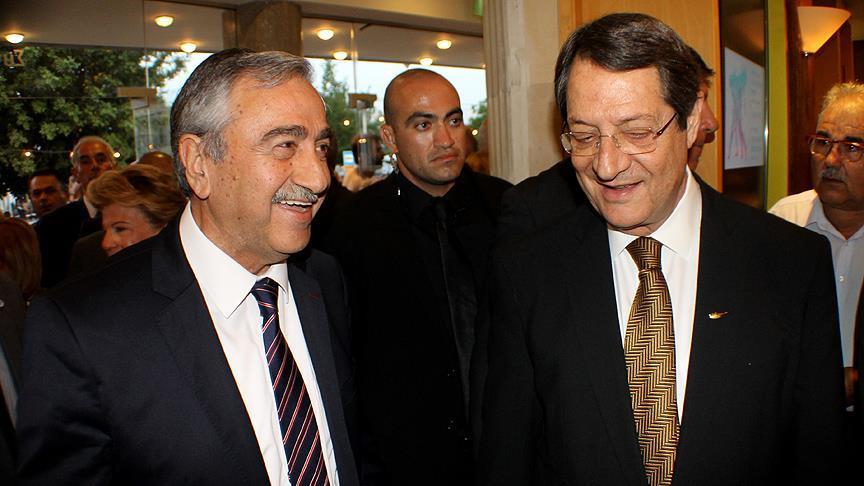
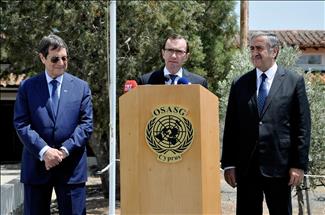
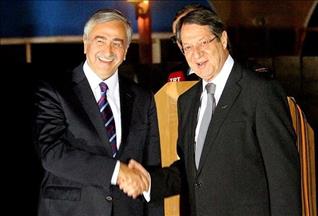
The word is often used by the respective leaders of the Turkish and Greek Cypriot communities, Mustafa Akinci and Nicos Anastasiades, who have led their negotiating teams during intense negotiations for many months aimed at healing the island’s 42-year divide.
It was used by Turkish Foreign Minister Mevlut Cavusoglu, who told a conference of ambassadors in Ankara on Monday that he was hopeful the sides "will not have to wait long for the solution of the Cyprus problem".
And the sense of hope was repeated Thursday by U.K. Foreign Secretary Philip Hammond, whose country was the former colonial power in Cyprus and remains a guarantor of the country’s independence. Hammond told reporters that he was "optimistic that we may be on the brink of a breakthrough in resolving this dispute".
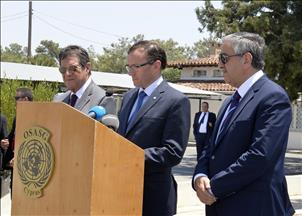
As Hammond began his visit to Athens and Ankara on Thursday, Akinci and Anastasiades were holding their first meeting of the year in the UN buffer zone that divides the communities’ respective territories.
Oya Tuncali, London representative of the Turkish Republic of Northern Cyprus, told Anadolu Agency that the desire and determination for a solution was evident in both communities.
"Of course this helps to raise our own hopes too," Tuncali said. "We are at the table to form a bi-zonal, federal structure based on two founding states. We are at the table to agree on a structure where we will be politically equal and secure.
"By finding a solution to the Cyprus problem, we could perhaps achieve a first for the Eastern Mediterranean, where there are so many problems and difficulties," she said.
For Sinan Ulgen, head of the Center for Economics and Foreign Policy Studies, there are a number of reasons for what he terms "this cautious optimism" in the air.
"The first of these is that there are two representatives on the island who have formed a relationship of trust between them. The economic crisis has meant the Greek Cypriot side better understands the advantages of uniting compared to 2004 [when its voters rejected the last peace plan sponsored by the United Nations]," Ulgen said.
"It has [also] emerged that Greek Cypriots will not be able to benefit from offshore energy resources until a solution is found," he continued, adding: "That is why the most optimistic environment since 2004 has been found."
A senior Greek Cypriot official, speaking to Anadolu Agency on condition of anonymity, echoed the feeling of goodwill: "The mood is very positive because the two leaders [Akinci and Anastasiades] get along well with each other."
But the official added that as the negotiating teams talk about some of the most contentious issues, including property and external guarantees, they would soon need to ask who will pay to fund a Cyprus settlement.
The question of money is indeed looming on the horizon. The international community would need to provide support to Cyprus not just with warm words but with hard cash, according to Ulgen.
"Beyond individual countries, the United Nations will need to hold an international donor conference as envisaged during the Annan Plan to establish an international fund that will aid a solution.
"It is extremely difficult to resolve the [property] compensation issue without some external support," he said.
And despite the generally optimistic international mood, Ulgen warned Russia could attempt to block a deal: "It is not possible to dismiss this scenario, but even if it is attempted I do not believe Russia can achieve it alone.
"This is because there is a dynamic that has emerged in the talks and significant process has been made. Neither side will want to be seen as responsible for failure. That is why I do not see the Russians will want to be seen as the lone factor in prevent a solution," he added.