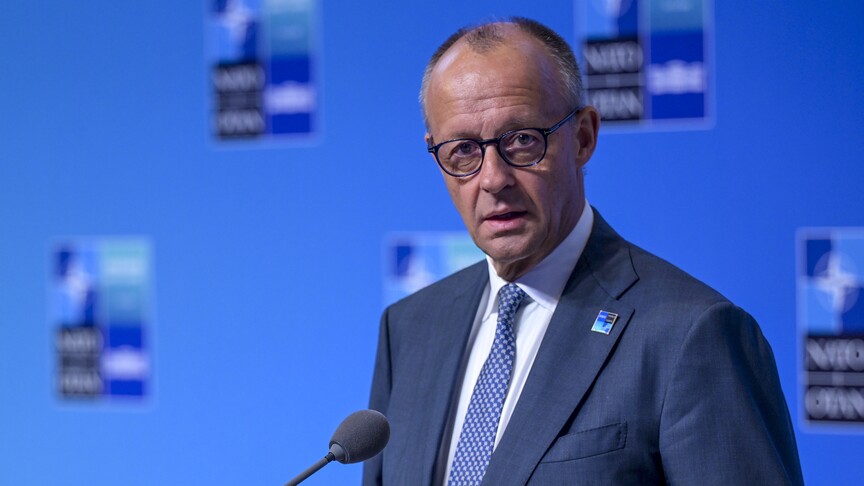
July 2026 marks the biggest turning point since Friedrich Merz was elected German chancellor in May 2025. The majority of Germans, including CDU/CSU voters, are dissatisfied with the government’s performance. According to various polling organizations, the far-right AfD has surged ahead by up to 8% at both federal and state levels. The coalition has already experienced several moments of weakness, and there is a risk that the possible election of an AfD politician in Saxony-Anhalt in September 2026 could trigger a political earthquake later this summer.
Against this backdrop, Merz began by painting a picture of his government’s capacity to act and demonstrating self-confidence in his policy statement to the German Bundestag on July 9, 2026, under the heading "The Centre Delivers". The chancellor was still visibly buoyed by what was described as the success of the NATO summit in Ankara and announced the purchase of Tomahawk cruise missiles with a range of up to 2,500 kilometers (1,553 miles), which would close an important strategic gap in Germany's defense.
He was also able to announce the contract awarded to the defense contractor ThyssenKrupp Marine Systems for the purchase of 12 submarines by Canada as a successful outcome of the NATO summit. Merz was full of praise for the coalition partner, the SPD, and, in his presentation of the comprehensive reform plans that had been set in motion, he focused on the areas of pension reform, tax reform, healthcare and the labor market.
This narrative was echoed at the chancellor's press conference on current domestic and foreign policy issues, which traditionally takes place before the summer recess in front of the assembled Federal Press Conference and provides an important opportunity to take stock of the government's work. Merz emphasized that the Federal Government had secured the approval of the Bundestag and the Bundesrat for all the projects that had been planned, including the Future Investment Act – which would significantly streamline the entire planning and implementation of infrastructure projects relating to roads, waterways, railways and other infrastructure – as well as a comprehensive reform of statutory health insurance. It was no coincidence, but rather a foreshadowing of the forthcoming Cabinet reshuffle, that Merz took this opportunity to expressly praise Health Minister Nina Warken for her "truly high level of professionalism" and "rapid pace of work."
Nina Warken has since succeeded Thorsten Frei as head of the Federal Chancellery, and her previous ministerial position has been filled by Carsten Linnemann, the secretary-general of the CDU. These changes follow the resignation of CDU/CSU parliamentary group leader Jens Spahn, who came under public scrutiny regarding his private decision to have a child carried by a surrogate mother within his same-sex marriage. Forced to step down from his post under pressure from Merz, Spahn has now been replaced by Frei as the new parliamentary group leader.
Merz has highlighted two issues in particular as key tasks for the future: firstly, the plan to put the pension system on a new footing (for which a commission has drawn up groundbreaking proposals); and secondly, the plan to reverse the burden of proof regarding reporting and documentation requirements for payment transactions, thereby bringing about a paradigm shift across the entire bureaucracy. The problem of high labor costs, however, remains an unresolved issue on the agenda. Merz also cited the reduction of red tape among the reform projects close to his heart, and referred to the second meeting of a so-called "deregulation Cabinet" during this parliamentary term, which had dealt almost exclusively with easing administrative constraints and abolishing statutory regulations. Excessive bureaucracy not only contributes to the paralysis of the German economy's competitiveness, but has also helped foster a mindset that further stifles the willingness to innovate, personal initiative and a sense of responsibility.
Merz showed signs of self-criticism. He referred to projects that had been left unfinished and long-overdue reforms. He argued against a spirit of despondency and expressed satisfaction with the mid-year review, which also serves as an early assessment of the first third of his term in office.
The Federal Press Conference highlighted the strengths, weaknesses and pitfalls of the CDU/SPD coalition government. Among the strengths are the chancellor's rhetorical brilliance and his unshakeable self-confidence. Even though there is considerable friction within the coalition with the Social Democrats, Merz shows no sign of discontent. He has demonstrated that, for him, preserving the coalition is of greater importance than pushing through radical reform projects. There is also – and this counts as both a strength and a weakness – a tendency to rest on one’s laurels and gloss over pressing issues. Regarding the National Security Council – which, whilst its members work together in a spirit of trust, does not yet perform a coordinating role, let alone a strategic one, and has thus failed to meet many expectations – the chancellor explained that, following 30 years of discussion, they had succeeded in establishing "this institution within four months" and that he was now grateful "that we have this institution, within which we … can speak confidentially and, if necessary, in secret, in order to tackle the challenges we face in both domestic and foreign policy."
Merz is hardly fazed by criticism; he is, in any case, a master at presenting himself in this light and, in response to questions from journalists, made it clear that, as a "learning system," he is improving every day. One of the government’s weaknesses is that it is already clear that the reluctant partnership between the Christian Democrats, Christian Social Union, and Social Democrats is not helping any of the coalition partners in the polls and is not suited to halting the rise of the AfD. The inability to find a response to this challenge posed by the AfD – one that exposes this protest party’s deliberate ambiguities, lack of economic solutions and pro-Russian foreign-policy ignorance – is the real dilemma facing German politics. The government is unable to shift the focus of the political agenda away from the topics of public debate set by the AfD.
Despite speculation to the contrary, Merz will remain in office as federal chancellor for the entire parliamentary term. The art of government will continue to be defined by the trials and tribulations of the various levels of government. The continuing decline in support for the three parties forming the government – each grappling with their own distinct set of problems – is the central crisis facing German politics. The fact that Merz acts wisely and skillfully on the international stage is an asset that benefits Germany as a whole; however, against a backdrop of growing strategic uncertainties, it does not appear sufficient to bring about a fundamental turnaround. The personnel decisions of the last few days will not lead to a fundamental change in policy. They demonstrate once again that Merz takes action and also – and this distinguishes him from his predecessor Angela Merkel and links him to Gerhard Schroder – possesses the political instinct to make a clean break when he deems it appropriate. In Thorsten Frei, he has appointed one of his few confidants to lead the CDU/CSU parliamentary group in the Bundestag, a man who will loyally stand by him. As long as Frei leads the parliamentary group, Merz need not fear any mutiny, and by appointing Nina Warken, he has ensured that a politician with whom he has been familiar since their time together in the opposition group will assist him in organizing power within the Federal Chancellery.
*Opinions expressed in this article are the author's own and do not necessarily reflect the editorial policy of Anadolu.
news_share_descriptionsubscription_contact

contact_the_ombudsman
is_there_an_error_in_this_story