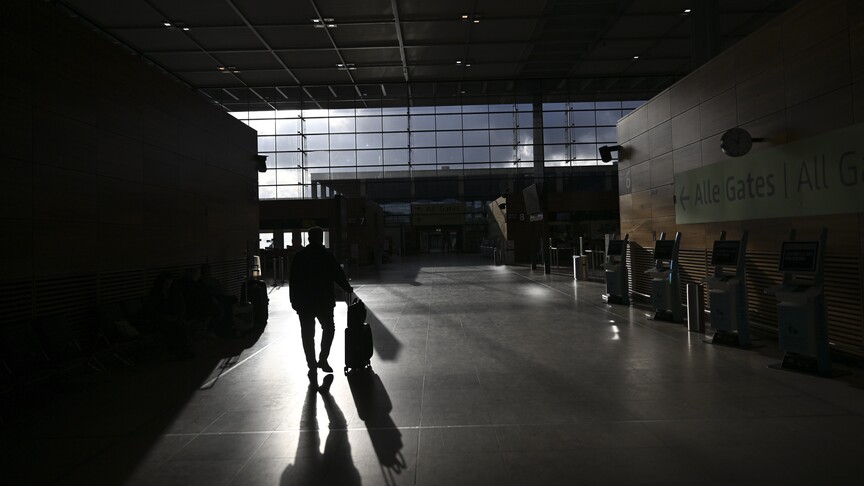
The attempted drone attack on Aug. 5 at Germany's Leipzig/Halle Airport showed once again how crucial the role of the aviation industry is for geopolitical interests. Besides being one of the largest cargo hubs in Europe, the airport hosts NATO's Strategic Airlift Interim Solution (SALIS), the air logistics arm of the alliance. Together with Rzeszow Airport in Poland, it is one of the most crucial nodes through which military supply to Eastern Europe is delivered.
The Leipzig attack attempt
The drone incident targeting a parked AN-124 belonging to Ukraine's Antonov Airlines marks a turning point for Germany. What matters is less the attempt itself than the fact that Western aid was physically targeted on German soil for the first time. The timing falls in a very polarized phase of the country: election campaigns are running in three eastern states, once part of the Soviet occupation zone, which is also where the attack attempt took place. This triggered the debate over aid to Ukraine and over Germany's policy towards Russia. As Russian influence remains considerable in the so-called new states even after reunification, the incident deepened the polarization in the country further.
On Sept. 1, the German government attributed the incident openly to Russia for the first time. Interior Minister Alexander Dobrindt based this assessment on the fact that the means used in the attack were already known from other hybrid operations carried out by Russia. Berlin then ordered the closure of the Russian Consulate General in Bonn and the Russian House in Berlin. A note of protest was handed to the Russian ambassador, and Germany announced that it would push for additional steps at EU level. With this step, Germany acted on its own outside EU institutions for the first time since Russia attacked Ukraine in 2022.
Russia has been linked to similar infrastructure sabotage before, and Western intelligence services regard these cases as part of a hybrid war. The aim is to make Germany more hesitant in its support for Ukraine and, at the same time, to create anxiety in society and to polarize the public over a critical defense question. If this support decreases, Russia will find itself in a stronger position on the battlefield, as Ukraine's defense capability depends to a large extent on these deliveries.
An old pattern
Civil aviation has been used for state interests for many years. State-owned carriers have treated diplomatic traffic and commercial considerations as parallel priorities, and the same applies to state-linked cargo and charter companies. One of the best-known examples of this is Air America. It was an airline established by the United States to carry weapons and supplies directly into the armed conflicts in Southeast Asia within the framework of covert operations. Whether the same aircraft were also used in the opium trade is still debated to this day.
Another example is St. Lucia Airways, on paper a Caribbean airline, which carried weapons to Angola and later missiles to Iran on behalf of the CIA. The revenue from these sales was transferred to the Contras in Nicaragua.
Belonging to the same line are the "Black Flights" that supported the Bosnian Muslims, backed by Iran and the US. Without them, the genocidal campaign of war criminal Ratko Mladic, who passed away last month, could have taken a different course.
A more recent example is the use of Russian-built Ilyushin aircraft by the United Arab Emirates to deliver weapons to the Rapid Support Forces in Sudan. These shipments, carried out through Chad, paved the way for last year’s massacres in El Fasher. A similar structure was seen in Libya as well, where the UAE backed Khalifa Haftar. Such airlifts, moving in the grey zone under a civilian appearance, shape crises to a large extent and determine which side remains standing.
A sector under pressure
The aviation sector has been under pressure for a long time. The Strait of Hormuz crisis, which flared up in Iran on Feb. 28, has affected airlines heavily on the cost side through fuel supply constraints. The closure of Middle Eastern airspace in the same period and the longer routes that followed have driven the crisis further.
In the northern hemisphere, the closure of Russian airspace to the countries that sanctioned Russia creates a serious competitive disadvantage with respect to other carriers. As a result, airlines based in the EU and the US are falling behind, while Turkish and Gulf carriers, together with Southeast Asian companies, are moving ahead.
A further case in point is Israeli state carrier El Al. Its aircraft, equipped with air defense systems and flown by former air force pilots, give the airline room to operate during conflicts. While most airlines suspended their flights in the region during Iranian attacks, El Al continued in line with national interests. The company moved its fleet to the Greek Cypriot Administration during the conflict with Iran in order to protect it. At the same time, the Israeli state fleet was stationed in Athens until the attacks ended, which also marks a remarkable diplomatic move in terms of the relations between these countries.
Strategic use of civil aviation
In such periods, state carriers therefore carry two functions at once. The sector is both an asset that has to be protected and an instrument that secures the state's freedom of action. The Chicago Convention, which applies to civil aircraft, regulates this field. State aircraft in military, customs and police service are left outside its scope. Aircraft of this kind have to obtain separate permission from each country for every transit. What is decisive, however, is not the aircraft itself or the cargo it carries, but the definition, that is, the purpose of use. And this definition is made by the operating state that owns the aircraft. It is this legal gap in Article 3 that makes operations such as the Air America and Ilyushin flights possible.
Aviation can also become a source of leverage for states, through the ability to influence or cut access. Island states in the Pacific and the Caribbean, for instance, depend on a limited number of air links for their vital supplies. The side that provides or subsidizes these routes gains political influence over those states at low cost. Aviation therefore offers third countries considerable opportunities, both in terms of supply capability and in terms of global political influence over island states.
Takeaways from Leipzig
With the increased security measures after Sept. 11, 2001, hijacking incidents, once a widespread method of political action, have disappeared. Their place has been taken by provocative models such as Leipzig. Even when these targets are located in countries that are not a party to the conflict, such facilities start to become targets, and the risk for those countries of being drawn into the conflict rises considerably.
Understanding this dynamic allows a state to use air capacity to its own benefit, or in the opposite direction, by targeting it in a rival. Due to the current airspace restrictions and fuel costs, Europe's maneuvering room has become considerably tighter. An example of how to deal with such threats independently can be observed in Türkiye, which is in a more advantageous position here.
Türkiye in an advantageous position
With Istanbul Airport, Türkiye has one of the highest-capacity hubs in Europe. Turkish Airlines has recently extended its network to Australia and, after the Air Europa acquisition, also to South America. The fact that the operational hub, the fleet, and the reach are under state backing allows Türkiye to pursue its own interests without depending on foreign capacity and foreign permissions, and makes it a supportive partner for its allies.
The side that holds civil aviation capacity can turn geopolitical tensions to its own advantage. The other side attacks precisely that capacity, as in Leipzig.
In conclusion, historically and today alike, civil aviation determines far more than its place in the tourism and transport sector suggests. The attack at Leipzig-Halle Airport once again highlights this fact, underscoring the strategic importance of civil aviation in terms of security and geopolitical competition.
*Opinions expressed in this article are the author's own and do not necessarily reflect the editorial policy of Anadolu.
news_share_descriptionsubscription_contact

contact_the_ombudsman
is_there_an_error_in_this_story