Said Amori and Rania Abushamala
07 November 2026•Update: 08 November 2026
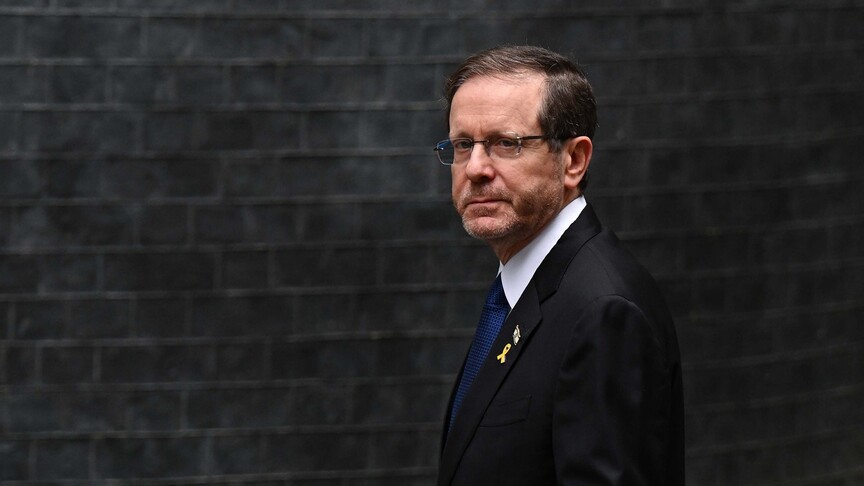
Israeli President Isaac Herzog will task Yashar party leader Gadi Eisenkot with forming the next government, his spokesperson said on Saturday.
The spokesperson said in a statement that Herzog informed Eisenkot of his intention to task him with forming the government.
Herzog has invited Eisenkot to the president’s residence, where he will formally hand him the mandate at 5 pm local time (1500GMT) on Sunday.
During consultations, parliamentary factions representing 67 Knesset members recommended that Herzog give the mandate to Eisenkot. Factions representing 46 lawmakers recommended Prime Minister Benjamin Netanyahu, the Likud leader and a member of the Knesset. One seven-member faction declined to recommend a candidate.
The spokesperson said Herzog held in-depth talks in recent days with figures from across the political spectrum, including Netanyahu and Eisenkot.
Once the president assigns the mandate, the lawmaker has 28 days to form a coalition. If more time is needed, the president can grant an extension of up to 14 days.
On Thursday, after concluding consultations with parliamentary factions, Herzog said he would hold additional talks before making a decision. He said the number of recommendations alone could not determine who was able to form a government, given disagreements and competing demands about Cabinet posts among the factions.
Israel held parliamentary elections on Oct. 27, in which neither of the two main blocs secured the 61 seats needed for a majority in the 120-member Knesset.
Netanyahu’s Likud won 27 seats, while Eisenkot’s Yashar won 21. Other parties took the remaining seats.
Final results gave Netanyahu’s bloc 53 seats and Israeli parties opposed to him 48. The two Arab lists, the Joint List and the United Arab List, also known as Ra’am, won 19 seats between them. Together, the parties opposed to Netanyahu held 67 seats and recommended Eisenkot for the mandate.
Several major parties in Eisenkot’s camp oppose forming a government that includes Arab parties. Eisenkot must therefore find a way to secure a parliamentary majority or form a minority government that relies on outside support.
The seven lawmakers from the ultra-Orthodox United Torah Judaism party, part of Netanyahu’s bloc, declined to recommend either candidate amid disagreements with their allies about military service exemptions for ultra-Orthodox Jews.
Eisenkot will have to bridge differences among the parties opposed to Netanyahu. Likud remains the largest single party in the Knesset, with 27 of the 61 seats needed for a majority.
If Eisenkot fails to form a government within the initial 28 days and any extension Herzog grants, Israel could enter another round of political consultations. Netanyahu’s government would remain in a caretaker capacity until a new government is formed.
Netanyahu is one of Israel’s longest-serving prime ministers. He first held office from 1996 to 1999, returned in 2009 and served until 2021, then took office again in December 2022.
He has been on trial in Israel since 2020 on charges of bribery, fraud and breach of trust in three corruption cases. He denies the charges.
The International Criminal Court also issued an arrest warrant for Netanyahu in November 2024 for war crimes and crimes against humanity in the Gaza Strip.