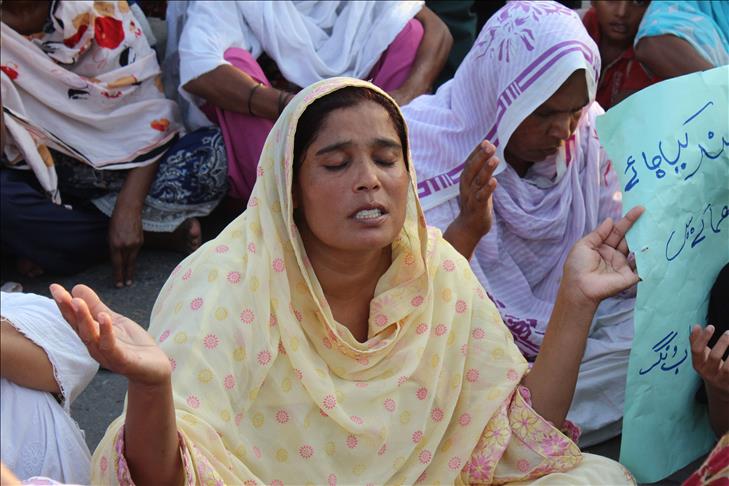
Everything has gone wrong for Gul Meena, a resident of military operation-hit Mir Ali town of North Waziristan. Last month, she had to run in a hurry along with her family to save their lives, and now she is struggling to prove her national identity.
She does not possess any document that could prove her Pakistani nationality. No birth certificate, no National Identification Card.
“I never thought that I would need those documents," an apparently wan, weather-beaten Gul Meena, in her mid 20s, told Anadolu Agency through a female reporter of a local TV channel.
Talking to men who are not relatives is strictly prohibited for women in highly conservative tribal society that forced the Anadolu Agency correspondent to seek the help of the lady reporter.
Standing in a queue outside a mobile center of National Registration and Database Authority, NADRA, and wrapped in traditional white “burqa” (veil), Gul desperately needs the National ID card to get her share of financial compensation from the government.
“I am not the only one who does not have the [national] ID card. I can tell you that there are thousands of women in North Waziristan who do not possess any government documents," Gul said.
Gul Meena appears to be happy to have first ever document to prove her identity.
“I am excited to see the first ever document that will belong to me”, she said.
Not having the National ID cards or birth certificates is not a surprising phenomenon in tribal society. A large number of tribesmen hardly bother to get the birth of their children registered as there are only a few government hospitals in region. A bulk of people prefer to take their wives to small private clinics or home-based clinics run by mid-wives at the time of birth.
The case of Gul Manana, another North Waziristan resident, is even worse.
She only knows that she was born 50 years ago in a village of Mir Ali, the second largest town of North Waziristan. Like Gul Meena, Manana too has no documents to prove her identity.
Her husband, Gul Khatir says he never found it necessary to get a national ID card for his wife.
The national ID card is a must to cast vote in general and other elections in Pakistan. But Waziristani women are isolated from this process too, which is another reason for not acquiring the essential documents.
“Our women hardly travel outside Waziristan. They do not even cast vote. Therefore, she simply did not need that," Gul Khatir, who runs a small shop in Mir Ali, said.
Noor Mohammad, an official of NADRA who has been assigned with the task to register the displaced persons from North Waziristan in the wake of an ongoing military onslaught against Taliban confirms that thousands of internally displaced persons, mostly women, did not have any documents.
“I was startled to know that every second or third woman did not have the National ID card. Thousands do not have even their birth certificates or any other document to prove their nationality," Mohammad said.
“Thousands of women from North Waziristan are going to get their identity for the first time in life," Mohammad said. However, he added that many women were still not interested in getting their ID cards because of pressure from their men and families who do not want them to be pictured for registration.
In addition to customary taboos about exposure of women, some blame the Taliban for making things worse for women.
“Taliban had barred women from casting vote in elections a decade ago. That’s why a large number of women could not get themselves registered either with election commission or NADRA," Gul Khatir said.
However, many do not blame solely Taliban for the practice. They heap the onus on centuries-old conservative customs that have little space for women’s role in the tribal society.
www.aa.com.tr/en