LAGOS
The 492 delegates taking part in Nigeria's long-awaited national conference will be grouped into at least 20 committees determined by the meeting's secretariat.
"Each of the delegates is to suggest three committees he/she believes they fit into," conference spokesman Akpandem James told Anadolu Agency on Tuesday.
"The secretariat will then decide who belongs where based on the choice already made," he added.
Committees will cover revenue generation, devolution of power, social welfare, religion, political restructuring and forms of government, national security, politics and governance, foreign policy and diaspora affairs, land tenure and law, judiciary affairs, human rights and legal reform.
The conference secretariat is expected to officially name the 20 committees and their respective members on Thursday.
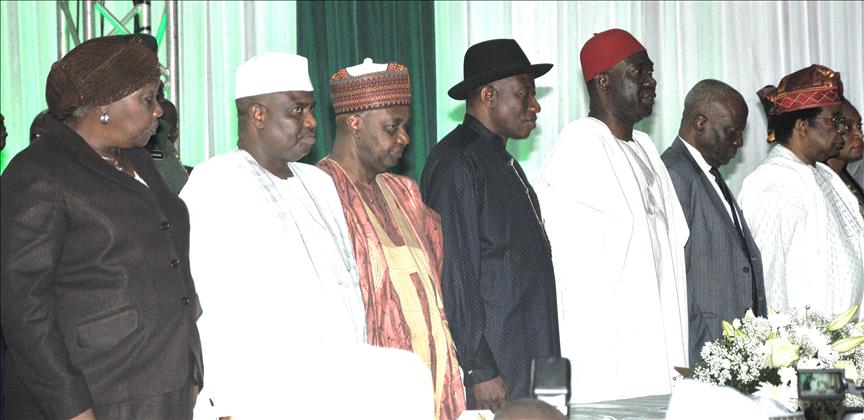
Last week, Nigerian President Goodluck Jonathan inaugurated the national conference, which brings together 492 delegates from different segments of Nigeria.
The conference is being chaired by Idris Legbo Kutigi, a former chief justice and one of the country's few senior judges with an unblemished public record.
Kutigi has been deputized by Bolaji Akinyemi, a former foreign minister from Nigeria's southwestern region and a widely respected scholar of international relations.
Conference proceedings, to be held in capital Abuja, will officially wind up on June 10, when reports will be submitted.
Delegates are drawn from the country's various ethno-religious and special interest groups, professional bodies, and each of the country's 36 states.
-Debate-
Delegates, meanwhile, have yet to agree on many of the rules that will regulate conference proceedings over the next three months.
It remains unclear how the conference will resolve the current procedural stalemate and reach decisions on the many issues that delegates have been tasked to resolve.
"Although the [conference] chairman overruled the suggestion that we should adopt a two-thirds majority as the benchmark to reach decisions… it is clear that many of us don't agree with the 75-percent majority contained in the draft rules and the president's speech," firebrand civil rights activist and conference delegate Jaye Gaskia told AA.
Delegates say it is almost impossible to reach consensus – or even a 75-percent majority – on the country's knottiest issues, with more vocal delegates calling the current benchmark a recipe for failure.
Some of the more controversial issues on the event's agenda include devolution of powers, structure of government, state police, Sharia issues and resource control – all topics that have traditionally divided the country's competing ethno-religious interests.
By Rafiu Ajakaye
englishnews@aa.com.tr