By Aamir Latif
ISLAMABAD
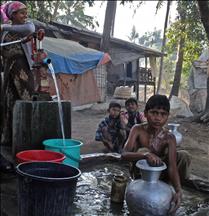
Drought in Pakistan's southern Thar desert region has killed 129 children in the past few days, but while local and international concerns have focused on the lack of rain and famine, there are more structural issues that have contributed to the deaths.
The fact of drought itself is not unusual in the region; it regularly occurs in the Tharparkar, on the edge of the desert. where life largely depends on seasonal rains. Bad governance, negligence, poor infrastructure, a lack of medical facilties and avoidable food shortages have all exacerbated the problems caused by drought. Almost 75 per cent of the lives could have been saved if malnutritioned children were brought to the hospital in time, diagnosed properly, and required medical facilities were available.
Tharparkar comprises six towns and spans over 22,000 square kilometers with a population of 1.5 million.
“Heaping the full blame on drought and famine for these deaths is unjustified, and aimed at hushing up the bad governance and negligence,” says Naimatullah Khan, a former mayor of Karachi. He is also head of Pakistan's largest NGO, Al-Khidmat Foundation, which has been involved in relief work in the Thar desert for the last decade.
Reports about the famine, which has killed a total of 170 people, have claimed that there has been no rain the whole of Thar for the past two years, something Khan says is only partially correct. Some towns in the region have recieved abundant showers while others have gone without a single drop of rain in a year.
He says that the scarcity of water for agricultural use has been particularly severe in the past year and that NGOs had brought this to the anttention of the provincial government three months ago.
“If precautionary arrangements were made on time, the gravity of the crisis would have reduced,” says Khan.
Journalist Rasool Bux Rehmadani lives in Umerkot, one of the affected towns, and agrees with Khan.
“Around 60,000 tons of wheat is still lying and getting rotten in government godowns in district headquarters Mithi, but not distributed among the residents of those areas where there has been no rain spell for last two years,” says Rehmadani. “If this mount of wheat had been distributed properly three months ago, the impact of famine would have been diluted to a huge extent.”
Long distances and poor infrastructure have also contributed to the extraordinary number of deaths. This year, Rehmadani says, hundreds of villages located deep inside the desert have been badly affected by the drought, where no health and medical facilities were available, forcing the residents to migrate en-masse.
“One has to travel for four to five days on foot to reach Civil Hospital Mithi, where too much of required equipment and facilities are not available for serious patients,” he adds.
He said only four of 16 doctors at the government hospital in Nangarpar town were on duty.
- Damage to livestock
The income derived from livestock is one of the major sources of livelihood for the residents of the Thar desert but a lack of vaccinations in the last year mean that half a million animals, of a total of 6 million, have become infected by various illnesses.
Local residents say there has been no blanket vaccination to the animals since last year due to unavailability of veternarians; there are only 11 assigned for six million animals scattered across the vast area, Rehmadani says.
“Damage to livestock has further exacerbated the situation as hundreds of families that depend on this source of income turned out to be empty handed due to spread of ailments among animals,” he ads.
“It’s the 21st century where a mother had to travel four to five days to take her son or daughter to the hospital as there are no roads, no transport,” says Rehmadani.
“We are looking for those parliamentarians who show their faces at the time of elections, and then simply disappear till next polls,” he says.
englishnews@aa.com.tr