- Eralp’s Left Party wins Berlin state vote and eyes becoming the city-state’s first governing mayor with a migrant background
- Supporters compare her rise to New York Mayor Zohran Mamdani’s 2025 victory; she calls him a role model
- She campaigned to cap soaring rents and condemned war crimes by Netanyahu’s government in Gaza
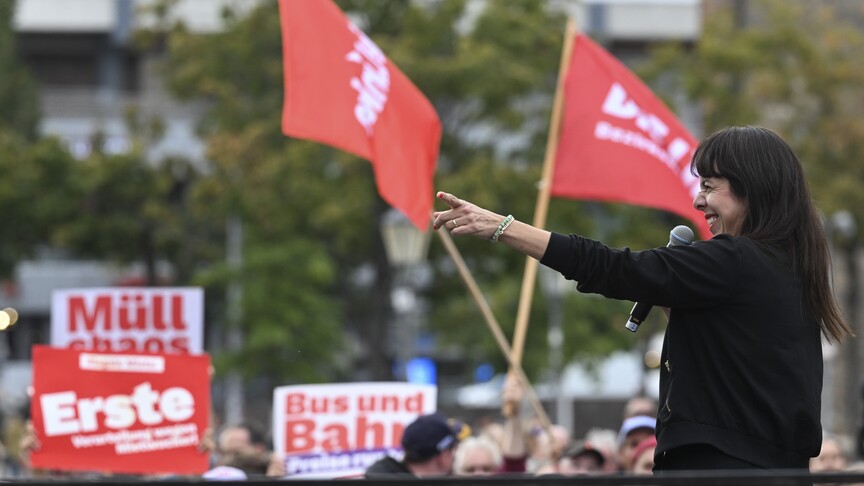
Berlin voters handed a historic win on Sunday to Elif Eralp, a human rights advocate of Turkish origin who now stands to become the city-state’s first governing mayor with a migrant background.
Her socialist Left Party took 25.7% of the vote—more than doubling its share from three years ago. In the spring, the party was still polling in the mid-teens. The surge was widely interpreted as evidence that Eralp had won Berliners’ trust and captured the city’s mood.
“Berliners, thank you — thank you for your trust,” Eralp told jubilant supporters on Sunday night. “Together, we made history today. Starting now, we will change Berlin — together.” She said “love and justice” had prevailed over “hatred.”
In recent months, supporters and many commentators in international media have compared her rise to New York Mayor Zohran Mamdani’s 2025 victory. Eralp also embraced that parallel during the campaign.
“I hope what in Manhattan, in New York was possible will be possible here in Berlin as well,” she told Anadolu only days before the vote. “Mamdani focused on social demands and that’s what we also do. And he brought different communities together, that was a big success, and that's what we also try to do.”
Like Mamdani, she put everyday economic pressures at the center of her campaign: soaring rents, higher transport costs, and problems in street waste collection. Her team ran a door-to-door campaign across neighborhoods and did not skip districts that backed the anti-immigration Alternative for Germany (AfD).
She proposed a rent cap on city-owned apartments, a state office to fight illegal rent hikes, and a revival of plans to bring large housing companies into public ownership. She pledged that a Left Party-led government would make Berlin more affordable for all.
From migrant family to Berlin politics
Eralp’s parents came to Germany from Türkiye after the 1980 military coup. Born in Munich in 1981, she grew up in Dortmund and Hamburg and has lived in Berlin for 16 years.
She has said she decided to study law after witnessing injustice and discrimination as a child, and has repeatedly recalled how, in primary school, she was affected by the wave of right-wing extremist violence targeting migrants in Germany in the 1990s.
That path took her into human rights work. She became a legal policy adviser to the Left Party’s group in the Bundestag, joined the party in 2017 and entered the Berlin state parliament in 2021. She has long worked against discrimination and argued for voting rights for people with a migrant background.
She still lives in a rented apartment and has looked for a new one for years without success. Asked whether landlords rejected her because of her Turkish surname, she said she did not know, because landlords do not have to give a reason.
A fightback against the AfD surge
Eralp cast herself as an answer to the far-right AfD after that party’s strong showing in Saxony-Anhalt two weeks earlier. A Left Party win in Berlin, she argued, would mark a turning point against the AfD’s momentum.
“I am the answer to Saxony-Anhalt election,” she said after that vote. It would be a strong signal, she argued, if someone with a migrant background became governing mayor in Berlin and offered answers to social injustice instead of blaming refugees.
She also sharply criticised Chancellor Friedrich Merz’s conservative CDU for adopting far-right positions associated with the AfD and for failing, in her view, to address people’s main concerns. Many voters, she said, feel that “those at the top just do what they want” and no longer hear them.
Protest voters fear social decline and accept scapegoat theories, she said, “although refugees are not to blame for the mess we are in, but a neoliberal policy that cuts funds for social spending and does not support the poorest.”
The Left Party, she said, is the alternative: new measures against rent increases, action against large real-estate firms that squeeze tenants, and more affordable cities regardless of social background or origin.
Protests, Gaza and free speech
Eralp also made the debate over pro-Palestinian protests part of her profile. She accused the outgoing CDU-led coalition under Governing Mayor Kai Wegner of canceling events and using disproportionate police force against peaceful demonstrators.
“The mayor of Berlin never listened to the issues of the Palestinian people here in Berlin, which is a big mistake,” she said. “We saw a lot of violence and repression against the people. And I want that this stops.”
She has been an outspoken critic of Israeli Prime Minister Benjamin Netanyahu’s government and its far-right ministers, and she has condemned war crimes in Gaza. Asked about the International Criminal Court arrest warrant against Netanyahu, she said she would push to have him arrested if he came to Berlin.
“Netanyahu must be arrested and answer before international courts for the crimes he has committed,” she said in a recent interview.
She strongly rejects accusations of antisemitism against her party, saying it supports the protection of Jewish life as well as Palestinian and Muslim life, and that both Israel and Palestine have a right to exist. Criticism of war crimes by Netanyahu’s government in Gaza, she argues, is not antisemitism. She has also said that throughout her career, she has taken part in campaigns against antisemitism.
Coalition talks will test the comparison
Eralp’s election-night triumph does not yet give her the mayor’s office. The next challenge is turning a campaign built on cheaper rents and a change of course into a coalition that can govern Berlin.
Despite its clear lead, the Left Party fell far short of an absolute majority and would need at least two partners. After a race fought against CDU policy, the most viable path is a three-party alliance with the center-left SPD and the environmentalist Greens.
That is where the Mamdani parallel will be tested. Attention in the coming days will turn to whether Eralp can hold her core promises while bargaining with parties that do not share all of the Left Party’s positions.
Eralp has said her party’s program won the election and that cheaper rents and social justice must be written into any coalition deal. Potential partners will press her on what she is willing to drop. How far she bends — and how much of that agenda survives — will determine whether the Mamdani comparison fades as campaign rhetoric or becomes something she can actually deliver in office.