- Snap elections would amount to 'political suicide' for CDU/CSU and SPD, and no senior conservative appears ready to take over amid unpopular reforms, Muno says
- Growing distrust of established parties and economic anxiety are driving voters toward right-wing AfD and eroding faith in democracy, expert war
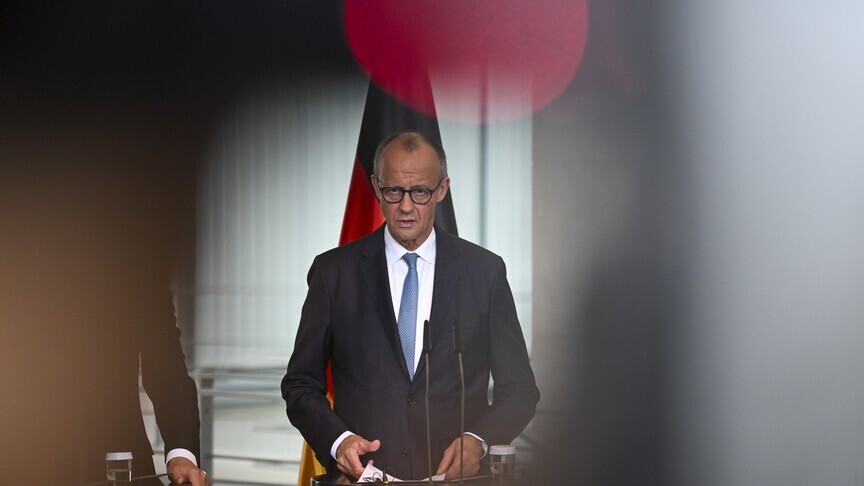
Chancellor Friedrich Merz’s crushing defeats in recent state elections have raised fresh questions in Germany about his political future and the survival of his coalition government.
A recent YouGov poll found that 48% of Germans do not expect Merz to remain chancellor through the end of the year, while a separate survey for news channel n-tv showed 55% want him to resign.
But Wolfgang Muno, a professor of comparative politics at Germany's University of Rostock, said Merz is unlikely to step down anytime soon despite growing pressure, and that coalition partners have little appetite for early federal elections.
“A snap election would be more or less political suicide for Chancellor Merz’s Christian Democrats (CDU/CSU) and their coalition partner, the Social Democrats, as both are polling below their results in the last federal election,” he told Anadolu.
The Christian Democrats’ record losses in three federal states this month have fueled speculation about a “chancellor swap,” in which the CDU/CSU would nominate a new candidate and elect a successor in the federal parliament without calling new elections.
Muno, who closely follows German domestic politics, described that scenario as unrealistic in the short term, saying no senior conservative appears ready to take over while the government is pushing through unpopular reforms.
“I don’t see any candidate who is willing to do so. Neither North Rhine-Westphalia’s premier Hendrik Wuest nor Bavarian premier Markus Soeder said they would be willing to step in,” he said, referring to the two popular figures widely mentioned as possible successors.
Even if conservative lawmakers united behind a new candidate, Muno argued, a leadership change would do little to address Germany’s deeper problems.
The election results, he said, reflect widespread public frustration that Merz’s resignation alone cannot resolve.
CDU’s heavy defeat, right-wing AfD’s rise
This month, Merz’s CDU suffered heavy losses in state elections in Saxony-Anhalt, Mecklenburg-Vorpommern and Berlin.
The anti-immigrant AfD won by a wide margin in the two eastern states, while in the Berlin city-state election the CDU was overtaken by the socialist Left Party.
Surveys suggested that while state-level concerns – such as local economic conditions, public services and infrastructure – played a role, many voters also used the elections to voice their discontent with the Merz government.
The right-wing AfD made unprecedented gains, particularly in the east, winning 38.2% in Mecklenburg-Vorpommern and about 43.8% in Saxony-Anhalt.
Muno said AfD’s surge cannot be explained solely by voters with extremist views or concerns about immigration, stressing that the party has also attracted people who feel alienated from the established parties and are looking for an alternative.
“We have a higher and higher level of mistrust in established political parties,” he said.
“They (voters) are drawn to right-wing populist politicians who say: ‘Those politicians in Berlin, the elites, do not care about you; they do not make policy for you,’” he added.
Economic worries and a steady stream of crisis narratives are deepening that sense of alienation, Muno said, pointing to the economic downturn, the energy crisis, and fears of rising gas prices ahead of winter.
Lower-income groups in particular see the government’s planned changes, especially to pensions and health care, as socially unfair, Muno said.
“They say people with lower income have to suffer from cuts, but people with higher income do not suffer the same way,” he said.
- Declining confidence in democratic system
Muno warned that while the AfD’s surge is concerning, an even greater danger is the steady erosion of public confidence in democracy, especially in the eastern states.
“I would say we are losing many people … because they don’t believe in democracy anymore,” he said.
He stressed that senior AfD figures’ understanding of democracy fundamentally conflicts with a liberal, pluralist system, saying the party seeks to curb the independence of the judiciary and media freedom and abandon the principle of equal rights for all.
“In the view of the AfD, there are different groups of people, and especially immigrants should not have the same rights as the people they consider to be Germans by blood,” he said.
“That’s their basic idea, and this is why it’s also a danger for democracy itself.”
In May 2025, Germany’s domestic intelligence agency, the Federal Office for the Protection of the Constitution (BfV), classified the AfD as a “confirmed right-wing extremist” organization. The party is contesting the designation in court.
Muno pointed to surveys on attitudes toward democracy in the two eastern states where the AfD won this month’s elections.
In Mecklenburg-Vorpommern, three-quarters of people no longer see democracy as the better political system, he said, while in Saxony-Anhalt more than half of respondents said they would prefer “only one strong party” deciding and representing the people.
Need for tangible results, positive narrative
Muno also highlighted another weakness behind the mainstream parties’ poor performance.
They have focused too much on crisis talk, he said, reinforcing the AfD’s narrative that Germany faces constant problems and that nothing is going well.
To win back disillusioned voters, he said, Merz’s conservative CDU/CSU alliance and their Social Democrat coalition partners must first deliver concrete results people can feel in their daily lives.
Just as important, Muno argued, mainstream politicians need a positive narrative for overcoming socioeconomic concerns – one that builds trust and addresses people’s fears.
Otherwise, he warned, more people will begin to question the value of democracy itself.
“If democracy is not able to deliver social benefits and economic benefits, then the people say, what’s the sense of democracy? I can vote, but I don’t have enough to pay my rent, to pay for my gasoline,” he said.
“People fear their income is falling and their wealth is shrinking, and this is a very dangerous situation,” Muno warned, adding that if voters no longer see democracy delivering a stable living, more of them will simply stop believing in it.