Anadolu Ajansı © 2026


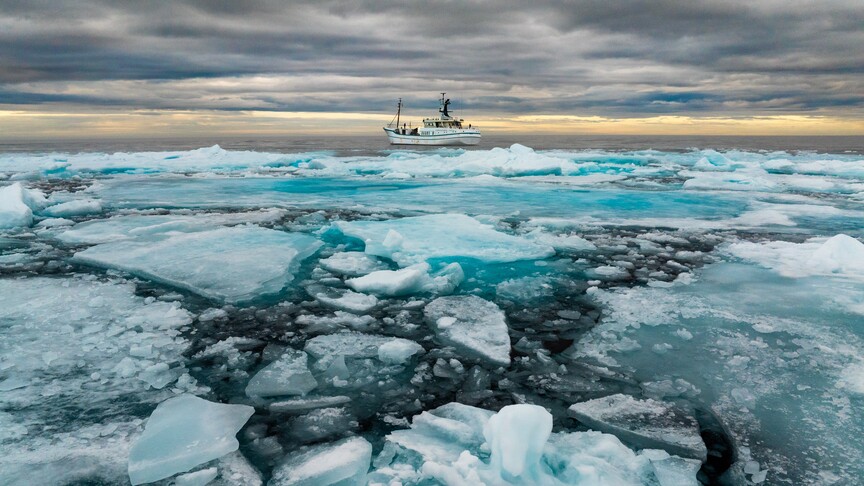
What happens when a region transformed by climate change begins to attract an industry associated with global emissions?
As rising temperatures accelerate the loss of Arctic sea ice, the region is becoming more accessible to commercial shipping, creating new opportunities for trade while raising concerns about the environmental costs.
Chinese container shipping company Sea Legend announced in mid-August the launching of the first regular container shipping service through the Arctic.
The route connects Ningbo on China's eastern coast with Felixstowe in the UK along Russia's Northern Sea Route (NSR) and is expected to cut the usual 40-day sailing time roughly in half.
The company has branded the weekly service the "Ice Silk Road," in reference to the historic trading routes that connected China and Europe.
The development follows a rise in commercial activity along the route, with 23 transits recorded last summer compared with 15 in 2024, according to Financial Times.
South Korea is also testing the route.
The 2,800-TEU PanStar Acro departed Busan in late August for the country's first trial voyage along the Arctic shipping route, passing through the Bering Strait and Arctic Ocean toward European ports.
Meanwhile, experts warn that growing commercial shipping along the route could intensify climate impacts, pollution and biodiversity loss in the fragile Arctic.
The growing interest in the route thus highlights a climate paradox: can a region becoming increasingly navigable because of climate change absorb the environmental consequences of becoming a new artery of global trade?
Sian Prior, lead adviser to the Clean Arctic Alliance, told Anadolu that the increase in Arctic shipping has coincided with the loss of sea ice.
“The Arctic Council’s Protection of the Arctic Marine Environment indicates a 40% increase in the number of ships and an almost doubling of the amount of the distances being sailed in the Arctic in the 12 years to 2025,” she said.
Arild Moe, a research professor at Norway-based Fridtjof Nansen Institute, said shorter transit times are a major attraction for companies, although the route remains constrained by vessel size and its limited operating season.
“When it comes to transit to Europe, the advantage is speed, the drawback is relatively small ships, compared to the regular container lines,” Moe told Anadolu.
He said the route can only be used for about three to four months a year, meaning companies are currently testing whether it can work commercially.
A study published in Nature Reviews Earth and Environment found that September Arctic sea ice area decreased by 35.8% between 1980 and 2024.
During 2013-2023, meanwhile, the number of ships entering the Polar Code Arctic area increased by 37.3%, while shipping-related CO2 emissions rose 6.3%.
“The loss of sea ice is allowing ships to access Arctic waters previously covered by sea ice and leading to access at times of the year when there was previously little opportunity,” Prior further said.
She cautioned, however, that melting ice is not the only factor driving increased activity.
“It is however the desire to control the Arctic and the demand for access to Arctic resources - oil and gas, minerals, and fish - that are creating new opportunities - not the reduction in sea ice,” Prior said.
Elizabeth Wishnick, senior research scientist at the Center for Naval Analyses, pointed to disruptions on traditional maritime routes as another factor making the Northern Sea Route more attractive.
“The war in Iran has disrupted shipping via the Red Sea as well as the Persian Gulf,” Wishnick, who is also a distinguished fellow at Columbia University's Weatherhead East Asian Institute, told Anadolu.
The emergence of regular container services also adds a commercial dimension to growing interest in a route largely controlled and regulated by Russia.
“The dominant cargo traffic on the NSR has since 2018 been exports of LNG from Yamal, mainly westwards to Europe and also oil in that direction,” Moe said.
He noted that private Chinese companies have increasingly used the route to transport consumer and industrial goods to Russia.
“I see these activities as commercially driven, although Chinese authorities take an interest in the NSR over the longer term,” Moe said.
He added that Russia has become more accommodating toward Chinese involvement as it seeks Chinese investment in Arctic infrastructure, although future cooperation will depend on the broader Russia-China relationship.
Wishnick also said the new container services should be viewed in the context of wider China-Russia cooperation in the Arctic.
“China is seeking to normalize its presence in the Arctic and reduce the skepticism among the Nordic countries about China's role in the region,” she said.
She also linked South Korea's trial voyage to Seoul's longstanding interest in Arctic cooperation with Russia.
“Although the same feasibility/profitability drivers we see in China are likely at work here, too, I think Korea may be viewing this NSR container service as a more discreet means of engaging with Russia while still maintaining sanctions,” Wishnick added.
As the Arctic becomes more accessible, greater shipping activity could add pressure to the environment that made the route possible.
One of the main concerns is black carbon, a short-lived climate pollutant produced by burning fossil fuels. When it settles on snow and ice, it reduces their ability to reflect sunlight, increasing heat absorption and accelerating melting.
“Shipping is already contributing to the loss of ice, through greenhouse gas emissions, and emissions of the short-lived climate pollutant black carbon from the burning of fossil fuels,” Prior said.
She explained that black carbon can travel hundreds or thousands of kilometers, but its impact is particularly significant when released near the Arctic because it is more likely to settle on snow and ice.
“Local warming and snow and ice melt from air pollutants such as black carbon have a disproportionate impact when they are released in and near the Arctic, up to five times higher than when released in temperate or tropical regions some studies have shown,” Prior underscored.
Prior also highlighted the wider climate feedback triggered by the loss of Arctic ice.
"The loss of ice results in greater absorption of heat as underlying dark land and water are exposed creating a self-sustaining cycle of melting ice and increasing heat," she said
A Clean Arctic Alliance assessment found that black carbon emissions increased across all of its Arctic geographic scopes between 2019 and 2024, rising from 259 to 759 metric tons in the Polar Code area.
“Shipping is a primary source of black carbon emitted north of 70N latitude,” Prior further recalled.
Environmental risks also extend beyond emissions.
Prior said greater vessel traffic can increase underwater noise, disturb marine wildlife and raise the risk of oil and chemical spills, with consequences for communities that depend on Arctic marine resources.
“These impacts and risks aren’t theoretical for the daily lives of people in the North,” Prior underscored.
The region's remoteness also creates difficulties in responding to accidents.
"Spills of oils and chemicals are a threat with major consequences for Indigenous communities, particularly since the equipment required to respond to spills is very limited in the Arctic," Prior said.
"If a shipping accident happens and people need to be rescued, search and rescue response will be very limited."
For now, the experts say the Northern Sea Route is unlikely to replace traditional routes, despite its potential to significantly shorten voyages.
“In the foreseeable future, only as a seasonal addition. It cannot replace Suez,” Moe said.
Wishnick similarly cautioned that unpredictable ice conditions could undermine the reliability required by container shipping.
"The receding ice is unpredictable and the on-time deliveries needed for container shipment may not work as planned," she said.
"The route is no panacea for shipping problems elsewhere," Wishnick added.
For Prior, reducing the environmental footprint of vessels that do operate in the Arctic is a priority.
"A switch to cleaner distillate fuels immediately could result in a 50-80% reduction in black carbon emissions," she said, calling for monitoring and reporting of black carbon emissions.
Prior warned that long-term environmental costs of expanding Arctic shipping will outweigh the economic and logistical benefits, saying that Arctic ice acs as a thermoregulator and reflects the sun’s heat.
“Disturbances and changes in the Arctic will not be experienced only in the Arctic,” she cautioned.
“What happens in the Arctic does not stay in the Arctic.”
news_share_descriptionsubscription_contact

contact_the_ombudsman
is_there_an_error_in_this_story