PARIS
Students from Singapore and Korea have performed best in the first assessment of a scheme involving creative problem-solving run by the Organisation for Economic Co-operation and Development, the organization has said.
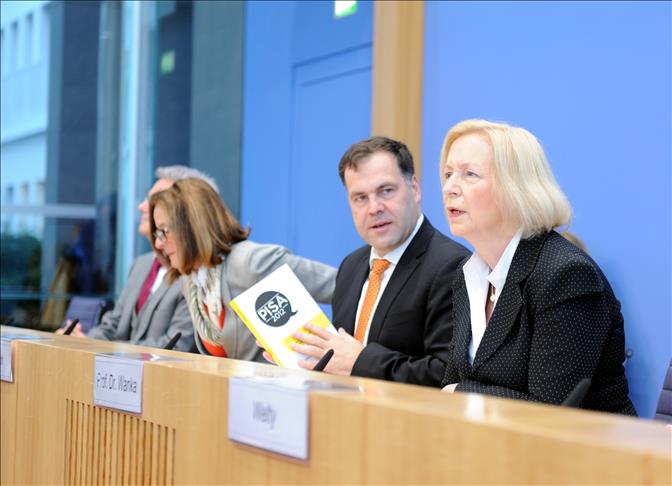
In a report released in Paris on Tuesday on the Programme for International Student Assessment (PISA) scheme, OECD PISA officials said students in the two countries were quick learners, highly inquisitive and able to solve unstructured problems in unfamiliar contexts.
A total of 85,000 students from 44 countries and economies took the computer-based test, involving real-life scenarios to measure the skills young people will use when faced with everyday problems, such as setting a thermostat or finding the quickest route to a destination.
Japan, Macao‑China, Hong Kong-China, Shanghai-China and Chinese Taipei were also among the top-performing economies.
Modern needs
Students from Canada, Australia, Finland, England, Estonia, France, the Netherlands, Italy, the Czech Republic, Germany, the United States and Belgium all scored above the OECD average.
Turkey scored below the OECD average, according to the report.
About one in nine (11.4 percent) of 15-year-old students across OECD countries are able to solve the most complex problems, compared to one in five in Singapore, Korea and Japan.
But on average across OECD countries, about one in five students are able to solve only the simplest problems, meaning they lack the skills the modern workplace needs.
The OECD is a global economic policy forum. It provides analysis and advice to 34 member-governments and other countries worldwide, describing itself as promoting better policies for better lives.
englishnews@aa.com.tr