Tugba Altun and Emir Yildirim
09 October 2026•Update: 09 October 2026
Private aerospace companies are playing an increasingly important role in developing infrastructure for future operations on the Moon, but competition for limited resources and suitable locations could create international disputes without clear regulations, a space industry executive told Anadolu.
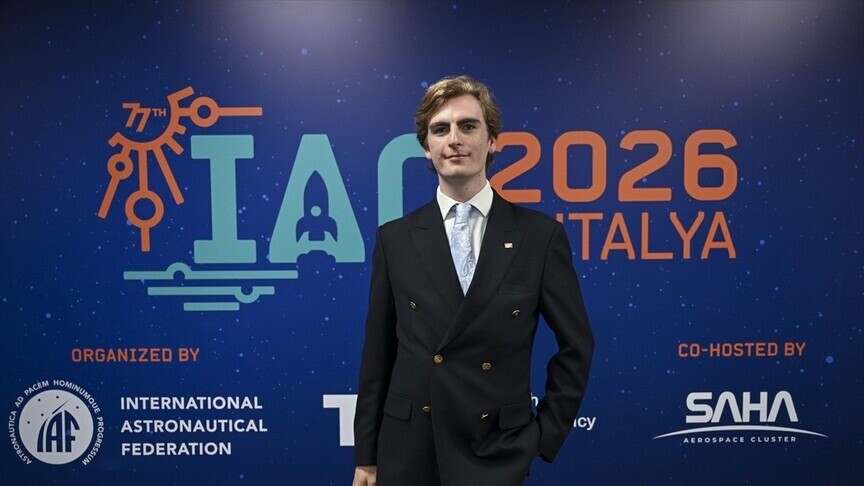
Stirling Forbes, CEO of Forbes-Space, said the growing involvement of commercial companies marked the beginning of a "second space age," distinct from the government-led competition of the Cold War era.
Speaking on the sidelines of the 77th International Astronautical Congress (IAC) in Antalya, Forbes said private companies were increasingly building infrastructure for both government and commercial use.
"These commercial companies are contributing to the construction of a shared, sustainable infrastructure that will generate returns for Earth," he said.
Forbes pointed to companies developing launch vehicles, lunar rovers, power systems, communications infrastructure and landing facilities.
"These missions range from, of course, the rockets from SpaceX or Blue Origin, down to the rovers of Astrobotic or Lunar Outpost, even to the infrastructure of power systems, communications, even landing pads," he said.
The growing range of commercial projects, he added, was laying the groundwork for a more diversified lunar economy.
Moon could become refueling hub for deeper space missions
Forbes said advances in artificial intelligence and robotics would be essential for future lunar operations, particularly in environments where machines must function autonomously without constant human intervention.
Such technologies could reduce risks to astronauts during early exploration and generate innovations with applications in industries on Earth, he said.
One potential business model involves using the Moon as a refueling station for spacecraft traveling farther into the solar system.
"I think, with the construction of more of this infrastructure on the Moon, one of the main business models is for the Moon to essentially be used as a fuel station," Forbes said.
He envisioned spacecraft stopping at lunar facilities to refuel before continuing toward Mars, the asteroid belt and other destinations.
Forbes also welcomed the growing participation of countries beyond the traditional space powers, citing Türkiye's planned lunar mission as an example.
"We live in a very exciting time of this commercialization, but also democratization of space," he said.
He described Türkiye's lunar program as "a fantastic example of new nation-states getting involved in this race for the Moon," while emphasizing the potential economic and technological benefits of space exploration.
Competition for lunar resources raises concerns
Despite the opportunities, Forbes warned that the concentration of valuable resources and suitable terrain in limited areas of the Moon could lead to disputes over access.
He estimated that only about 6% of the lunar surface offered favorable conditions for future infrastructure, based on factors such as access to water ice, solar energy and relatively flat terrain.
That concentration, he argued, could encourage powerful countries to seek control over strategically valuable locations, potentially excluding smaller nations and private companies.
Forbes called for transparent international regulations to ensure sustainable and nondiscriminatory access to lunar resources and infrastructure.
"We have to be very vigilant that this does not happen, and we have to build the regulations and structure to help the Moon go in a commercially sustainable direction rather than increasing militarization," he said.
He warned that allowing powerful countries to dominate lunar development could prevent emerging space nations and companies from benefiting from future opportunities.
Forbes said commercial companies should play an active role in shaping the rules governing lunar activities rather than leaving decisions exclusively to national governments.