Global markets start week on negative note
Lack of clarity over Fed's policy steps, in addition to ongoing uncertainties, puts focus on Fed Chair Kevin Warsh's speech at Jackson Hole Economic Policy Symposium this week
Global markets start a busy week with a sell-off trend, driven by US growth and inflation data, the Jackson Hole Economic Policy Symposium and Nvidia's balance sheet.
Investors entered the week nervously as uncertainties regarding a cease-fire in the Middle East continued to complicate pricing, testing macroeconomics, monetary policy and the artificial intelligence theme simultaneously.
As negotiations between the US and Iran yielded no concrete results, the mutual defiance of the parties spreading to the economic field rather than remaining limited to the military front increased current uncertainties.
US Treasury Secretary Scott Bessent is expected to announce new economic sanctions against Iran on Monday.
Oil prices maintained their high levels as geopolitical uncertainty persisted over the Strait of Hormuz, which plays an important role in energy supply, keeping concerns about inflationary pressures alive on a global scale.
Analysts said current pricing in money markets indicated the Fed could raise interest rates once by the end of the year, while these expectations could change depending on announced economic data and geopolitical developments in the Middle East.
The lack of clarity over the Fed's policy steps, in addition to ongoing uncertainties, turned attention to statements Fed Chair Kevin Warsh will make at the Jackson Hole Economic Policy Symposium on Friday.
US growth data and the personal consumption expenditures (PCE) price index, an inflation indicator, remained among the important topics in investors' focus.
The data is expected to guide expectations regarding the Fed's interest rate path through the strength of economic activity and the course of inflation.
Financial results to be announced by Nvidia also remained among the important items to follow this week to gauge whether the artificial intelligence theme will continue, in addition to these developments.
Analysts said Nvidia's profitability and growth expectations and its forecasts for the future of the semiconductor sector could increase volatility in the markets.
The tariff issue between the US and Canada was also among the developments occupying the agenda.
Canadian Prime Minister Mark Carney said the US proposed "economically unviable and unfair" conditions in ongoing trade negotiations, adding that Canada will respond in kind to Washington's new tariffs to protect workers, farmers, families and businesses.
Gold at 14-week high
Selling pressure eased in the bond market for a while after the US Treasury Department doubled its long-term bond buyback operations.
The 10-year US bond yield, which ended the week at 4.74% with a three-basis-point increase on Friday, started the new week at 4.71%.
The two-year US bond yield also dropped to 4.23%, a decrease of two basis points.
Expectations that the US Treasury Department could increase its interventions in the bond market continued to put pressure on the dollar.
The US dollar index started the new week flat at 98.8.
Finding support from the weakening dollar and the curbing of the rise in bond yields, an ounce of gold hit a nearly 14-week high, rising to $4,657 at the start of the new day.
The price of Brent crude oil for October delivery hovered at $93 per barrel, down 1.5%.
US index futures also started the week on a negative note.
European index futures follow mixed course
Index futures in European derivatives markets started the week on a mixed course amid uncertainties regarding geopolitical developments in the Middle East.
Markets considered it certain that the European Central Bank (ECB) will raise interest rates next month as concerns continued that high oil prices in the region will increase energy costs.
The Consumer Price Index (CPI) for July in the Eurozone came in line with expectations last week, increasing 0.2% monthly and 2.9% annually.
Inflation remaining above the ECB's 2% target was among the factors supporting expectations of monetary policy tightening by the bank.
Investors will follow growth and the economic confidence index in Germany, European Central Bank (ECB) meeting minutes on Thursday, the unemployment rate in Germany on Friday and the consumer confidence index in the Eurozone this week.
Markets will also closely monitor messages regarding monetary policy at the Jackson Hole Economic Policy Symposium in the US.
Asian stock markets follow negative course
Asian stock markets started the week on a negative note in light of current developments.
Developments in the Middle East and messages at the Jackson Hole meeting are expected to affect the direction of regional markets.
The rise in US-Canada trade tensions brought concerns that a new tariff agenda toward the region could emerge.
Shares of China's leading e-commerce and technology company Alibaba fell 9.8% on reports that the company planned to sell $10.2 billion in shares to finance its investments in artificial intelligence.
South Korea-based electronics company Samsung Electronics announced it would transfer 90 trillion to 110 trillion won, around $65 billion to $80 billion, to shareholders this year.
Samsung shares lost 8% in value because the record $80 billion shareholder return plan did not meet expectations.
With these developments, Japan's Nikkei 225 index dropped 0.5%, South Korea's Kospi index 2.9%, China's Shanghai Composite Index 0.9% and Hong Kong's Hang Seng Index 2% near the close.
Turkish Central Bank restarts one-week repo auctions
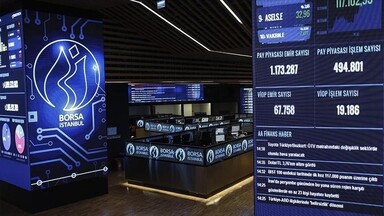
Following a buying-heavy course on Friday, the BIST 100 index on Borsa Istanbul ended the day up 0.82% at 14,514.82 points.
The Central Bank of the Republic of Türkiye (CBRT) decided to restart one-week repo auctions, which were suspended on March 1, 2026.