Burhan Sansarlioglu and Emir Yildirim
28 September 2026•Update: 28 September 2026
Global markets came under selling pressure at the start of the new week after US President Donald Trump rejected Tehran’s seven-day ceasefire proposal to reopen the Strait of Hormuz to vessel traffic.
Expectations that geopolitical risks could be resolved via the 81st session of the UN General Assembly held last week boosted risk appetite, driving up global markets.
Following Trump’s rejection, November-delivery Brent crude rose 2.5% to $109.6 a barrel, as expectations of a near-term US-Iran ceasefire faded.
The US 10-Year Treasury yield hit its highest level since 2007 at 5.23% on Sept. 25, stabilizing at 5.21% on Monday.
The two-year yield rose by four basis points to 4.91%, while the 30-year yield saw its highest level since 2004 at 5.53% on Sept. 25, stabilizing at 5.51% on Monday.
Rising global bond yields continue to drive up the borrowing costs of tech firms as they scramble to fund their artificial intelligence (AI) efforts worth billions of dollars.
The selling pressure in the bond markets could continue until clear signs emerge that financial conditions have sufficiently tightened, analysts say.
The US Dollar Index is trading up 0.1% at 101.1, while gold is down 2.1% at $4,196 per ounce on Monday amid the US-Iran tensions.
The Fed is 68% likely to hike rates in October, money market estimates show.
Following Chinese President Xi Jinping’s visit to the US on Sept. 23-25, the White House said the two countries reached a deal to reduce tariffs on $30 billion of non-sensitive goods in both directions.
Markets are seeking clearer signals on the inflation trajectory and economic activity in the US, while all eyes turned to the growth, nonfarm payrolls, and personal consumption data to be released this week.
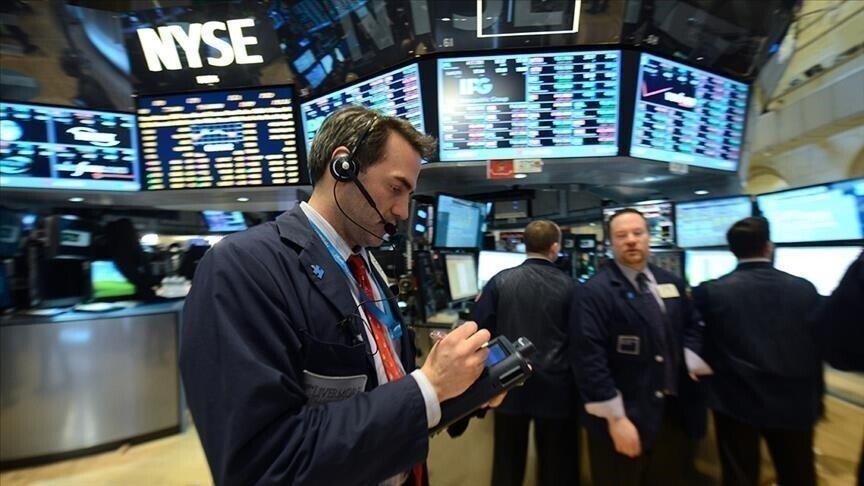
The New York Stock Exchange traded positively on Sept. 25 amid expectations of a potential deal in the Middle East easing concerns over energy supply, while rising AI stocks contributed to the optimism.
US tech giant Microsoft’s shares surged 3.6% after it released new features for its chatbot Copilot, including a coding tool and an autonomous AI agent, “Autopilot.”
Akamai Technologies shares climbed 3.2% after signing an $11.6 billion multi-year deal with Anthropic.
Meanwhile, the University of Michigan’s consumer sentiment index was upwardly revised to 48.1 in September.
The US durable goods orders remained flat, defying expectations of a decline.
The Dow Jones Industrial Average rose 0.93%, the S&P 500 gained 0.51%, and the Nasdaq was up 0.48% on Sept. 25.
American indexes opened Monday in the red.
At the same time, European stock markets traded mostly higher on Sept. 25, driven by gains in banking, mining, and tech stocks.
Germany's DAX 40 rose 0.56%, Italy's FTSE MIB 30 gained 0.63%, and the UK's FTSE 100 climbed 0.14%, while France's CAC 40 lost 0.04%.
Asian equity markets saw a selloff near Monday’s close.
China’s industrial profits posted their slowest monthly increase of the year at 4.2% in August.
Japan’s Nikkei 225 fell 0.1%, South Korea’s Kospi dropped 2.1%, and China’s Shanghai Composite was down 1.7%, while Hong Kong's Hang Seng climbed 0.6% near Monday’s close.