By Shadi Khan Saif
KABUL
The appearance of stability maintained by Afghanistan's economy during the past 14 years of heavy conflict has begun to slip, exposed in recent weeks by a heavy slump in the value of its currency.
At the end of December 2014 U.S.-led foreign forces formally ended their combat mission and their exit was accomanied by a departure of aid and investment.
The international exit also preceded a dip for the Afghani, the Afghan currency, which after several years of being valued at around 57 to a U.S. dollar has slumped in the past month, vacillating erratically between 57 and 61 Afghanis to a dollar.
Interim central bank president Khan Afzal Hodawal has tried to play down the development, telling reporters on Monday that Afghans should not be worried, as the bank has $7 billion in reserve. He had earlier said that other currencies had also depreciated because of increasing demand for the dollar.
Despite Hodawal's assurances, the slide has raised doubts about the sustainability of Afghanistan's aid-addicted economy which, for nearly a decade, had seen its output grow at an average of 10 percent, boosted by the economic activity that accompanied the large foreign military and civilian presence.
At a time when Afghanistan is trying to rebuild after decades of conflict, it is also concerning for many of the country’s most economically vulnerable. A reliance on imports of food and other necessities means the depreciating value of the Afghani will make vital goods more expensive.
According to Khan Jan Alokozay, president of the Afghanistan Chamber of Commerce and Industry, it not surprising that the currency's value has begun to suffer.
“First of all, let us not forget that the Afghani value that was maintained for around 14 years was not a real one, it was actually an inflated one," Alokozay said.
“Our trade balance is extremely out of equilibrium, as we import 94 percent and have exports of just around 4 percent, so no wonder the currency falls as foreign forces exit and foreign aid is reduced,” he said.
This reliance on imports means Afghanis are sold to spend abroad, inceasing the supply and decreasing the value.
This is compounded by the inability of Afghanistan's limited exports in bringing in the dollars needed to support the currency in the way that the heavy presence of foreign troops and aid groups did, by creating well-paid jobs and a market for goods and property.
Exports rely heavily on the agricultural sector, which is itself limited by a lack of resources and trade avenues.
There is potential for Afghanistan to exploit mineral resources which, according to the Afghan Geological Survey, are worth some $3 trillion but remain largely untapped.
Afghanistan's central bank, Da Afghanistan Bank, had been supporting the currency by pumping millions of dollars into the open market every week but it has, according to currency traders, scaled down this practice in recent weeks.
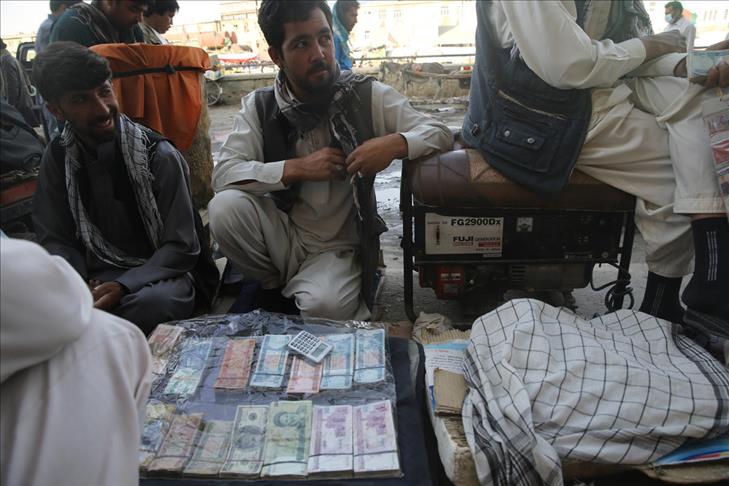
In Sara-i-Shahzada, Kabul’s main currency market, traders told Anadolu Agency that people were now holding on to whatever dollars they had.
Afghan President Ashraf Ghani, himself a former World Bank official, has since taking office in September insisted that the economy is his priority.
He has sought to promote Afghan business abroad, pitching to regional neighbors the vision of Afghanistan as a hub for trade and energy links between South and Central Asia.
This drive is yet to bear visible results however and, according to former finance minister Abdul Hadi Argandiwal, a long term strategy needs to be defined and executed to stabilize the trade balance.
“At the moment, they [the government] should continue pumping dollars into the open market if the government has sufficient stock but this is never going to work for long term,” he said.
Despite Ghani's commitment to reform Afghanistan's economy, political instability has remained a concern and potential deterrent to investment.
A months-long disputed election unsettled Afghans and has not completely been eased by the setting up of a national unity government. Ghani and his power-sharing partner, Chief Executive Abdullah Abdullah, have also not yet appointed a director for the central bank.
“Political uncertainty and the absence of the Da Afghanistan Bank director are the main reasons for the currency's decline. As soon as these issues are resolved the Afghani should regain its original value,” said Khan Mohammad Baz, the President of the Currency Traders Association.
The chamber of commerce director Alokozay said a worsening state of security has also been a factor, forcing capital flight from the country.
“The trader or industrialist needs to be confident about his investment in the country but currently many are concerned about the insecurity, not just in the far away provinces but in the capital Kabul as well,” he said.
Alokozay said President Ghani and his finance team have assured the business community that efforts were underway to address the issues facing the economy.
“We understand that the current value of Afghani against the dollar has been an inflated one for the past many years but what we want the government to do is to not let the value fall suddenly, as that would shock the business community and inflict heavy losses,” he said.