Aybuke Inal and Irmak Akcan
09 October 2026•Update: 09 October 2026
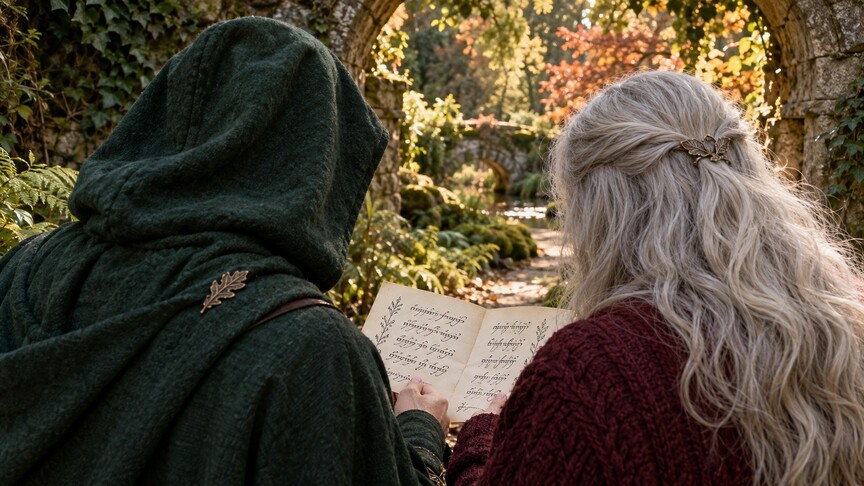
The fictional Elvish languages developed by British author and philologist J.R.R. Tolkien continue to be studied and used by fans decades after their introduction in works including The Lord of the Rings, The Hobbit and The Silmarillion.
Tolkien designed multiple languages for the peoples of Middle-earth, giving them distinct grammar, vocabulary and sound systems as well as imagined histories showing how they changed over time.
Among the best known are Quenya and Sindarin. Quenya was conceived as an older, ceremonial language associated particularly with the Elves of Valinor, while Sindarin was more commonly spoken among the Elves living in Middle-earth.
Tolkien drew inspiration from real languages when developing them. Finnish and Latin influenced Quenya, while Sindarin was shaped partly by Welsh.
Although Tolkien did not complete every element of the languages, enthusiasts have continued studying his manuscripts and other writings to reconstruct and use them.
Norwegian author and philologist Helge Kare Fauskanger told Anadolu that his interest began when he encountered the Elvish script in The Lord of the Rings as a young reader.
He said the 1987 publication of The Etymologies, a document included in The Lost Road, greatly expanded scholars’ understanding of Tolkien’s languages by providing thousands of words and linguistic roots.
According to Fauskanger, Tolkien first imagined a primitive Elvish language and then developed separate branches by applying different sound changes. This allowed Quenya and Sindarin to appear related while retaining their own characteristics.
Many familiar Middle-earth names, including Aragorn, Galadriel, Minas Tirith, Mordor and Gondor, have roots in Sindarin, he said.
Learning the languages can nevertheless be challenging because Tolkien repeatedly revised their structure during his lifetime.
“Rather than pieces from a single puzzle, what we have is a mixture of pieces from countless puzzles,” Fauskanger said, explaining that individual documents often reflect Tolkien’s thinking at a particular moment.
A student with a linguistic background could understand the fundamentals of Quenya grammar within a week, he said, although learning its vocabulary would take considerably longer. Gaps also remain in the known vocabulary.
“There is a word for rat, but none for mouse,” he said, adding that future publications could fill some of those gaps.
Despite the difficulties, online communities continue to use Quenya and other Elvish languages.
“They generally try to translate phrases intended for tattoos or inscriptions on rings, or share poems and other short texts,” Fauskanger said.
For many fans, he added, the languages and Tolkien’s writing systems are inseparable from the broader aesthetic and cultural appeal of Middle-earth.