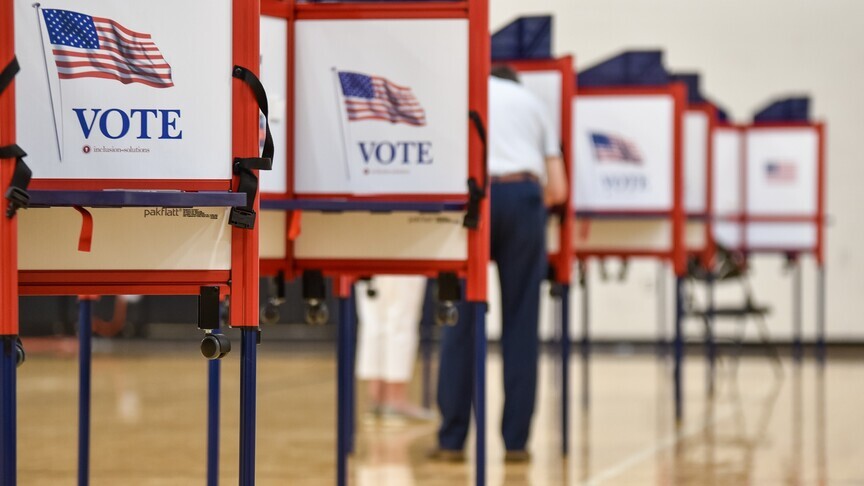
Voters in the US states of Florida, Alaska, Wyoming, and California shaped a series of key November midterm races Tuesday, with Florida state Rep. Angie Nixon scoring an upset in the Democratic US Senate primary and closely watched contests also taking shape for Senate, House, and governors’ seats.
Nixon secured more than 56% of the vote, despite facing off against a much better-funded opponent. She has been an outspoken supporter of Palestinian rights and previously introduced a resolution in the Florida House calling for de-escalation and a ceasefire in Israel and the occupied Palestinian territories.
Ashley Moody, who was appointed in 2025 to fill the Florida Senate seat vacated by Secretary of State Marco Rubio, won the Republican nomination with 79.6% of the vote against three challengers, and so will be on the ballot for the congressional midterms this Nov. 3.
Elsewhere in Florida, incumbent Democratic Rep. Jared Moskowitz defeated challenger Oliver Larkin in the state's 25th Congressional District, winning 63.5% of the vote to Larkin's 36.5%.
Larkin campaigned in support of Palestinian rights and an end to US military aid to Israel, while Moskowitz supports Israel and has received sizable contributions from pro-Israel groups. The district is in South Florida, which has a sizeable Jewish electorate, many of them older and traditionally pro-Israel.
Moskowitz will face Scott Singer in November. Singer won a crowded Republican primary with 31.4% of the vote.
In Florida's 7th Congressional District, incumbent Republican Rep. Cory Mills lost his reelection bid to former Orlando television news anchor Ryan Elijah.
Mills, who was endorsed by President Donald Trump, has faced allegations of assault and threatening behavior toward women as well as an investigation by the House Ethics Committee.
Elijah won 47.3% of the vote to Mills' 34.1% and will face Bale Dalton, who won the Democratic primary with 45.5%.
In the race to succeed term-limited Florida Gov. Ron DeSantis, Trump-backed Rep. Byron Donalds won the Republican nomination with 47.8% of the vote in a crowded field.
Donalds will face former Rep. David Jolly, a former Republican who became a Democrat. Jolly won the Democratic primary with 61% of the vote.
Alaska Senate race could help determine control of chamber
In Alaska, former Democratic Rep. Mary Peltola and incumbent Republican Sen. Dan Sullivan advanced from the state's nonpartisan US Senate primary, setting up a November contest that could play a significant role in determining control of the chamber.
Peltola had 47.3% of the vote to Sullivan's 44%, with 73% of ballots counted. Two other candidates will join them on the November ballot under Alaska's system, which advances the top four primary finishers regardless of party affiliation.
Republicans currently control the Senate, while Democrats need to retain every seat they hold and flip four others to regain the majority. Democrats view Alaska as one of their potential pickup opportunities and have invested heavily in Peltola's campaign.
Sullivan, who is endorsed by President Donald Trump, is seeking a third term and enters the general election with the advantage of running in a state that has historically favored Republicans.
Peltola, however, has twice won election to Alaska's single at-large US House seat as a Democrat and has the backing of Senate Minority Leader Chuck Schumer, factors Democrats believe make the race competitive.
Peltola has also outraised Sullivan during the primary election cycle, bringing in $18 million compared with Sullivan's $11.7 million. Sullivan nevertheless had more cash on hand at the end of July, with $7.3 million compared with Peltola's $4.6 million, according to Federal Election Commission data.
In Alaska's lone US House race, incumbent Republican Rep. Nick Begich and independent Bill Hill were the top two vote-getters, with 46.7% and 30.9%, respectively, with 72% of precincts reporting. Two other candidates will also advance to November.
Muslim candidate leads in California
In California, state Sen. Aisha Wahab held a narrow lead over Melissa Hernandez in a special runoff for the 14th Congressional District, with the race yet to be called.
Wahab, the first Muslim and Afghan American elected to the California State Senate, had 51% of the vote to Hernandez's 49%, with 62% of ballots tallied as of 10 pm local time (0500GMT Wednesday). The winner will serve the remainder of former Democratic Rep. Eric Swalwell's term after his resignation.
Wahab and Hernandez, both Democrats, will also face each other in November for a full two-year term representing the district.
In Wyoming, both parties selected nominees for the US Senate seat being vacated by retiring Republican Sen. Cynthia Lummis.
Trump-backed Rep. Harriet Hageman won the Republican nomination with 64.9% of the vote. She will face James Byrd, who easily won the Democratic nomination with 79.3%.
Wyoming voters also chose nominees to succeed Republican Gov. Mark Gordon, who opted not to seek a third term.
State Sen. Eric Barlow defeated Trump-backed candidate Megan Degenfelder with 45% of the vote to win the Republican nomination. Barlow will face Kenneth Casner, who ran unopposed in the Democratic primary.