

BANGKOK
The cooling of relations between the U.S. and Thailand following last year’s military coup has seen the kingdom move closer to China, a superpower with eyes on extending its influence in Southeast Asia.
A Thai military delegation is currently visiting China and Thailand, a steadfast U.S. ally and a bulwark against communism in the region since the 1950s, is eyeing deals for Chinese military hardware and joint exercises with the People’s Liberation Army.
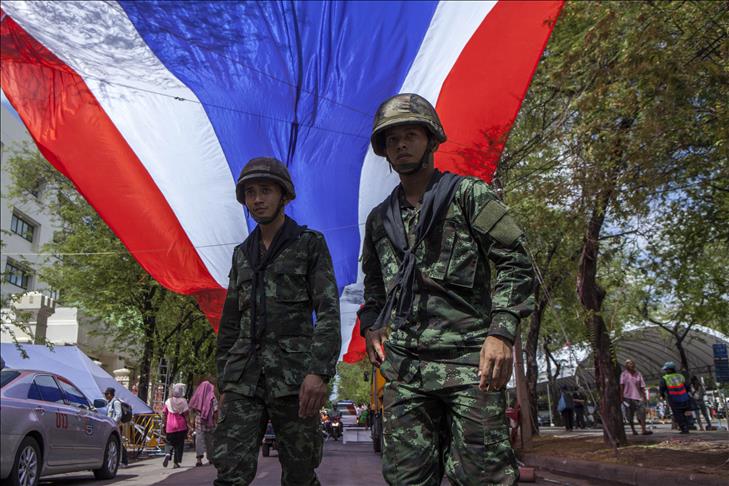
The May 22 military takeover, when the army ousted the government of Yingluck Shinawatra, led to U.S. discomfort over its ties to a regime with such an apparent disregard for democratic values.
The U.S. has suspended military cooperation projects and last year reduced the scale of the yearly joint Cobra Gold war games. During a visit in Bangkok in January, Deputy Secretary of State Daniel Russel warned that America’s relationship with Thailand “cannot return to normal until democracy is re-established.”
The junta’s irritation at this remark was likely exacerbated by his private meeting with Shinawatra and his failure to meet Prime Minister Prayuth Chan-ocha, the former general who now heads the junta.
Speaking at the Foreign Correspondents Club of Thailand on Wednesday evening, Panitan Wattanayagorn, an adviser to Defense Minister Gen. Prawit Wongsuwan, outlined the crux of Wongsuwan’s visit to Beijing, where he is accompanied by Thailand’s supreme military chief and the three service chiefs.
“For the first time, this year we will have a joint Thai-Chinese air exercise,” he told journalists. “And I have hope today or tomorrow, Prawit Wongsuwan can finalize the agreement on a joint exercise for the marines of both countries.”
In further news that is likely to set pulses quickening in the Pentagon, the delegation of Thai top brass is also exploring the possibility of buying Chinese submarines, fighter jets and other military hardware.
The junta’s flirtation with China may seem strange for a group of military men who rose through the ranks at a time when Thailand was one of America’s staunchest anti-communist allies in the region during the Vietnam War and its aftermath, when Thailand benefited hugely from U.S. aid.
It may also seem odd that the U.S. would shun such an ally when the Obama administration has publicly stated its goal of switching its foreign policy focus to the Pacific region, where China has been flexing its military muscles, particularly in territorial disputes with Thailand’s neighbors over swathes of the South China Sea.
“We need the U.S. to maintain stability in the region,” Wattanayagorn said. “We welcome their presence and the Cobra Gold exercise. But China has much more to offer, for instance in the areas of defense and agricultural trade.”
It seems the junta’s disappointment at the U.S.’s attitude toward them has led them into the arms of an eager China.
Wongsuwan’s visit to Beijing is the second since the coup and Chinese Defense Minister Gen. Chang Wanquan stopped by Bangkok in January.
With its new military partner, the Thai armed forces look set to embark on a makeover.
“Procurement has become more diversified, less U.S.-centric,” political scientist Thitinan Pongsudhirak told Wednesday’s press conference. “One of the reasons is that the U.S. did not want to transfer the technology but also because buying only from the U.S. limits the interoperability of weapons systems.”
Among the items on Thailand’s shopping list are diesel-powered Chinese submarines, each worth $1 billion, as well as Chinese fighters to replace its ageing F16 jets.
In return, China is counting on Thailand to support the regional ambitions that have brought it into conflict with countries such as Vietnam, the Philippines, Malaysia and Brunei, particularly over the sovereignty issues in the South China Sea. Chinese warships have already been involved in several tense stand-offs with the Philippine and Vietnamese navies in the area.
Despite the apparently blooming relationship between Bangkok and Beijing, most experts think that, in the long run, Thailand will be careful to balance its diplomatic strategy so as not to become over-dependent on one dominant power.
“If the domestic political situation becomes more complicated, Thai authorities will go more to the side of China, but in the long run, they will come back to a balance,” Pongsudhirak said. “It will be transitory, as it is not in the Thai DNA to go exclusively to one side, but it could take between five to eight years.”
However, whether this balancing act could see Thailand rush back to the embrace of its old ally remains to be seen.
On the horizon looms another of the Cold War protagonists. On Thursday, Russian Prime Minister Dmitry Medvedev was in Bangkok urging Thailand to consider creating a free trade area with the Russia-dominated Eurasian Economic Union.
Ahead of his visit Chan-ocha voiced his wish for Thailand, already Russia’s biggest trading partner in Southeast Asia, to double the value of this trade. Defense equipment would be a feature of such an increase.
"If you want that, we will supply the equipment to you," Medvedev said in an interview with Suthichai Yoon, chairman of Nation Multimedia Group, on Thursday when asked about military trade.
And unlike its former nemesis, Russia is showing no signs of squeamishness over the regime’s lack of democratic credentials.
"We try to behave in a civilized way,” Medvedev said about the coup’s possible effect on Thai-Russian relations. “This is an internal process happening in Thailand and we pay attention to it and we do it with respect.”
Anadolu Agency website contains only a portion of the news stories offered to subscribers in the AA News Broadcasting System (HAS), and in summarized form. Please contact us for subscription options.


