
Cricket: A victim of mounting India-Pakistan tension
South Asia’s most popular sport appears to be the latest victim of mounting tension between arch-rivals India and Pakistan
Pakistan
By Aamir Latif
KARACHI, Pakistan
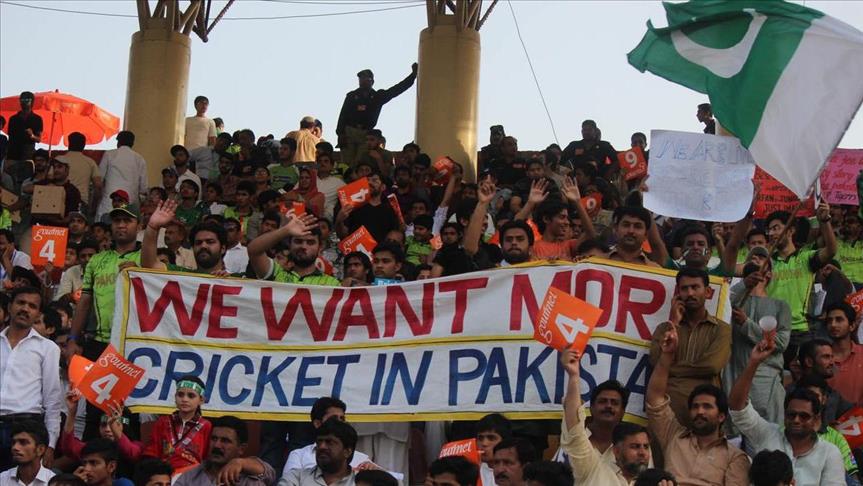
Cricket, South Asia’s most popular sport, appears to be the latest victim of growing tension between arch-rivals Pakistan and India, with predictions of no-play between the two cricket giants for an unforeseen period.
The chances of a much-awaited bilateral series -- following an eight-year hiatus -- dimmed further this week when hundreds of members of fringe Hindu group Shiv Sena stormed the headquarters of the Indian cricket board in Mumbai, where the heads of the Indian and Pakistani boards were scheduled to meet to discuss the upcoming series.
The rowdy activists forced authorities to cancel the meeting amid a thin police presence, which was insufficient to control the protesters.
Shouting anti-Pakistan slogans, Shiv Sena members announced they would not allow the proposed cricket series to take place because of “Islamabad’s involvement in terrorism in India” -- a reference to a string of deadly attacks in Mumbai in 2008, in which over 150 people were killed.
India severed its sports ties with Pakistan soon after the Mumbai attacks, which it blamed on the latter. Islamabad, however, has consistently denied the allegations.
Last year, the two cricket boards signed an agreement according to which they would play six series from 2015 to 2023, conditional on clearance from the Indian government.
Threats
Bowing to the threats, the International Cricket Council (ICC), which regulates international cricket, also stopped renowned Pakistani cricket umpire Aleem Dar from officiating an ongoing series between India and South Africa.
Dar, who won the ICC’s “Best Umpire of the Year” award for the three consecutive years (from 2011 to 2013), was threatened by Shiv Sena to either leave India or “face the consequences”.
Meanwhile, two leading former Pakistani cricketers-turned commentators -- Wasim Akram and Shoaib Aktar -- have also been warned to leave India by Shiv Sena, which has a history of threatening players, singers and actors from majority-Muslim Pakistan.
Akram, a former captain of Pakistan’s national cricket team, and Akhtar, a former pacer, were both hired by different sports channels as commentators for the ongoing India-South Africa series.
“I am no longer optimistic about a bilateral series taking place between India and Pakistan,” Shahryar Khan, chairman of the Pakistan Cricket Board (PCB), told reporters on Tuesday before leaving for Pakistan.
“I am disappointed with the attitude of the BCCI [Board of Cricket Control India],” he said.
“Not only am I, but millions of cricket fans from both sides, [are] disappointed,” Khan, who served as Pakistani foreign secretary in the 1990s, added in a thinly-veiled reference to the poor security measures adopted by the Modi government to contain Shiv Sena’s protest at the BCCI headquarters.
Tensions
Political tensions have often affected cricket, with no series being played between the two sides from 1961 to 1978, and then from 1989 to 1999.
The last series between the two nuclear rivals was played in India in 2007.
“If we want to restore cricket ties, then both [cricket] boards have to work on that. It’s not only Pakistan’s responsibility,” Khan asserted.
“Today, cricket and India have lost and the hardliners have won,” Pakistani private television channel Geo commented on the recent events.
“It is clear now that there is no chance of restoration of cricket ties between Pakistan and India -- at least in the near future,” the channel added.
Pakistan and India rank fourth and fifth in the ICC’s test ranking, while India ranks second in the one-day ranking and Pakistan eighth. India has won the world cricket cup twice -- in 1983 and 2011 -- while Pakistan won it once in 1992.
Matches between the two cricket-loving nations attract millions of fans, many of whom can pay ten times the retail price of a ticket on the black market.
The government of Indian Prime Minister Narendra Modi, meanwhile, has distanced itself from the recent acts of Shiv Sena, an ideological ally of the ruling Bhartia Janta party (BJP).
However, many Indian analysts believe the Modi government itself is not interested in restoring ties -- of any kind -- with Pakistan.
Modi is already facing international criticism due to his failure to protect Muslims and other minorities from hardline Hindus, especially on the issue of beef consumption.
Since Modi, a Hindu nationalist, took office last year, hardline Hindu groups -- including Shiv Sena -- have sought a complete ban on beef consumption, which is considered sacrilege by practicing Hindus.
Cows are worshiped as sacred by Hindus, although for many poor Muslims in India, beef sales represent a major source of income.
Anadolu Agency website contains only a portion of the news stories offered to subscribers in the AA News Broadcasting System (HAS), and in summarized form. Please contact us for subscription options.