JUBA
By Okech Francis
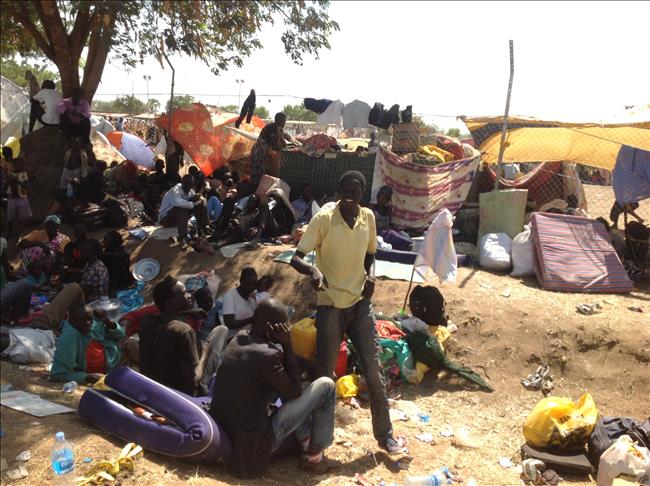
The camp of the United Nations Mission in South Sudan (UNMISS) in South Sudanese capital Juba is teeming with nearly 27,000 internally displaced people (IDPs), according to a top UN official.
"At the moment, there are about 27, 000 people [in the camp] and they tell us, and we feel, they are congested," Toby Lanzer, the deputy head of UNMISS and UN humanitarian coordinator for South Sudan, told Anadolu Agency in an exclusive interview.
"I think largely it has increased – not because of continuing hostilities, but because people are arriving in Juba," he added.
The UN official cited new arrivals from Bor, capital of the war-ravaged Jonglei State, who had initially sought refuge in Lakes State's Awerial County before trying their luck in Juba.
South Sudan has been shaken by violence since mid-December, when President Salva Kiir accused his sacked vice president, Riek Machar, of standing behind a failed coup attempt against his regime.
The violence has already claimed the lives of more than 10,000 people.
During a recent visit to South Sudan, Amos Valerie, UN undersecretary-general for humanitarian affairs and emergency relief coordinator, said some 3.7 million people were severely food insecure, while more than 820,000 had been displaced by the violence.
Representatives of the two warring parties will meet in Addis Ababa on Tuesday for a second round of peace talks brokered by the Intergovernmental Authority on Development (IGAD).
Lanzer, for his part, insisted that, despite the congestion at the camp, the compound's doors would remain open to other refugees.
"For the time being, if more people come and have a well-founded fear and feel unsafe, yes [they will be admitted]," he said.
"What we're trying to do is provide a place where people feel safe, but also where they can stay as healthy as possible," Lanzer added.
"Overcrowding, combined with heat and rain, will be very challenging."
-Suffering-
The UN official said the recent influx had stretched the camp's sanitation capacities.
"We didn't have enough space for latrines, but have now found enough space for building 300 latrines," he said. "In a camp setting, the aim is to have one latrine for 50 people."
"We're doing everything possible in terms of water, sanitation and healthcare to make sure the risk of disease is as low as possible," he added.
He noted that all children in the camp under the age of 15 had been vaccinated against measles, adding that cholera vaccinations would also be provided before the rainy season begins in March.
According to one IDP, citing a lack of toilets, sanitation inside the camp had initially been appalling.
"The UN has dug temporary shelters, but still they cannot prevent diseases and, in case the rains begin, it can pollute the environment," he told AA, declining to give his name.
He also lamented the lack of drugs and medicine.
"People are suffering; children are suffering from different diseases and there are no treatments," said the young man.
He added that, in the absence of adequate shelter, people were being exposed to the elements.
"The majority of people staying here are affected by direct sunlight, but have chosen to stay regardless of rain or sunshine," said the IDP. "We will stay as long as it takes because it's not safe out there."
He noted that relief supplies were not enough and that people were struggling to fend for themselves.
"People are depending on their own pockets... We will bear the situation until things become calm," he said.
Lanzer, the UN official, expects more challenges during the rainy season.
"If there are still people here during the rainy season, there will be a risk of diseases like cholera and malaria," he told AA.
"Malaria cannot be vaccinated against, but we will provide for cholera."
He said that camp officials were working hard to help displaced persons and minimize the hardships they faced – especially when the rains start falling.
"We will do what we can to help, but we can't help everybody at the same time," said Lanzer.
englishnews@aa.com.tr