BERLIN
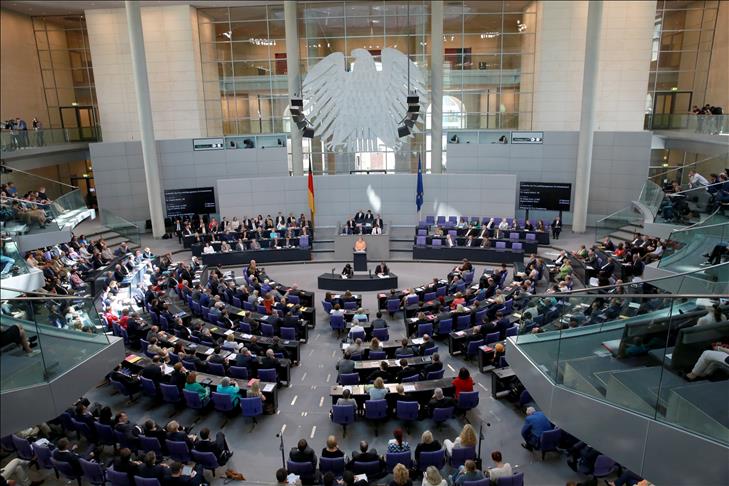
The German parliament on Friday approved the start of negotiations with Greece for an 85 billion euro ($93 billion) conditional bailout program, local media reported.
A total of 439 German lawmakers voted in favor of a government motion demanding a mandate to enter negotiations on a third bailout program for Greece, with 119 lawmakers voting against and 40 abstaining.
Chancellor Angela Merkel’s conservative-left coalition government, which has a strong majority in the 631-seat Bundestag, supported the bailout.
Germany's main opposition Left Party voted against the proposal while a majority of opposition Green Party lawmakers abstained.
The vote also revealed growing discontent at Merkel’s handling of the crisis within the ruling party.
Sixty lawmakers from the chancellor’s Christian Democrat bloc voted against the bailout, according to German news agency DPA, marking the biggest rebellion to date over a bailout deal.
Merkel told lawmakers ahead of Friday’s Bundestag vote that a conditional third bailout was important to avoid deeper economic and political crisis in Greece and to keep the country in the eurozone.
She defended the agreement reached between European leaders and Greek Prime Minister Alexis Tsipras in Brussels earlier this week after more than 17 hours of negotiations.
“If we had given up and did not give a last try to bridge our differences with Greece, it would mean leaving the country bleed to death in front of our eyes, with people not being able to get any more money, which could have resulted in chaos and violence,” Merkel said.
She argued that Germany has acted in line with the EU’s principle of solidarity, adding that she also expected the Greek government to understand its responsibilities and implement austerity measures.
Merkel stressed that the idea of a temporary exit of Greece from the eurozone, floated this week by Finance Minister Wolfgang Schauble, was not an option unless requested by Athens.
“The way we opted for can clearly be differentiated from the so-called 'time-out', which cannot be decided against the will of Greece," Merkel said.
"This can only be possible with the agreement of Greece and the 18 other members of the eurozone. Neither Greece, nor the other 18 members signaled [their] readiness for that so that option was not conceivable.”
Germany’s opposition parties criticized the government for imposing strict austerity measures and threatening Athens with a possible exit from the eurozone.
Left Party leader Gregor Gysi said the policies pursued by Schauble and supported by Merkel and Economy Minister Sigmar Gabriel were anti-European, undemocratic and anti-social. He accused Schauble of “destroying the idea of Europe”.
He added: “The three of you are making the greatest failure of your political careers.”
Gysi said the demands of the EU and international creditors - strict austerity measures, cuts in wages and pensions and tax rises - would worsen Greece’s economic situation and called for stimulus measures to boost growth as well as a debt cut.
Greens leader Katrin Goring-Eckardt backed his suggestions. “Not only the IMF [International Monetary Fund], but almost all economists are saying that Greece needs debt reduction and it needs long-term investment,” she said.
European leaders and the Greek government agreed on a conditional bailout deal on Monday in hope of preventing the country going bankrupt.
The EU agreed to begin formal negotiations on a new bailout on condition the Greek government passed four key bills to streamline sales tax, broadening the tax base, make key pension reforms and introduce spending cuts.
As part of the deal, Greek government assets will be privatized to create a 50 billion euro ($54 billion) fund for recapitalizing Greek banks and investing in the country's economy.