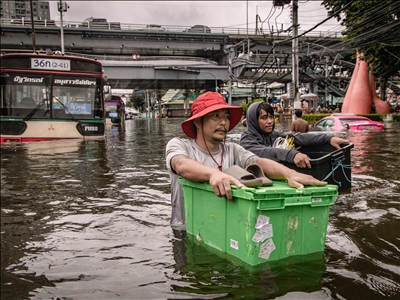
Floods affect over 2.6M people across Thailand


The Paris Agreement was adopted by 195 countries on 12 December 2015, at the 21st Conference of the Parties (COP21) to the United Nations Framework Convention on Climate Change (UNFCCC) held in Paris, France.
Aiming to keep the global average temperature rise well below 2°C above pre-industrial levels, and to limit it to 1.5°C if possible, the agreement entered into force on 4 November 2016, after meeting the condition of ratification by at least 55 parties accounting for 55% of global greenhouse gas emissions.
Distinguished as the first international agreement to enter into force less than a year after its adoption, the Paris Agreement brought all parties together to combat climate change with binding provisions for the first time.
In the context of combating the climate crisis, the Paris Agreement established a framework for implementation regarding issues such as national contributions, mitigation, adaptation, loss and damage, finance, technology development and transfer, capacity building, transparency, and the global stocktake.
Climate finance provided to countries in need
The agreement is built on a five-year cycle of climate actions carried out by party countries. In this framework, countries have been submitting their Nationally Determined Contributions (NDCs) since 2020, covering more ambitious targets compared to previous versions. In their NDCs, party countries report their steps to reduce greenhouse gas emissions to achieve Paris Agreement targets and to build resilience to adapt to climate change impacts.
Support for financial, technical, and capacity building is offered to countries in need. While it is emphasized that developed countries should take the lead in providing financial assistance to lower-income and more vulnerable countries, voluntary contributions are also encouraged. At this point, climate finance is considered necessary for reducing emissions, as large-scale investments could play a significant role in this regard.
Considering that developing countries do not have enough capacity to address many challenges posed by climate change, the Paris Agreement attaches great importance to climate-related capacity building for these nations, and all developed countries are requested to increase their support for capacity-building actions in developing countries.
Since the agreement entered into force, low-carbon solutions and new markets have emerged. As more countries, regions, cities, and companies have started to set carbon-neutral targets, zero-carbon solutions have become competitive in economy sectors that account for 25% of emissions. The current trend is most evident in the energy and transportation sectors. Zero-carbon solutions are expected to become competitive in sectors representing more than 70% of global emissions by 2030.
Global Stocktake
The first “Global Stocktake,” evaluating the progress of the Paris Agreement, was completed at COP28 in 2023.
At COP28, agreement was also reached on the Loss and Damage Fund, which had been demanded for years by developing countries struggling to cope with the destructive impacts of climate change.
Enhanced transparency framework
Under the Paris Agreement, the Enhanced Transparency Framework also entered into force as of 2024. Under the framework, parties are required, starting in 2024, to provide transparent reports on actions taken and progress made on climate change mitigation, adaptation measures, and support provided and received.
Türkiye’s participation in the Paris Agreement
Türkiye signed the Paris Agreement on April 22, 2016, during the High-Level Signing Ceremony held in New York, together with representatives of 175 countries.
The agreement was approved by a presidential decree on October 7, 2021, completing the domestic ratification process. The instrument of ratification, together with Türkiye’s national statement, was submitted to the UN Secretariat on October 11, 2021.
US withdrawal from the Paris Agreement
US President Donald Trump, who repeatedly stated he did not believe in climate change and remained distant from COP summits, signed a decree foreseeing his country’s withdrawal from the Paris Agreement before COP23 in 2017.
Joe Biden, who assumed the US presidency in 2021, announced the country’s re-entry into the Paris Agreement and pledged to cut methane emissions by 30% by 2030.
However, after being elected US president for a second term, Donald Trump withdrew the country from the Paris Agreement once again upon taking office in 2025. The Washington administration informed the UN in a letter that the United States would cease to be a party to the Paris Climate Agreement as of January 27, 2026.