

ANTALYA
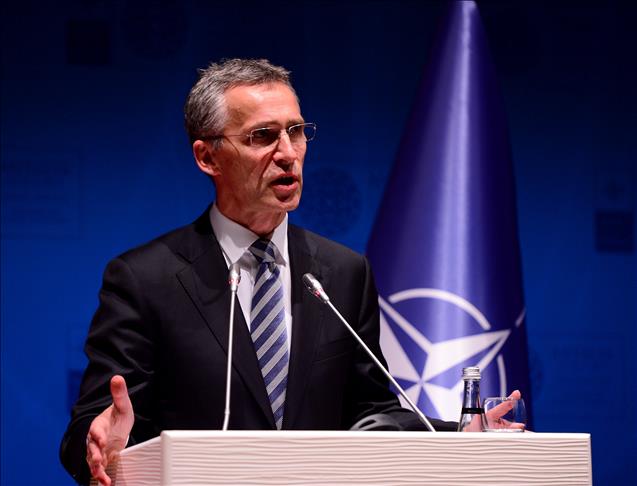
NATO will maintain its presence in Afghanistan even after the end of its current mission, the NATO Secretary-General Jens Stoltenberg said on Wednesday.
"Today, we agreed that we will maintain our presence in Afghanistan even after the end of our current mission," Stoltenberg told the press at the NATO foreign ministers meeting in Turkey's southern province of Antalya.
The current mission, known as "Resolute Support," is a NATO-led, non-combat mission. It was launched on January 1, following the conclusion of the previous NATO-led International Security Assistance Force mission.
NATO's presence in Afghanistan from 2015 consists of three inter-related components. A NATO-led "Resolute Support" mission to train, advise and assist the Afghan security forces, a contribution to the broad effort of financial support of Afghan security forces, and a strengthened NATO-Afghanistan "Enduring Partnership."
"Our aim would be to advise Afghan security institutions to help them become self-sufficient and to build on what we have achieved so far as part of a broader international effort," said Stoltenberg.
"There are still many challenges and difficulties ahead. But I am confident that the Afghan people will rise to the challange and we will continue to stand with them," he added.
Stoltenberg said NATO and its partners will continue to support Afghan forces and Afghanistan.
"We will continue to support Afghanistan with the "Enduring Partnership" mission, which is going to follow the "Resolute Support" Mission," he added.
"Enduring Partnership" is a project that NATO will launch later on, Stoltenberg said. "We have not yet defined all the concerete content of 'Enduring Partnership.'"
"It is going to be a civilian-led partneship. That is something new. Because the ISAF mission and the present "Resolute Support" mission is military led. It is led by a military commander," he said.
He also said they have not decided on the exact number of personnel who are going to be in Afghanistan.
"We have to make sure that we are able to defend all of our allies. That is the reason why we increased our military presence in the Eastern part of the alliance. What we do is defensive. It is proportionate and it is fully in line with our international commitments," he added.
NATO backs Ukraine's territorial integrity
Meanwhile, NATO Secretary-General Jens Stoltenberg reiterated NATO's strong commitment to an independent, peaceful and prosperous Ukraine and Ukraine's sovereignty and territorial integrity.
Stoltenberg said: "We reaffirm our strong support for the settlement of the conflict in eastern Ukraine by diplomatic means and by dialogue."
"We see continued violence and also continued Russian support for the separatists to destabilize Ukraine," said Stoltenberg.
He added: "We call on all sides to comply with the Minsk agreement and to ensure the OECD monitors to do their work." Stoltenberg also said Russia has a "special responsibility" in this respect.
At the NATO foreign ministers meeting, U.S. Secretary of State John Kerry said in the early morning: "I think that there is strong agreement among all the NATO members that this is a critical moment for action by Russia, and by the separatists to live up to the Minsk agreement."
A cease-fire agreement, known as the Minsk accord, was signed between Ukrainian government forces and the rebels in Belarus' capital Minsk on Feb. 12, which included the withdrawal of heavy weaponry from combat areas, the withdrawal of all foreign-armed formations and the release of all hostages and unlawfully detained persons, as well as political reforms and decentralization in the eastern Ukrainian regions.
Stoltenberg said successful reforms will be crucial for stability and progress in Ukraine.
Fighting in eastern Ukraine has left more than 6,000 dead since April 2014, according to the UN. Russia annexed the Crimea in March of last year.


Morning Briefing: March 31, 2026
Azerbaijan and Iran’s foreign ministers express ‘deep concern’ over escalating tensions in Middle East
2 large Chinese container ships transit Strait of Hormuz in 2nd attempt amid Mideast conflict
Tanker struck by projectile near Dubai, investigation underway: UKMTO
At least 70 killed, 30 wounded in Haiti gang 'massacre,' rights groups say
