
In Selma, Obama says march for rights not yet over
“From the streets of Tunis to the Maidan in Ukraine, this generation of young people can draw strength from this place.”
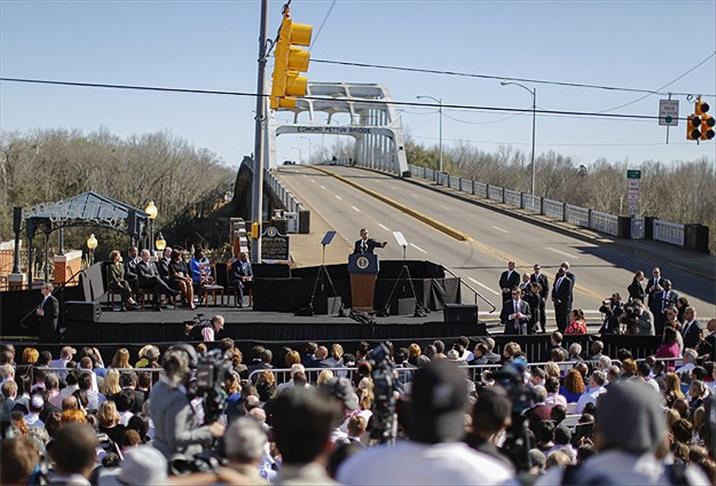
WASHINGTON
President Barack Obama told thousands of people gathered in Selma, Alabama to mark the 50th anniversary of “Bloody Sunday” that the nation’s racial history “still casts its long shadow upon us.”
“We know the march is not yet over. We know the race is not yet won,” the nation’s first black president said Saturday in front of the Edmud Pettus Bridge.
Also in New York, a racially mixed crowd of around 250 people marched across the Brooklyn Bridge on Saturday, walking in the "Selma is Everywhere" march and shouting slogans that invoked recent police-involved killings of Michael Brown in Missouri and Eric Garner in New York.
They carried placards emblazoned with an iconic photo from a Selma solidarity march in Harlem in 1965, which showed protesters carrying a massive sign reading "We march with Selma."
Hundreds of voting rights activists were attacked by Alabama state troopers a half-century ago while trying to cross the fateful bridge during a march on the Alabama state capital, Montgomery, for voting rights.
“The Americans who crossed this bridge, they were not physically imposing. But they gave courage to millions. They held no elected office. But they led a nation,” Obama, who was joined by his family and former President George W. Bush, said. “We gather here to honor the courage of ordinary Americans willing to endure billy clubs and the chastening rod; tear gas and the trampling hoof; men and women who despite the gush of blood and splintered bone would stay true to their North Star and keep marching towards justice.”
Rather than deter activists, the brutal crackdown attracted many others from across the country who joined in the cause, and shortly thereafter culminated in the passage of the milestone Voting Rights Act. The act prohibits racial discrimination at polling stations.
It took activists three attempts to finally reach Montgomery.
“From the streets of Tunis to the Maidan in Ukraine, this generation of young people can draw strength from this place, where the powerless could change the world’s greatest power and push their leaders to expand the boundaries of freedom,” Obama said.
The Selma anniversary follows the Justice Department’s recent conclusion of an investigation into the Ferguson, Missouri police, judicial and penal systems that exposed widespread racial discrimination against blacks in the St. Louis suburb.
Despite the searing report that harkens back to the discrimination faced by blacks a half-century ago, Obama rejected the notion that nothing in America has changed since then.
“What happened in Ferguson may not be unique, but it’s no longer endemic. It’s no longer sanctioned by law or by custom. And before the Civil Rights Movement, it most surely was,” he said to applause. “If you think nothing’s changed in the past 50 years, ask somebody who lived through the Selma or Chicago or Los Angeles of the 1950s.
"Ask the female CEO who once might have been assigned to the secretarial pool if nothing’s changed. Ask your gay friend if it’s easier to be out and proud in America now than it was thirty years ago. To deny this progress, this hard-won progress -– our progress –- would be to rob us of our own agency, our own capacity, our responsibility to do what we can to make America better."
On his way to Selma, Obama signed legislation that awarded the Congressional Gold Medal to the Foot Soldiers who participated in the Selma voting rights demonstrations.
Following his speech, Obama joined First Lady Michelle Obama, their daughters, former president Bush, and First Lady Laura Bush, and some of the original foot soldiers in a march across the iconic bridge.
Anadolu Agency website contains only a portion of the news stories offered to subscribers in the AA News Broadcasting System (HAS), and in summarized form. Please contact us for subscription options.