
MOSCOW
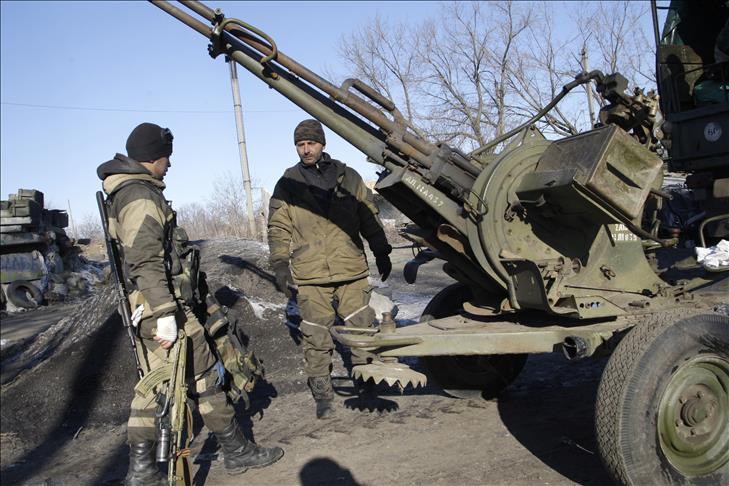
Ukraine’s military has announced its withdrawal of heavy weapons from the front line in the east of the country in line with a peace deal struck in Minsk earlier this month.
"Carrying out the agreements reached in Minsk on February 12, Ukraine begins the withdrawal of guns of 100mm or greater caliber from the front lines," a statement from the Ukrainian military’s press bureau said on Thursday.
"This is the first step to the removal of heavy weapons, which will be exclusively monitored and verified by the OSCE," it added.
The statement also warned that in the event that separatist forces launch any attacks, the timetable of the removal of heavy weapons will be "adjusted."
Removing heavy weapons from the line of contact in eastern Ukraine is the second point stipulated in the so-called Minsk II agreement signed on 12 February, the first point being a total cease-fire.
The agreement requires both sides to remove all artillery of 100mm caliber or greater, as well as multiple rocket launch systems such as the BM-21 "Grad," BM-30 "Smerch," and the BM-27 "Uragan."
Both Kiev and pro-Russia separatists have repeatedly accused each other of causing civilian casualties by shelling populated areas with such artillery systems.
Government and separatist forces have reported numerous violations of the cease-fire that had been set to begin at midnight on 15 February, although the number of attacks decreased significantly after Ukrainian forces withdrew from the surrounded city of Debaltseve last week.
Separatist leaders have issued statements claiming to have begun the withdrawal of their heavy weapons, but the OSCE has yet to confirm their claims.
Government seeks to save economy amid respite
Ukraine is looking to patch up its battered economy during a short respite in fighting in its eastern regions, but fears of further attacks by pro-Russian separatists are growing.
With Ukrainians rushing to buy whatever they can as currency panic hits the country, the government is struggling to service its outstanding debt of $20 billion.
Ukrainian hryvnia, already the world’s worst-performing currency, fell to a new low of 33.5 against the dollar Tuesday and with its hard currency reserves now below $10 billion, the central bank lacks resources to defend the currency.
Ukrainian Ambassador to Turkey Sergiy Korsunsky told The Anadolu Agency on Thursday that President Petro Poroshenko had worked with the central banker and the finance minister to draft measures to support the hryvnia. The International Monetary Fund, has offered a $40 billion loan package.
Korsunsky said: "Parliament should take action to implement the IMF agreement in early March.
"The funds from this agreement are needed badly to help support the economy and the currency."
- Massed troops
But as Kiev grapples with the economy, pressure is again building in eastern Ukraine.
Separatists are currently massed not far from the strategic port city of Mariupol.
Having taken two villages as of Thursday situated inside the mutually agreed buffer zone agreed between Russia and Ukraine under the Minsk cease-fire agreement signed on Feb. 12, their forces are now closer to the northern extremities of the port city -- the second largest city in the Donetsk region.
Korsunsky said: "There is some evidence that rebels are following the agreement and there have been no casualties on our side for two days.
"On the one hand, fighting has stopped overall, and this is good news. On the other hand, we are very concerned about the continuing buildup of Russian troops and munitions at our borders."
He went on: "Mariupol is safe for now. We had to build up a substantial defense there.
"But the massing of rebel and Russian troops close to Mariupol could be the preparation for another attack after some time."
- 'Shaky' truce
A number of European leaders including British Prime Minister David Cameron, and French Foreign Minister Laurent Fabius have warned an attack on Mariupol by the separatists would trigger an immediate extension of economic sanctions against Russia.
"If there is an attack on Mariupol, then Minsk II is finished," Korsunsky said.
Russian authorities have confirmed the cease-fire is holding, although it is "still shaky."
And Ukraine may have limited time in which to tackle its economic problems.
Eastern Europe expert Mark Adomanis wrote: "Unless the West steps in to massively aid Ukraine’s economy in the very near future, the country will simply not be able to afford the 'anti-terror operation' in the east."
Measures taken by the Ukrainian Central Bank to help the economy have been ineffective so far.
- Plunging currency
In the fourth quarter, economic growth in Ukraine was at minus 15.2 percent, down from the previous quarter's reading of minus 5.1 percent, as well as missing estimates for minus 6.2 percent.
Economic growth has fallen since 2012 from more than five percent annually to negative levels.
The central bank banned currency trading in the hryvnia Wednesday, only to relax the ban Thursday as the currency continued its plunge.
Given its precarious state finances, Ukraine’s ability to do intervene in the economy has always been constrained.
But with its reserves below $10 billion, being saddled with $20 billion of debt and facing the possibility of renewed fighting, it could be about to run out.
Anadolu Agency website contains only a portion of the news stories offered to subscribers in the AA News Broadcasting System (HAS), and in summarized form. Please contact us for subscription options.