
BRUSSELS
NATO member countries have approved an interim rapid reaction force to respond to Russian threats in and around Ukraine.
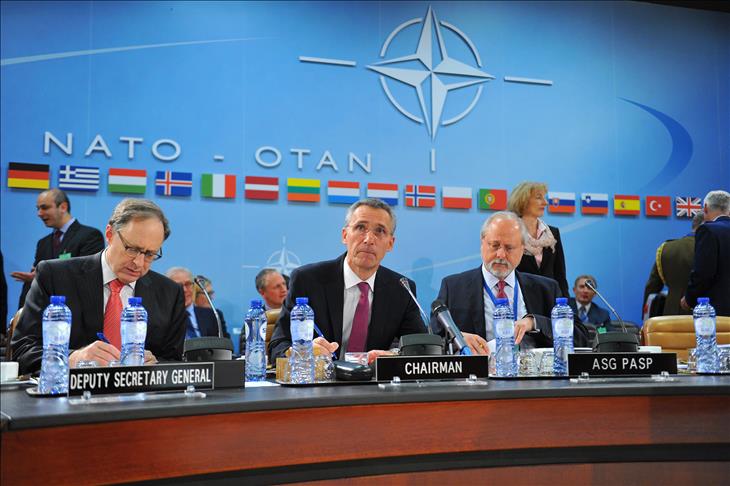
Foreign ministers from 28 NATO member countries announced in Brussels Tuesday that the interim rapid force would become operational in 2015.
The foreign ministers also agreed that NATO would maintain its presence in the eastern part of Ukraine through next year.
This is “the biggest increase in our collective defense since the end of the Cold War,'' NATO Secretary-General Jens Stoltenberg said.
The implementation of the reaction force has already begun through an increased presence in the air, at sea and on the ground in the eastern part of the alliance, the secretary-general added.
Ministers also discussed a Spearhead Force, set to be ready in 2016 and financed by contributing nations, which would enable NATO to meet any threats from wherever they may come, according to Stoltenberg
The Spearhead Force, comprising troops mainly from Germany, the Netherlands and Norway, will be able to deploy within a few days.
''The Russian military has shown that they are able to mobilize, concentrate and deploy up to an army size force within a few days - even within 72 hours,'' Heinrich Brauss, NATO Assistant Secretary-General for Defense Policy and Planning, told reporters in Brussels Tuesday.
Foreign ministers of NATO member states and Ukraine also condemned Tuesday Russia’s military build-up in Crimea and its reported deliberate destabilization efforts in eastern Ukraine.
The alliance accuses Moscow of providing pro-Russian rebels in eastern Ukraine with tanks, advanced air defense systems and other heavy weapons – allegations that Russia denies.
NATO also announced Tuesday that trust funds aimed at providing Ukraine with logistics and standardization, cyber defense, military career transition and medical rehabilitation remained operational.
“They will help make Ukraine’s defense forces more modern, more transparent, and more effective. And they will help some of those affected by the conflict,” NATO Secretary-General Jens Stoltenberg said after a meeting of the NATO-Ukraine Commission.
Anadolu Agency website contains only a portion of the news stories offered to subscribers in the AA News Broadcasting System (HAS), and in summarized form. Please contact us for subscription options.