
By Brent Crane
LAIZA
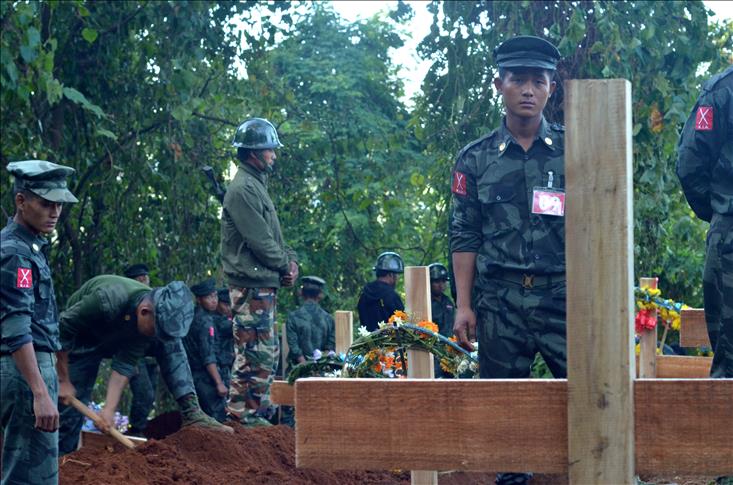
Soldiers in sweat-stained camouflage fatigues pant as they force shovels and pickaxes into the red jungle earth. The dirt thumps as it falls onto the plywood caskets of their fallen brethren.
It is not yet nine o’clock Thursday in northeastern Myanmar and several dozen fighters from the Kachin Independence Army, known as the KIA, are burying 23 cadets killed a day earlier in the worst single blow to the rebel army’s ranks in three years.
The KIA, formed in 1961, is Myanmar’s second largest ethnic army and the only group without a bilateral ceasefire agreement with the central government. Myanmar has at least seventeen armed ethnic groups and the estimated 8,000-strong KIA has been fighting the Burmese army, known as the Tatmadaw, in a slow-burning conflict for nearly six decades.
They are fighting for genuine autonomy within a federalized state and for control over Kachin state’s bountiful natural resources, such as teak and jade.
A 17-year ceasefire was broken in 2011 when government forces attacked KIA troops. Since then, nearly three hundred Kachin soldiers have died in hit-and-run fighting, according to a statement made in April by KIA Deputy Commander-in-Chief General Gun Maw.
Wednesday’s unprovoked attack occurred at 12:35 local time (08.05 Turkish time) at an officers’ training academy, according to a KIA statement. The academy, located on a heavily forested mountain, is 5 kilometers outside Laiza, a border town that serves as the rebels’ headquarters.
The mostly Kachin community, which has a population of around 5,000, sits on the border of China’s Yunnan province, separated only by the 16 meter wide Je Yan river. Though it has developed independently of central government control, Laiza is a fully functioning town with gas stations, two libraries, a movie theater, a football field, schools, churches and numerous eateries. It is run by the Kachin Independence Organization, the political wing of the KIA.
On its outskirts are four refugee camps, full of mostly rural Kachin who have been forced out of their homes by fighting and alleged Tatmadaw raids. Je Yang, the largest of the four camps, holds 8,000 people according to Zau Rau, the head of the IDPs and Refugees Relief Committee, a KIO body that runs the camps.
The attack came as a surprise to everybody. Captain Lawt Ning Li, an officer at the training academy, told Anadolu Agency that a single 76 millimeter artillery shell was launched by Burmese forces occupying a mountaintop position 50 km away. It struck a group of cadets undergoing basic training.
The cadets, all under the age of 25, were marching in formation when the shell hit. They had only been at the academy for nine days. Along with the 23 cadets killed, 16 cadets and four officers were also injured in the attack. The rebels did not return fire, Ning Li said.
Kachin State Security Minister Colonel Than Aung later told a press briefing held in Myitkyina that the shell had been intended as a warning shot.
The attack came six days after the end of the Association of South East Asian Nations summit held in Myanmar’s capital Naypyidaw, where world leaders discussed issues related to the region’s economic, social and security development.
The summit host has been in the throes of a fledgling democratization process that began in 2011 when a decades long military junta relinquished power to a quasi-civilian government.
U.S. President Barack Obama, who attended the conference, has positioned Myanmar’s political development as one of the key foreign policy goals of his presidency. Yet in many areas Myanmar has faltered and in some respects has even, as Obama admitted in an interview with Myanmar’s Irrawaddy magazine, gone backwards.
The government’s involvement in the Kachin conflict has followed a particularly degenerative path, with accusations of human rights abuses against civilians by the Tatmadaw. Acts of violence such as torture, the torching of villages, rape and extrajudicial executions have been widely reported.
During his visit to the country, Obama appealed for the government to push forward on peace talks with the Kachin.
Yet given the wide gap between the government’s words and the army’s actions, many analysts believe Myanmar President Thein Sein does not have the solid grip on the country’s armed forces that was previously believed.
Certainly for the soldiers laying soil over the coffins of those killed in yesterday’s attack, peace must seem a long way away.
Anadolu Agency website contains only a portion of the news stories offered to subscribers in the AA News Broadcasting System (HAS), and in summarized form. Please contact us for subscription options.