
Thai central bank cautious on junta’s economic policy
Bank's governor warns junta not to get carried away in efforts to extinguish ousted government’s 'populist' economic policies
BANGKOK
In its first public assessment of the Thai junta's economic policy, the country's central bank has expressed cautious optimism for an upturn in the economy, while warning the regime not to get carried away in its efforts to extinguish the ousted government’s "populist" economic policies.
Prasarn Trairatvorakul, the governor of the bank - a staunchly independent institution - told reporters late Thursday night “There is cause for short term optimism.”
“We see a restart of government spending. The plan for public investment in infrastructures is now back on track and the 2015 budget will be ready in time which is a big relief,” he added.
Prior to the May 22 coup, seven months of massive anti-government demonstrations left the elected government of Yingluck Shinawatra paralyzed when it came to the economy, particularly after the December 9 dissolution of Parliament which left the administration with limited authority. Government projects were blocked, domestic consumption collapsed and exports – which contribute 60 percent to the Thai GDP – weakened. In the first quarter of 2014, the economic growth rate shrank 2.1 percent compared to the previous year.
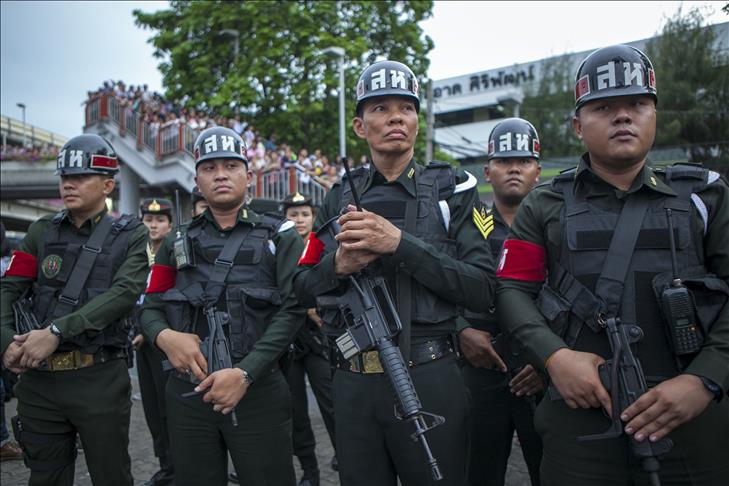
Since the coup, the junta has quickly taken control of the economy, overhauling the boards of state enterprises, cancelling some government mega-projects -- such as a high-speed train scheme -- and pledging to eradicate corruption in public ventures. General Prayuth Chan-ocha, the junta chief, has appointed himself chair of the government committee in charge of granting tax and other privileges to foreign investors.
Trairatvorakul said the shake-up of the economy has been well received by the business community.
“The business sentiment had declined in the past six months, but there is now a turn-around. From this quarter onwards, we expect a clear pick-up in growth,” he said, predicting a 1.5 percent growth in GDP for 2014.
Trairatvorakul underlined that the regime hadn't -- so far -- “exerted any pressure on him” to influence bank policy, but warned the generals “to avoid being the source of harm.”
“Less monetary discipline would be associated with hyper-inflation,” he warned.
Thailand's central bank has a long tradition of independence from political power. It usually sticks to a conservative policy emphasizing strict fiscal discipline and a tight control of monetary policy. Under Yingluck's ousted government, Trairatvorakul has said he doggedly resisted pressure from the finance ministry to cut down interest rates to energize domestic consumption.
He also questioned the junta's all-out offensive against the populist policies of the former government, warning that withdrawing those specifically composed to help rural communities could create problems.
“If they want to withdraw populist policies, and there is no alternative for the people in the countryside, that will be tough," he stated.
One of the junta's first moves was to scrap the government's much criticized rice-subsidies scheme. The scheme -- under which farmers were paid 50 percent more than market price for their crop -- had led to a loss in export market share, had mass funding problems, and had suffered constant allegations of corruption.
"The [replacement] assistance [to farmers] currently extended by the authorities [junta] is much smaller,” Trairatvorakul said. “If authorities cut the price from 15,000 baht [$460] per ton of rice, to 8-9,000 baht, I doubt they will be able to keep peace and order.”
Trairatvorakul also criticized the junta's rush to pay back farmers still waiting for their dues under the scheme -- it paid out $2.7 billion in the first few days after the coup.
“Actually, a major part of this money went to the rice-millers from whom the farmers had already taken their dues," he said, and then challenged the military to come up with a better solution.
"The question is, with limited state resources, can you [the military] find a better use for the money?” he asked.
He also warned the junta against dismantling “village funds.” The funds were first created in 2001 by former Prime Minister Thaksin Shinawatra, and then reactivated around 5 years later by his sister Yingluck's incoming government, which was recently overthrown.
The funds allow villagers to borrow money to finance small companies, such as mobile phone shops or food stalls.
“According to our research, these funds are generally successful. They don’t aim at stimulating consumption but they provide capital for the people to invest,” said Trairatvorakul.
Many analysts have said that even though the Shinawatras rose to power on a wave of populism, their strategies did enable a working class workforce -- which previous governments had little time for -- empowering them to think about their vote and the importance of democracy.
Prior to what became known as "Thaksinomics," elections saw rural voters rewarded with around 500 baht from the village headman, along with an instruction which box to tick. Thaksin's policies caused villagers to think more about where their vote was going, empowering them to make their own choices.
Likewise, the "village funds" took power away from local moneylenders -- often under the protection of village headman -- giving villagers access to legal loans, rather than relying on local loan sharks and the exorbitant interest rates they charged.
Anadolu Agency website contains only a portion of the news stories offered to subscribers in the AA News Broadcasting System (HAS), and in summarized form. Please contact us for subscription options.