


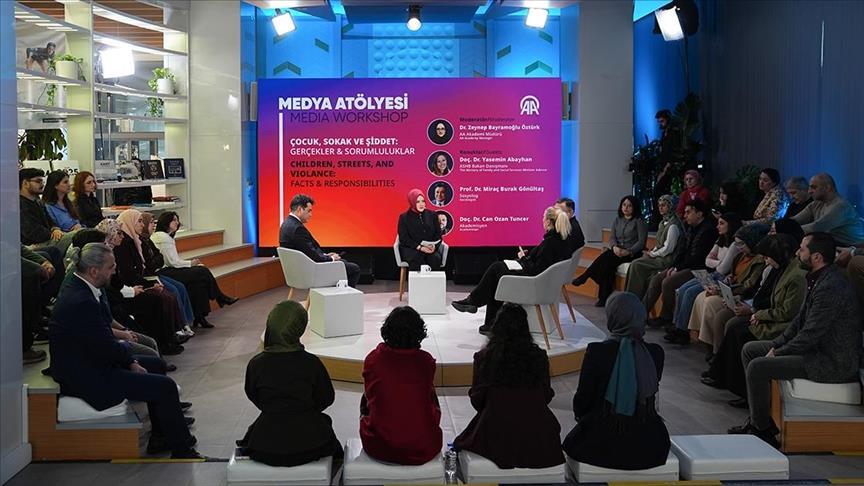
The session moderated by Dr. Zeynep Bayramoğlu Öztürk, AA Academy Manager, held at AA Istanbul International News Center, addressed the issue of children and street violence in its social, psychological, and structural dimensions.
Speaking at the session, which discussed why children turn to violence, how street violence is produced, and how this process relates to family, school, poverty, migration, social exclusion, and environmental conditions, Associate Professor Yasemin Abayhan evaluated the concept of “juvenile pushed to crime.”
Abayhan stated that in assessing the phenomenon of crime, the decisive factor is whether the individual acts with knowledge and foresight of the consequences of their actions.
Noting that in some cases, individuals may engage in behavior without being aware of the consequences it will bring about, Abayhan explained that in such processes, it is possible to speak of a drift that arises from environmental conditions, the context in which one finds oneself, and guiding factors, rather than individual will.

Abayhan asked, "Where do we say ‘delinquent child’? Or should we say delinquent child? If the child repeatedly commits the crime, if there is a pattern of behavior, if the child does this despite being aware of the consequences of the behavior, if the child continues to do this despite having previously been in the penal system, then we can talk about a delinquent child in a process of taking responsibility for their actions rather than being dragged along."

Associate Professor Can Ozan Tuncer, who touched upon the issue of digitalization in relation to juvenile crime, stated that digitalization has engulfed the era, creating an environment that pushes children into a climate and ecosystem of crime through involvement, interference, or exposure.
Tuncer also touched upon the digital gains of the era, stating, "There are new platforms. With very few tools, just a phone, network-based approaches, and a narrow network, a child can very quickly become involved in a crime, even without family pressure. Therefore, I believe that the pressure established by the literature, the rapid pace of time, and the significant narrowing of the transfer of developments between generations require us to redefine the child in the eyes of the law. So, yes, a child is a child, but there is a ‘new childhood’ state."
Tuncer said the following regarding “gang formation” in juvenile crime:
"Now there is a concept called ‘new generation gangs’. Looking at it, the motivations of children to get involved in crime and join organized crime groups have changed significantly from the motivations of similar organized crime and involvement in crime in the past. When you examine these new generation gangs, when you examine their profiles individually, they are designed to capture the gaps in society, childhood states, that is, all the empty states of the child. Let's say there are malicious individuals in the setup, and they can organize very quickly."
Speaking about Assoc. Prof. Tuncer's assessments, Abayhan noted that the World Health Organization is re-discussing its definitions of developmental stages, saying, "According to previous studies, brain development was considered complete at 18-19. But new studies say it extends to 20-25. There is extended adolescence. So, perhaps when we say that childhood is one thing, the onset of adolescence is another, and the transition from adolescence to adulthood is yet another, we may be able to resolve some of this confusion."

“Antisocial behaviors are precursors to crime”
Sociologist Prof. Dr. Miraç Burak Gönültaş, who commented on the issue during the program, explained that juvenile delinquency had not been on Türkiye's agenda for many years and that it was suddenly confronted with this issue.
Gönültaş said, "We define children based on Article 1 of the Convention on the Rights of the Child, which states that ‘every individual under the age of 18 is a child.’ Naturally, this is what comes to mind when we talk about juvenile delinquency. Of course, in legal definitions, there is also a definition of juvenile delinquency, particularly in the definition of ‘juvenile pushed to crime,’ which describes the processes after they enter the criminal justice system."
Prof. Dr. Gönültaş commented on the future implications of children's involvement in crime, stating, “Criminality that begins in childhood increases the likelihood of both chronicity and recidivism. Here, in child delinquency, what we see most, both in our fieldwork and academically, are socialization problems.”
Gönültaş, who stated that antisocial behavior emerges when children do not follow the rules, said, "We were children and teenagers too, and we engaged in antisocial behavior, but the people around us warned us, saying, 'Don't do that, it's wrong. ' What did we do? We corrected our behavior, obeyed the rules again, and became part of society. But unfortunately, when conditions become even more adverse, some children can take these antisocial behaviors to more critical levels. If the necessary interventions are not made when antisocial behaviors occur, if the necessary things are not done, there is a possibility that they will turn into what we call ‘destructive, disruptive behaviors.’".
Gönültaş emphasized that frequent lying, conflict with authority, substance use, running away from home and school, and staying out late at night are antisocial behaviors, saying, “These are not defined as crimes punishable under the Turkish Penal Code, but unfortunately, these are the foundation of the crimes, and antisocial behaviors are their precursors' .”
The event concluded with the Q&A session.
