Türkiye's livestock waste offers major untapped energy potential



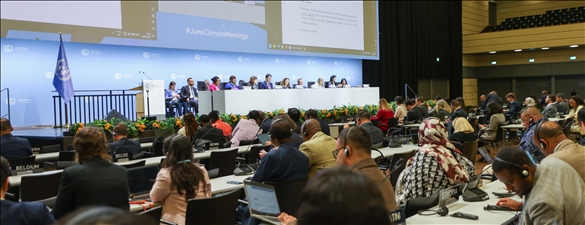
While a roadmap for phasing out fossil fuels had been expected at the 30th Conference of the Parties (COP30) to the United Nations Framework Convention on Climate Change (UNFCCC), held in Brazil, the final text did not include a clear statement regarding this issue.
However, negotiations led by Minister of Environment, Urbanization and Climate Change Murat Kurum at COP30 resulted in the decision for Türkiye to host and preside over COP31 next year.
Speaking to Anadolu, Sahin said COP30, held after the US President Donald Trump withdrew the United States from the Paris Agreement and practically declared war on renewable energy, was a conference where multilateralism was damaged.
COP30 falls short of expectations
Sahin noted that COP30 started “1–0 behind” due to the absence of the United States, historically one of the world’s largest polluters, adding that despite expectations of a highly ambitious presidency by Brazil, the conference did not deliver strong outcomes.
Recalling that Brazil had promoted COP30 as an “Amazon COP” and hosted it in Belém, in the heart of the Amazon region, Sahin said major decisions on reversing deforestation had been anticipated but no roadmap on this issue emerged.
He added that the acceptance of the global goal on adaptation and the work programme regarding the just transition mechanism at COP30, referred to as the "adaptation COP," could be regarded a as positive development, despite its perceived incompleteness.
Countries’ mitigation targets slowed
Sahin stressed that COP30 was critical for the submission of new Nationally Determined Contributions (NDCs), but according to the synthesis report, countries expected to move fastest had instead slowed their pace. Even in a scenario where existing NDCs are fully implemented by 2035, emissions reductions would reach only 12%, he said.
According to the Intergovernmental Panel on Climate Change (IPCC) and considering the 60% reduction commitment endorsed at COP28, Sahin said reductions of just 12%, or even less, made it impossible to evaluate COP30 as a successful conference.
“I believe a step on deforestation can be taken at COP31”
Sahin said competition between Australia and Türkiye during the COP31 host selection process could increase expectations for the conference, adding that he anticipates an ambitious and interesting COP31.
Noting that the Mediterranean theme could feature prominently on the COP31 agenda, Sahin said this was significant given the increasingly strong cooperation among Mediterranean countries and civil society in recent years.
“For instance, there is a claim regarding increasing the renewable energy installed capacity of countries around the Mediterranean to 1 terawatt. I expect this to come to the agenda again due to this COP being a 'Mediterranean COP,' but when we say Mediterranean COP, of course, it also entails adaptation and impact dimensions beyond mitigation, particularly forest fires, heatwaves, and extreme heat. COP30 was not successful enough, especially regarding deforestation. I believe a step can be taken on deforestation at COP31, with Türkiye taking a leading role,” he said.
Sahin also underlined that electrification would be another major topic at COP31.
He added that efforts to transition away from fossil fuels would also be on the agenda and said Türkiye owns this issue and assume a leading role in line with its 2053 net-zero target.
Improvement needed in Türkiye’s national policies
As COP31 president, Türkiye’s steps, especially regarding NDCs, face close scrutiny, says Sahin.
“For Türkiye to demonstrate leadership, it must improve its national policies. Türkiye’s NDC is inadequate; it does not even include an absolute emissions reduction target. That should be the starting point. Beyond that, and perhaps more importantly, Türkiye could reinforce its leadership by announcing a coal phase-out target with a clear timeline. If you look at the Ministry of Energy and Natural Resources’ National Energy Plan, an implicit coal phase-out is already evident. All the figures show coal’s share declining clearly over the next decade. Our studies at the Istanbul Policy Center show that a coal phase-out by 2036 is possible,” he added.