California wildfire forces thousands to evacuate, burns 570 acres


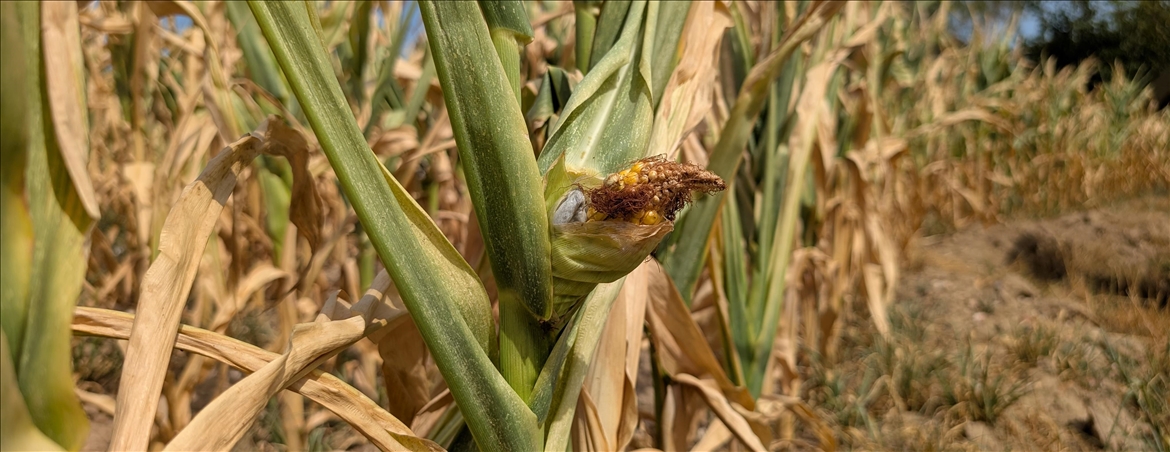
Persistent drought and repeated heat waves are taking a mounting toll on Europe's agriculture and forests, with France facing its worst potato harvest in more than three decades, Switzerland's plan to end additional forest climate funding drawing criticism from environmental groups, and a new European Commission report showing summer crop yields across the bloc down by as much as 14%.
France
France's potato production is expected to fall at least 23% from last year as heat waves and severe drought hit crops, potentially resulting in the lowest yield in more than three decades, local media reported Monday.
France experienced five consecutive heat waves this summer, along with a severe rainfall deficit since late May and historically dry soils, significantly affecting potato crops.
"Last year, we were at just over 43.5 tonnes per hectare in 2025. And this year, for the moment, the projection is around 34.5 tonnes," said Geoffroy D'Evry, president of the National Union of French Potato Producers.
"That's even less than in 2022, when we were already at a historically low yield," he added.
The anticipated decline comes after potato-growing areas were reduced by 10% in France and 11% across northwestern Europe following overproduction in 2025, French broadcaster RFI reported.
The French potato industry estimates that it has suffered nearly €400 million (about $466 million) in economic losses.
"The financial burden of climate change cannot be borne solely by the farmer. All of our buyers and customers need to understand that producing potatoes is expensive and risky," D'Evry said.
He warned that the losses could also affect consumer prices.
Agriculture Minister Annie Genevard announced on Aug. 5 that the government was preparing a "comprehensive plan" to assist farmers affected by repeated heat waves in France and elsewhere in Europe.
The proposed measures include emergency support for farm cash flow, relief on social security contributions, regulatory exemptions and assistance to help the hardest-hit farms resume production.
The government has yet to specify the amount of aid.
Arnaud Rousseau, president of France's largest agricultural union, FNSEA, said on Aug. 8 that the farming sector would need "billions of euros" to recover from what he described as a climate crisis unprecedented in scale and duration.
Genevard said decisions on the allocation of assistance would have to wait until a meeting of prefects scheduled for Aug. 27.
The French Federation of Commerce and Distribution also announced measures to support farmers, including relaxing standards concerning the size and appearance of fruit and vegetables and prioritizing French-grown products.
Switzerland
Switzerland's decision to end additional federal funding for forest climate adaptation from 2027 is raising concern among environmental groups as heat, drought and heightened wildfire risks put growing pressure on forests across the Alpine country.
The decision comes as Switzerland faces another period of intense summer heat, with elevated forest fire danger and restrictions on outdoor fires in parts of the country.
The pressure is not new. Switzerland's 2025 Forest Report, published by the Federal Office for the Environment (FOEN) and the Swiss Federal Institute for Forest, Snow and Landscape Research (WSL), found that forests had suffered significantly over the previous decade from extreme events including heat, drought, storms and harmful organisms, and needed to adapt to climate change to continue fulfilling their functions.
Parliament had previously approved 521 million Swiss francs (over $640 million) for forests for the 2025-2028 period, 70 million Swiss francs more than initially proposed by the Federal Council, with the additional money intended in part for climate adaptation and biodiversity measures.
FOEN told Anadolu in a statement that as part of federal savings measures, the Federal Council decided in 2025 that no additional funds would be allocated to adaptation measures in the forestry sector from 2027, a decision later confirmed by parliament. However, funding for forests will continue.
"Financial resources will nevertheless continue to be made available for forests from 2027, amounting to around 115 million (Swiss francs) per year," FOEN spokesperson Dorine Kouyoumdjian said.
The measure forms part of Switzerland's broader federal budget relief program for 2027-2029. Although parliament reduced the scale of the government's original proposals, the austerity program remains in place. The Federal Council said in June that without the measures, the 2027 budget would face a structural deficit of around 1.3 billion Swiss francs.
Kouyoumdjian said the Federal Council continues to give "high priority" to adapting forests to climate change under its Integrated Forest and Wood Strategy (IFWS) 2050, adopted in December 2025.
Thomas Wirth, biodiversity project manager and forest specialist at WWF Switzerland, told Anadolu that the effects of the current heat and drought could become increasingly visible over the coming years.
"The transformation of the forest is already in full swing due to climate change," Wirth said, warning that bark beetles and other harmful insects are expected to particularly affect weakened conifers, while many beech trees could die within two or three years.
"Without these resources, many forest owners will be left on their own with this task and will hesitate to make the necessary investments," Wirth warned, adding that common species such as spruce and beech are not well equipped to withstand heat and drought, unlike more resilient native species such as oak.
Elena Strozzi, policy project manager for spatial planning and forests at Pro Natura, told Anadolu that climate and other environmental changes are strongly influencing the natural dynamics of Swiss forests.
"We remain convinced that forests can react naturally to environmental and climatic changes, and positively to natural phenomena, including drought," Strozzi said, adding that Pro Natura advocates relying primarily on natural regeneration and self-regulation rather than large-scale intervention.
The organization opposes the "active transformation" of forests through introducing exotic species, warning their long-term effects remain "unknown." Strozzi cautioned against "hyperactivism" involving forced planting, calling instead for diverse forest structures, natural regeneration and native species, as well as protecting forest soils.
European Union
Exceptional heatwaves and dry conditions across Europe severely reduced summer crop yields by up to 14%, a new European Commission report showed on Monday.
The Joint Research Centre's MARS Bulletin highlighted widespread agricultural damage due to hot spells in July and August, with forecasters slashing yield expectations for all summer crops across the EU.
Severe heat stress and exceptional water deficits hit France, Hungary, southern Germany, and northern Italy the hardest. The adverse weather accelerated premature senescence and impaired grain filling for maize, sunflowers, and soybeans.
Soybean yields dropped by 14% compared to the five-year average, while green maize fell by 12%. French farmers faced an unprecedented drought that severely limited crop biomass accumulation, while Hungarian agricultural regions experienced extremely dry weather that destroyed numerous maize and sunflower stands.
Conversely, winter cereals largely escaped the devastating heatwaves because farmers completed harvests earlier in the season. The total EU wheat yield matched the five-year average.
Favorable rainfall in parts of northern and eastern Europe mitigated some of the continental crop losses, with eastern Romanian and Bulgarian croplands seeing near-average weather conditions that supported summer crop development. Meanwhile, locally high temperatures in southern Türkiye caused only limited effects on crop conditions.
The intense drought also deteriorated grassland productivity, raising alarms about fodder supply for livestock across the continent. Meteorologists predicted cooler and wetter conditions for late August, but this relief arrived too late to reverse the sustained crop damage.