Over 1,300 households left without power amid wildfires in France while blazes ease in Spain



Spanish Prime Minister Pedro Sanchez on Tuesday renewed his call for a national pact to address the climate emergency, saying the country was beginning to see "the light at the end of the tunnel" in the fight against the devastating wildfires.
"We are beginning to see the light at the end of the tunnel," Sanchez said during his traditional summer government review press conference, while stressing that authorities must remain vigilant as high temperatures continue across much of the country.
He warned that the heat wave affecting Spain could still complicate firefighting operations in the coming days.
Sanchez said the government had reinforced its personnel and resources to support the autonomous communities, which are primarily responsible for tackling wildfires.
"We have reinforced our resources with more personnel and, of course, with more resources to support the autonomous communities, which are primarily responsible for fighting the fires," he said.
The prime minister also reiterated the need for a broad political agreement on climate adaptation, criticizing those who deny the effects of climate change.
"Denialism is the worst kind of fuel," Sanchez said.
Spain's national weather agency Aemet warned that strengthening southerly winds on Tuesday and Wednesday, combined with high temperatures and low humidity, could complicate efforts to contain active wildfires.
The agency said most of the country would face a very high or extreme wildfire risk as the fourth heat wave of the summer is expected to begin on Wednesday and last at least until Sunday, with temperatures reaching up to 42C (107.6F).
A petition calling for tougher penalties for deliberately setting wildfires and for an urgent national ecological restoration and reforestation plan had gathered more than 45,800 signatures, according to Europa Press.
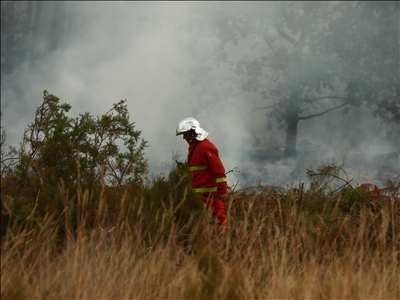
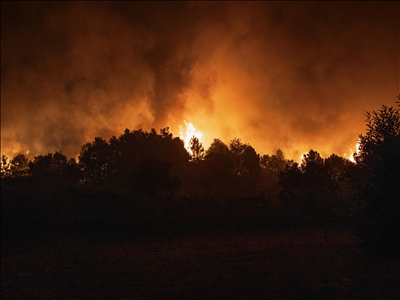
The remarks came as Spain continues to battle multiple wildfires that have burned around 172,400 hectares (425,967 acres) nationwide this year.

Authorities said the largest blazes have scorched approximately 50,000 hectares (123,553 acres) in Avila, around 28,000 hectares (69,189 acres) in the Madrid region and about 8,500 hectares (21,004 acres) in Castellon.
More than 180,000 people have been evacuated or ordered to remain indoors since the fires began, although restrictions have started to ease in some areas.

Red Cross warns new heat wave could worsen wildfires across Spain, France
Echoing those warnings about the incoming heat, the International Federation of Red Cross and Red Crescent Societies (IFRC) on Tuesday said another forecasted heat wave could worsen wildfires across Spain and France, where emergency teams are responding to fast-moving blazes and thousands of people have been forced from their homes.
The federation said in a statement that the humanitarian situation in both countries remains "highly volatile" as fires continue to spread, with evacuations ongoing and emergency shelters and support services under increasing strain.
"The wildfires are not happening in isolation – they come after months of extreme heat and drought," the IFRC said, noting that repeated heat waves since late spring have dried out vegetation and soil, creating conditions that allow flames to spread rapidly.
"This is the pattern we are seeing more and more across Europe: heatwaves, drought and wildfires feeding into one another, and communities bearing the consequences," said Maria Alcazar Castilla, IFRC deputy regional director for Europe.
She said the Red Cross is responding to the immediate emergency, but stressed that sustained investment in preparedness and climate adaptation is needed to help communities better withstand future shocks.
The Spanish Red Cross has mobilized 690 staff and volunteers, supported by 125 vehicles and 27 ambulances, to assist communities affected by fires around Madrid, Avila, Toledo and Castellon, according to the statement. It has opened 78 emergency shelters that have hosted more than 4,400 people.
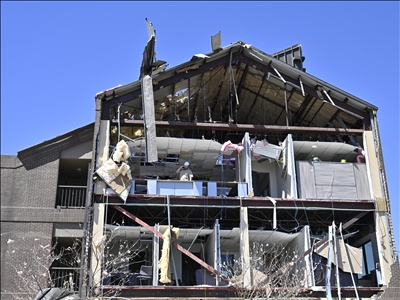
In France, the French Red Cross has deployed more than 300 volunteers from over 60 local branches to support evacuations, provide emergency accommodation and distribute essential relief items, while also preparing longer-term assistance for people whose homes have been damaged or destroyed.