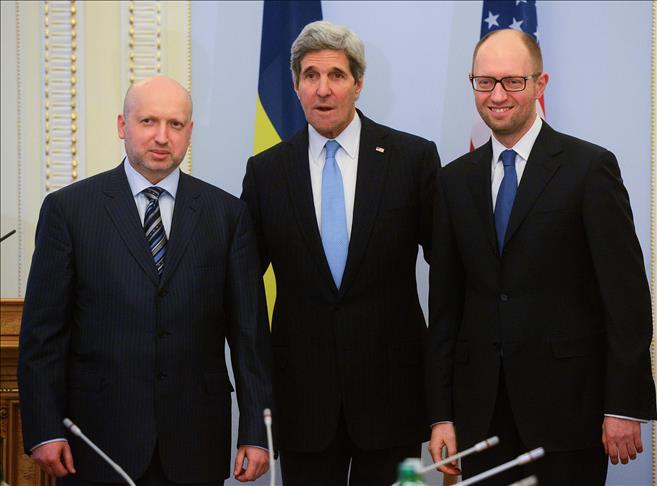
Secretary of State Kerry is to meet senior representatives of Ukraine’s new government. The visit follows Kerry’s description of Russian involvement in Ukraine as a “brazen act of aggression”.
“Russia has engaged in a military act of aggression against another country and it has huge risks. It’s a 19th century act in the 21st century that really puts at question Russia’s capacity to be within the G8,” Kerry told ABC’s George Stefanopulos.
Russian soldiers have taken increasing control of the Crimea region with parliament, government offices, state television, international airport and roads leading to Sevastopol being controlled by pro-Russian forces. Ukrainian police and military buildings have been isolated by Russian soldiers.
"Violence of ultra-nationalists threatens the lives and the regional interests of Russians and the Russian-speaking population", Russia’s Foreign Minister, Sergei Lavrov said on Monday in Geneva, adding that Russian troops were needed in Ukraine "until the normalization of the political situation".
The crisis has sparked a flurry of diplomatic activity ahead of Kerry’s visit, amid of backdrop of economic repercussions which has seen the Russian rouble tumble in value and Brent crude oil prices increase by 1.6 percent to more than US$2 per barrel, on Monday.
France’s Foreign Minister Laurent Fabius said that Paris was not currently thinking about suspending its military agreements with Moscow. “We are not at this stage now. Actually, we are thinking to stop Russia’s military activity in Ukraine and to create dialogue between two parties”, Fabius told RTL.
President of European Commission, Manuel Barroso, said on Monday that European Union must support the sovereignty of Ukraine and European prospects for the Ukrainian population.
“Ukrainians are showing that they belong to Europe culturally, emotionally, but also politically”, Barroso said, speaking in Berlin.
However, Parliamentary Assembly of the Council of Europe (PACE) is going to discuss the political crisis in Ukraine at the forthcoming meeting of PACE’s Standing Committee scheduled in Paris on 7 March.
In addition to diplomatic condemnation, which has seen German Chancellor Angela Merkel attack the ‘complete illegitimacy’ of Moscow’s military build-up in the region, leaders of the G7 nations have agreed to suspend preparations for the G8 summit scheduled to be held in Russia in June.
The European Union's Foreign Ministers have condemned Russia's military action in Ukraine as an "act of aggression" and violation, while urging Russia to withdraw its troops and abide with international law.
The statement says that unless Moscow decreases the tension in Crimea, measures will be taken, such as suspending talks to ease EU visa requirements for Russian citizens.
Speaking in a press conference after one of Monday's EU meetings, EU's Foreign Policy Chief, Catherine Ashton said that "further targeted measures" against Russia would be discussed in the EU leaders' summit, expected to convene on Thursday. Ashton said she would meet with Sergei Lavrov, the Russian Foreign Minister, on Tuesday regarding the crisis.
Pentagon suspends bilateral relations with Russian military
WASHINGTON D.C
The U.S. Department of Defense said Monday night that it has halted all military-to-military relations with Russia.
Pentagon Press Secretary John Kirby said that although the Department of Defense finds value in the military-to-military relationship with the Russian Federation that has developed over the past few years to increase transparency, build understanding, and reduce the risk of military miscalculation, he said that "in light of recent events in Ukraine, they will put on hold all military-to-military engagements between the United States and Russia.”
Among the suspended activities are exercises, port visits, planning conferences and bilateral meetings.
Kirby called on Russia to deescalate the situation in Ukraine, and to withdraw its forces to their bases.
He denied reports that the U.S. military has begun to move ships in the region, adding that there has been no change to the U.S. military presence in Europe or the Mediterranean.